


Learn the key differences between SAP R/3 and SAP S/4HANA, including architecture, data models, performance, and migration considerations.
SAP R/3 vs. SAP S/4HANA: Key Differences, Architecture, and Migration Considerations
Enterprise resource planning (ERP) systems have long been the backbone of business operations. For decades, SAP R/3 served as the foundation for enterprise ERP environments across industries. However, the rapid pace of digital transformation, the growing demand for real-time data processing, and advances in database technology have led SAP to introduce a new generation of ERP: SAP S/4HANA.
Today, many organizations that still rely on legacy SAP environments are evaluating the differences between SAP R/3 and SAP S/4HANA. Understanding how these systems compare is essential for planning modernization initiatives, optimizing business processes, and preparing for long-term ERP strategies.
This article explores SAP R/3 vs. SAP S/4HANA, including their architecture, data models, user experience, and performance capabilities. It also discusses why companies are moving to S/4HANA and what organizations should consider when preparing for migration.
What Is SAP R/3?
SAP R/3 was introduced in the early 1990s and quickly became one of the most widely adopted ERP systems in the world. Built on a three-tier client-server architecture, SAP R/3 enabled organizations to integrate core business functions — such as finance, logistics, manufacturing, and human resources — into a single platform.
At the time of its release, SAP R/3 represented a major technological advancement, replacing earlier mainframe-based SAP systems with a flexible architecture that supported distributed computing environments.
Even today, many enterprise systems still trace their structure and processes back to the design principles introduced in SAP R/3.
Key characteristics of SAP R/3
SAP R/3 was designed to support large-scale enterprise operations and complex business environments. Its architecture and functionality reflect the needs of global organizations that manage diverse processes across multiple departments.
Some of the key characteristics of SAP R/3 include:
- Client-server architecture: SAP R/3 uses a three-tier architecture that consists of the presentation layer, application layer, and database layer. This structure allows multiple users to interact with the system simultaneously, while maintaining centralized data storage.
- Database flexibility: One of the defining features of SAP R/3 was its ability to run on different relational databases, such as Oracle, DB2, Microsoft SQL Server, and others. This database independence allowed organizations to integrate SAP with existing IT infrastructure.
- Modular ERP structure: SAP R/3 is composed of multiple functional modules, including FI (Financial Accounting), CO (Controlling), MM (Materials Management), SD (Sales and Distribution), PP (Production Planning), and HR (Human Resources). Organizations could implement these modules individually or combine them to support end-to-end business processes.
- SAP GUI interface: Users typically interact with SAP R/3 through the SAP Graphical User Interface (SAP GUI). This interface provides access to transactions and system functions, but requires training and familiarity with SAP navigation.
- Centralized business processes: SAP R/3 integrates business data across departments, allowing companies to manage finance, supply chain, manufacturing, and logistics in a unified environment.
Typical SAP R/3 system landscape
A typical SAP R/3 system landscape is designed to support stable operations, while allowing controlled development and testing of system changes. To reduce risks and maintain reliability, SAP environments are usually divided into separate systems that serve different purposes.
The standard SAP R/3 landscape includes three main environments, each serving a distinct role in the system lifecycle:
- Development system (DEV): This environment is used by developers and technical teams to build and modify SAP functionality. Typical activities include creating custom ABAP programs, implementing enhancements, configuring modules, and performing initial technical tests. Because frequent changes occur here, the DEV system is not used for business operations. Once development is completed, changes are transported to the next environment using the SAP Transport Management System (TMS).
- Quality assurance system (QA): The QA system is used for testing newly developed functionality before it reaches the live environment. Here, organizations conduct functional testing, integration testing, and user acceptance testing (UAT) to verify that business processes work correctly. Since the QA system closely resembles the production environment, it helps identify issues early and ensures that changes are safe to deploy.
- Production system (PRD): The PRD system is the live operational environment where daily business transactions occur, such as financial postings, sales orders, inventory movements, and procurement activities. Because it supports critical business operations, access and system changes are strictly controlled. To maintain stability and reliability, only thoroughly tested updates from the QA system are deployed to Production.
In larger enterprises, the SAP R/3 landscape may include additional systems, such as sandbox environments for experimentation, training systems for end users, and staging systems for pre-production validation. These additional layers help organizations maintain system reliability, while supporting continuous improvement and innovation.
Limitations of SAP R/3 in modern IT environments
Although SAP R/3 was a major technological breakthrough when it was introduced, modern enterprise environments require capabilities that were not part of the system’s original design. As organizations increasingly rely on real-time insights, advanced analytics, and highly integrated digital ecosystems, several limitations of SAP R/3 have become more apparent.
Some of the most common challenges include:
- Limited real-time analytics: SAP R/3 was designed in an era when large-scale analytics were typically handled outside the transactional system. As a result, organizations often rely on separate systems (e.g., data warehouses or business intelligence platforms) to analyze operational data. Data must be extracted, transformed, and loaded into these systems before analysis can occur, which introduces delays and limits the ability to make real-time decisions.
- Complex and redundant data structures: Over time, SAP R/3 systems accumulate large volumes of data stored across numerous tables, indexes, and aggregate structures. Many of these were originally designed to improve performance in disk-based databases. However, this architecture can make data management more complicated, increase storage requirements, and create challenges when maintaining data consistency across the system.
- Performance constraints of disk-based databases: SAP R/3 typically runs on traditional relational databases that store data on disk. While effective for many workloads, disk-based storage limits the speed at which large data sets can be processed. This can affect reporting performance, transaction processing times, and the ability to run complex analytics directly within the ERP system.
- Limited support for modern user experiences: SAP R/3 primarily relies on the SAP GUI interface, which was designed for desktop environments and technical users familiar with SAP transactions. Compared to modern web-based interfaces, it can be less intuitive and more difficult for occasional users to navigate. As organizations adopt mobile and cloud-based applications, this traditional interface may not meet modern usability expectations.
- Challenges with system integration and scalability: Many SAP R/3 environments were built years ago and have gradually expanded with additional integrations and custom developments. Over time, these integrations can become complex and difficult to maintain. As companies adopt cloud platforms, digital services, and new applications, integrating legacy R/3 systems with modern technologies may require significant effort.
Because of these limitations, many organizations are exploring modernization strategies and evaluating newer ERP platforms, such as SAP S/4HANA, which were designed to support real-time processing, simplified data models, and modern user interfaces.
What Is SAP S/4HANA?
SAP S/4HANA represents the next generation of SAP ERP systems. Introduced in 2015, it was designed specifically to leverage the capabilities of the SAP HANA in-memory database.
Unlike previous SAP systems that relied on traditional relational databases, SAP S/4HANA uses an architecture optimized for real-time data processing, simplified data models, and advanced analytics.
The "S" in S/4HANA stands for simple, reflecting SAP’s effort to streamline system architecture, business processes, and user interactions.
Built for the SAP HANA in-memory database
The most significant technological shift between SAP R/3 and SAP S/4HANA lies in the underlying database technology. SAP S/4HANA runs exclusively on SAP HANA, an in-memory database that stores data in system memory rather than on disk.
This architecture enables:
- Faster data retrieval
- Real-time analytics
- High-speed transaction processing
- Simplified data storage structures
By eliminating many of the limitations associated with disk-based databases, SAP HANA significantly improves system performance.
Key innovations in SAP S/4HANA
SAP S/4HANA introduces several innovations that modernize enterprise ERP systems and address many of the limitations found in older SAP environments. By leveraging in-memory computing and redesigned system architecture, S/4HANA enables faster processing, simplified data management, and a more intuitive user experience.
Some of the most important innovations include:
- Simplified data model: SAP S/4HANA significantly reduces the complexity of traditional SAP data structures. Many aggregate tables and indexes that were necessary in disk-based databases are no longer required in an in-memory environment. As a result, the data model is streamlined, with fewer tables and reduced redundancy. This simplification improves system performance, makes data management easier, and supports faster reporting and analytics.
- Embedded analytics: In traditional SAP systems, analytical reporting often required separate business intelligence tools or data warehouses. SAP S/4HANA integrates analytics directly into the ERP platform, allowing users to analyze operational data in real time. Embedded analytics enable users to generate reports, dashboards, and insights directly within business processes, thus supporting faster and more informed decision-making.
- Modern user experience with SAP Fiori: SAP S/4HANA introduces SAP Fiori, a modern user interface designed to improve usability and productivity. Unlike the traditional SAP GUI interface, Fiori provides role-based applications that present users with only the functions and information relevant to their responsibilities. The interface is web-based, responsive, and accessible across devices, including desktops, tablets, and smartphones.
- Advanced automation and intelligent technologies: SAP S/4HANA supports a wide range of advanced capabilities, including automation, machine learning, and intelligent process optimization. These technologies help organizations streamline repetitive tasks, improve forecasting, and enhance operational efficiency. By integrating intelligent technologies directly into business processes, S/4HANA enables companies to move toward more automated and data-driven operations.
Deployment options
SAP S/4HANA offers multiple deployment models that allow organizations to choose the infrastructure and level of system control that best fits their IT strategy. These options provide flexibility for companies with different requirements related to scalability, customization, security, and cloud adoption.
The main deployment options include:
- On-premise deployment: In an on-premise deployment, SAP S/4HANA is installed and managed within the organization’s own data center. This model provides the highest level of control over system configuration, infrastructure, and security policies. Companies can customize the system extensively and integrate it with existing on-premise applications. However, organizations are responsible for maintaining the hardware, managing updates, and ensuring system availability.
- Private cloud deployment: With a private cloud model, SAP S/4HANA is hosted in a dedicated cloud environment, often managed by SAP or a cloud provider. This approach combines many benefits of cloud infrastructure (e.g., scalability and reduced hardware management), while still allowing a relatively high level of system customization. Private cloud deployments are often chosen by organizations that want to modernize their infrastructure, but maintain more control than a fully standardized cloud solution would provide.
- Public cloud deployment: In the public cloud model, SAP S/4HANA is delivered as a cloud-based service managed by SAP. The system runs in a shared cloud infrastructure and follows standardized configurations designed to simplify system management and accelerate implementation. Public cloud deployments typically offer faster innovation cycles, automatic updates, and lower infrastructure management overhead. However, customization options are more limited, compared to on-premise or private cloud environments.
SAP R/3 vs. S/4HANA: Key Differences
Understanding the differences between SAP R/3 and SAP S/4HANA helps organizations evaluate the potential benefits of migrating to the new platform.
Architecture
SAP R/3 follows a traditional three-tier architecture, separating the presentation layer, application layer, and database layer. While this architecture remains functional, it was designed for older database technologies and hardware limitations.
SAP S/4HANA introduces a simplified architecture optimized for in-memory computing. The platform is tightly integrated with the SAP HANA database, allowing transactions and analytics to operate on the same data in real time. This integration eliminates many of the data replication processes required in legacy systems.
Database and data processing
SAP R/3 supports multiple relational databases, which store data on disk. Because disk-based storage is slower than memory-based processing, many R/3 systems rely on batch jobs to perform data aggregation and reporting tasks.
SAP S/4HANA, in contrast, processes data directly in memory. This approach enables significantly faster query performance and supports real-time analytics across large data sets. As a result, organizations can analyze operational data instantly without waiting for batch updates.
Data model
The data model in SAP R/3 often involves multiple aggregate tables and indexes designed to improve performance in disk-based systems. Over time, these structures can create complexity and redundancy within the database.
SAP S/4HANA introduces a simplified data model that reduces the number of tables required for many processes. For example, the MATDOC table replaces multiple inventory tables used in older systems. This consolidation simplifies data management and improves processing efficiency.
User experience
SAP R/3 relies primarily on SAP GUI, a desktop-based interface that provides access to system transactions. While SAP GUI remains functional, it can be difficult for new users to navigate.
SAP S/4HANA introduces SAP Fiori, a modern, role-based user interface designed for web browsers and mobile devices. Fiori applications provide simplified navigation, personalized dashboards, responsive design, and real-time data visualization. These improvements help organizations increase user productivity and improve adoption.
Performance and analytics
In SAP R/3 environments, analytics often require separate systems, such as SAP Business Warehouse. Data must be extracted, transformed, and loaded into reporting systems before analysis can occur.
SAP S/4HANA integrates analytics directly into the ERP platform. Embedded analytics allow users to generate reports, dashboards, and insights without moving data to external tools. This capability significantly accelerates decision-making processes.
SAP R/3 vs. SAP S/4HANA: a quick comparison
The table below provides a clear summary of the key differences between SAP R/3 and S/4HANA:
| Feature | SAP R/3 | SAP S/4HANA |
| Database | Multiple relational databases | SAP HANA only |
| Processing | Disk-based | In-memory |
| User Interface | SAP GUI | SAP Fiori |
| Data Model | Complex with aggregates | Simplified |
| Analytics | Often external systems | Embedded analytics |
| Deployment | On-premise | On-premise or cloud |
Why Companies Are Moving from SAP R/3 to SAP S/4HANA
The shift from SAP R/3 or SAP ECC systems to SAP S/4HANA is not simply a technical upgrade. It is driven by broader changes in how enterprises operate, compete, and use data. While earlier ERP systems were designed primarily to support transactional processes, modern organizations increasingly rely on ERP platforms as the central digital core connecting multiple systems, business units, and data sources.
As a result, companies evaluating the move to S/4HANA often consider long-term operational and strategic benefits, as well as technical improvements.
Several factors are shaping this shift:
- Alignment with long-term SAP product strategy: SAP’s product development roadmap is now centered around S/4HANA. New innovations, industry-specific solutions, and advanced capabilities are being built primarily for this platform. Organizations that remain on older SAP systems may find it increasingly difficult to adopt new technologies or benefit from future enhancements within the SAP ecosystem. Moving to S/4HANA allows companies to stay aligned with SAP’s ongoing development strategy and ensures access to future updates and functionality.
- Greater flexibility for evolving business processes: Over time, many SAP R/3 environments accumulated extensive customizations and complex system landscapes. While these custom developments were often necessary to support specific business requirements, they can make systems difficult to maintain and adapt. S/4HANA implementations often provide an opportunity to re-evaluate and streamline business processes, reducing unnecessary customization and adopting standardized best practices. This can help organizations simplify their ERP environment and make it easier to introduce process improvements in the future.
- Better integration with modern enterprise applications: Modern organizations rely on a wide range of digital tools, including cloud applications, analytics platforms, supply chain solutions, and customer engagement systems. Integrating these technologies with older ERP architectures can become increasingly complex. S/4HANA is designed to integrate more easily with modern enterprise platforms through standardized APIs and integration frameworks. This makes it easier to connect ERP processes with other business systems and support end-to-end digital workflows.
- Improved support for global and data-intensive operations: As businesses expand globally and manage increasingly large volumes of operational data, ERP systems must support higher transaction volumes and more complex reporting requirements. S/4HANA’s architecture enables organizations to process large amounts of operational data more efficiently and manage more and more complex business environments without the same level of system fragmentation that can occur in older ERP landscapes.
- Opportunity to modernize the overall IT landscape: For many organizations, an ERP migration project becomes a catalyst for broader IT modernization. Companies often use the transition to S/4HANA as an opportunity to consolidate legacy systems, simplify system architectures, and adopt more scalable infrastructure strategies, such as cloud-based deployments. This broader modernization effort can help reduce long-term system complexity and create a more flexible foundation for future technology initiatives.
Taken together, these factors explain why many enterprises view S/4HANA as a strategic platform for long-term digital transformation. By modernizing their ERP foundation, organizations can better support evolving business models, integrate emerging technologies, and maintain competitiveness in increasingly data-driven markets.
Migration Paths from SAP R/3 or ECC to SAP S/4HANA
Moving from SAP R/3 or ECC environments to SAP S/4HANA is not a one-size-fits-all process. Organizations differ significantly in terms of system complexity, customization levels, data quality, and transformation goals. Because of this, SAP supports several migration paths that allow companies to transition to S/4HANA in ways that align with their technical landscape and business priorities.
From a practical perspective, the choice of migration strategy often depends on whether an organization primarily wants to modernize its existing system, redesign business processes, or selectively transform parts of its ERP landscape.
The most common migration approaches include system conversion (brownfield), new implementation (greenfield), and selective data transition (landscape transformation).
System conversion (brownfield approach)
The brownfield approach, also known as system conversion, upgrades an existing SAP ERP system directly to SAP S/4HANA while preserving most of the current configuration, historical data, and business processes.
In this scenario, the organization converts its current system environment rather than replaces it. The technical conversion process typically involves adapting the existing system to run on the SAP HANA database and adjusting data structures to match the simplified S/4HANA model.
Key characteristics of the brownfield approach include:
- Retaining existing business processes and configurations
- Migrating the entire historical database to S/4HANA
- Preserving most custom developments and integrations
- Performing a technical system upgrade rather than a full redesign
Because it focuses on continuity, brownfield migration is often considered the least disruptive approach for organizations with stable and well-managed SAP environments.
However, there are other important considerations. Since most system elements remain unchanged, legacy inefficiencies, outdated customizations, and data inconsistencies may carry over into the new system. For this reason, organizations that choose the brownfield approach often perform additional optimization initiatives after the initial migration.
Brownfield migration is typically suitable for organizations that:
- Have a mature and stable SAP ECC landscape
- Need to minimize business disruption during migration
- Want to preserve historical data and system configurations
- Plan to modernize processes gradually after the migration
New implementation (greenfield approach)
The greenfield approach involves implementing a completely new SAP S/4HANA system from scratch. Instead of converting the existing ERP environment, organizations build a new system and migrate only the required data and processes from legacy systems.
This approach provides an opportunity to rethink how the ERP platform supports business operations. Rather than carrying forward legacy processes and customizations, companies can adopt standard S/4HANA best practices and redesigned workflows.
Typical steps in a greenfield migration include:
- Installing a new S/4HANA system
- Designing new business processes and configurations
- Migrating selected master and transactional data
- Training users on updated processes and interfaces
The greenfield approach often requires a larger organizational transformation effort, as both IT teams and business users must adapt to new processes and system structures.
However, it also offers several strategic advantages. By starting with a clean system environment, organizations can eliminate accumulated technical debt and reduce long-term system complexity, fully in line with SAP Clean Core strategy.
Greenfield migration is commonly chosen by organizations that:
- Want to standardize or redesign their business processes
- Have heavily customized or fragmented legacy ERP landscapes
- Are consolidating multiple systems into a single environment
- Are adopting new digital operating models alongside the ERP transformation
Because it requires extensive planning and change management, greenfield implementations generally have longer project timelines and higher upfront costs, but they often result in a more streamlined and future-ready ERP environment.
Selective data transition (landscape transformation)
The selective data transition approach, sometimes called landscape transformation or hybrid migration, combines elements of both brownfield and greenfield strategies. Instead of migrating the entire legacy system or building a completely new one, organizations selectively transfer specific data sets, processes, or organizational units into a new S/4HANA environment.
This method provides greater flexibility in managing complex system landscapes. For example, companies can:
- Consolidate multiple SAP systems into a single S/4HANA instance
- Carve out specific business units or regions from an existing system
- Retain valuable historical data while redesigning selected processes
- Gradually modernize different parts of the organization
Selective data transition is particularly useful for large enterprises that operate multiple SAP environments across different regions or subsidiaries.
Compared to other migration approaches, this strategy offers a balanced level of transformation and continuity. Organizations can modernize key processes while still preserving critical operational data.
However, this flexibility also introduces additional complexity. The hybrid nature of the approach requires careful data mapping, system planning, and governance to ensure that migrated processes and data remain consistent.
Selective data transition is typically chosen by organizations that:
- Manage large or multi-system SAP landscapes
- Need to consolidate or restructure ERP environments
- Want to modernize certain processes while retaining others
- Require a phased or staged migration strategy
Choosing the right migration strategy
Selecting the appropriate migration path requires careful evaluation of both technical and business considerations. Factors that typically influence the decision include:
- The level of customization in the existing SAP system
- Data quality and historical data requirements
- Organizational readiness for process change
- Migration timelines and budget constraints
- Long-term ERP and digital transformation strategy
For some organizations, the migration journey may also include multiple phases, combining elements of different approaches. For example, a company might first perform a system conversion to S/4HANA and then gradually redesign processes through subsequent optimization initiatives.
Ultimately, the success of an S/4HANA migration depends not only on the chosen approach but also on careful preparation of the system landscape, data structures, and integration architecture. By aligning migration strategy with business objectives, organizations can ensure that their ERP transformation delivers both technical improvements and long-term operational value.
Data Challenges During SAP S/4HANA Migration
Data preparation is widely recognized as one of the most complex aspects of an SAP S/4HANA migration. While the technical conversion of systems often receives significant attention during project planning, many organizations discover that the real challenges emerge when preparing and transforming enterprise data for the new platform.
As discussed in more detail in DataLark’s guide on SAP S/4HANA migration challenges, migration projects frequently run over schedule or budget because underlying data issues are underestimated early in the process.
Rather than repeating those broader challenges, this section focuses specifically on data-related difficulties that commonly surface during migration preparation and execution.
Data inconsistencies accumulated over time
Most SAP environments evolve over many years. During this time, business processes change, system integrations expand, and data maintenance responsibilities shift between teams. As a result, inconsistencies often accumulate across master and transactional data.
Common examples include:
- Duplicate customer, vendor, or material records
- Different naming conventions across business units
- Missing or outdated master data attributes
- Inconsistent reference data across systems
These issues may not significantly disrupt day-to-day operations in legacy systems. However, during an S/4HANA migration they become much more visible because the target system enforces stricter data structures and validation rules. Without early identification and cleanup, these inconsistencies can cause migration errors or require last-minute remediation efforts.
Mapping legacy data to the simplified S/4HANA data model
SAP S/4HANA introduces a simplified data model designed to reduce redundancy and improve system performance. While this simplification benefits long-term operations, it can create additional work during migration.
Legacy systems often contain:
- Multiple tables representing similar business objects
- Custom extensions that diverge from standard SAP structures
- Historical fields that no longer exist in the S/4HANA model
During migration, organizations must determine how legacy data maps to the new structures. In some cases, multiple legacy objects must be consolidated into a single S/4HANA entity. This transformation requires careful planning, field mapping, and validation to ensure that business data remains accurate and usable in the new system.
Data extraction and transformation across complex landscapes
Many enterprises operate heterogeneous system landscapes that extend beyond a single SAP system. Data required for S/4HANA migration may originate from multiple sources, for example:
- Older SAP ERP systems
- Third-party ERP platforms
- Legacy databases or custom applications
- External data repositories
Extracting and transforming data from these sources can be challenging. Data may exist in different formats, follow different business rules, or contain conflicting definitions of the same business objects. Therefore, the process of extracting, transforming, and loading large volumes of data into S/4HANA becomes a significant technical and organizational task.
Without a structured data transformation approach, inconsistencies between systems can propagate into the new ERP environment.
Managing large data volumes and historical records
Another challenge involves determining how much historical data should be migrated. Many organizations maintain decades of transactional history in their SAP environments. Migrating all historical data can increase project complexity and extend migration timelines.
At the same time, organizations must consider:
- Regulatory and compliance requirements
- Audit and reporting needs
- Operational access to historical transactions
Finding the right balance between preserving necessary historical data and reducing migration scope requires careful analysis of business requirements and data usage patterns.
Ensuring data validation and reconciliation
Even after data is extracted and transformed, organizations must verify that it has been correctly loaded into the target S/4HANA system.
This involves multiple validation activities, such as:
- Reconciliation between source and target systems
- Verification of master data integrity
- Transactional data consistency checks
- Financial and operational balance validation
Without comprehensive validation, discrepancies between systems may only become visible after go-live, potentially affecting business operations or financial reporting.
The importance of structured data preparation
Because of these challenges, successful S/4HANA migrations typically treat data preparation as a structured program rather than a single migration task. Activities, such as data profiling, cleansing, mapping, and validation, must be performed well before the final migration phase.
Organizations increasingly rely on specialized platforms to manage these activities across complex SAP landscapes. Solutions, such as DataLark, help automate data extraction, transformation, and validation processes, enabling migration teams to maintain greater control over the data pipeline and reduce risks during large-scale ERP transformations.
When data preparation is approached strategically, organizations can significantly improve the predictability and stability of their SAP S/4HANA migration projects.
Preparing Your Data Landscape for SAP S/4HANA
Rather than treat data preparation as a final step before system conversion, many successful S/4HANA programs approach it as a continuous process that begins well before technical migration activities start. By systematically evaluating, cleansing, and governing enterprise data, organizations can reduce migration risks and ensure that the new system operates on reliable and consistent information from day one.
Several key practices can help organizations effectively prepare their data landscape.
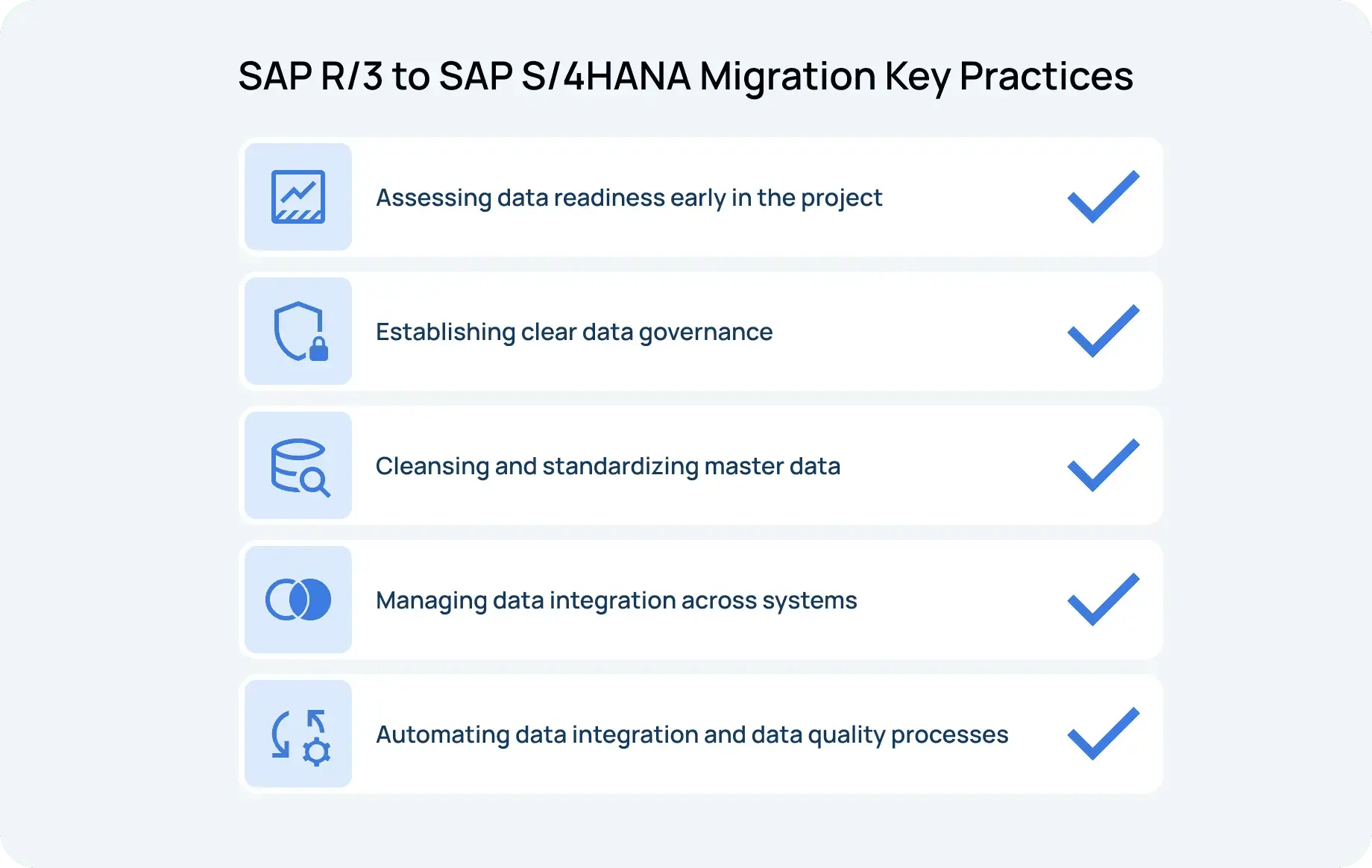
Assessing data readiness early in the project
Before migration activities begin, organizations should conduct a comprehensive data readiness assessment. This step helps identify potential data issues and determine how existing data structures align with the requirements of SAP S/4HANA.
A typical readiness assessment involves:
- Profiling key master and transactional data objects
- Identifying duplicate or inconsistent records
- Evaluating data completeness and accuracy
- Assessing the quality of reference and organizational data
Early analysis allows migration teams to estimate the scope of data preparation work and prioritize areas that require cleanup or transformation. It also helps prevent unexpected issues during later migration phases.
Establishing clear data governance
Effective data governance plays a central role in maintaining data consistency throughout the migration process. Without clear ownership and governance policies, data issues can reappear even after cleansing efforts are completed.
Organizations preparing for S/4HANA migration often establish governance structures that include:
- Defined ownership for critical data domains, such as customers, vendors, and materials
- Standardized naming conventions and data entry rules
- Approval workflows for creating or modifying master data
- Ongoing monitoring of data quality metrics
By formalizing governance policies, companies ensure that data improvements made during migration remain sustainable over time.
Cleansing and standardizing master data
Master data forms the foundation of many core SAP business processes. Inconsistent or inaccurate master data can therefore have significant downstream effects on reporting, logistics operations, and financial processes.
During migration preparation, organizations typically focus on cleansing and harmonizing master data across the system landscape. This may include:
- Removing duplicate business partner or material records
- Standardizing naming conventions and data formats
- Updating incomplete or outdated records
- Aligning master data structures across business units
These activities help ensure that key business objects are consistent and compatible with the target S/4HANA data model.
Managing data integration across systems
Modern enterprise environments rarely operate within a single ERP system. Instead, SAP landscapes are often connected to numerous external applications, including CRM systems, supply chain platforms, analytics tools, and legacy databases.
While preparing for migration, organizations must evaluate how these data integrations will interact with the new S/4HANA environment. This includes reviewing data flows between systems, validating interface structures, and ensuring that integration processes continue to operate reliably after migration.
In some cases, companies also use the migration project as an opportunity to simplify their integration architecture by consolidating redundant interfaces or modernizing integration frameworks.
Automating data integration and data quality processes
As enterprise landscapes grow more complex, manual approaches to data preparation can quickly become difficult to manage. Automation technologies can help organizations maintain consistent data pipelines and monitor data quality across multiple systems.
Platforms, such as DataLark, support organizations in automating data integration and data quality processes across SAP landscapes. This helps migration teams maintain reliable data flows between systems while preparing for ERP transformation initiatives. By automating validation, synchronization, and monitoring activities, organizations can reduce the operational overhead associated with large-scale data preparation.
Preparing the data landscape for SAP S/4HANA is ultimately about ensuring that the new system starts with accurate, consistent, and well-governed data. When organizations treat data preparation as a strategic component of their migration program, they reduce implementation risks and create a stronger foundation for future analytics, automation, and digital transformation initiatives.
Conclusion
For many organizations, comparing SAP R/3 with S/4HANA is the starting point of a much larger transformation journey. While SAP R/3 laid the foundation for integrated enterprise operations, modern business environments increasingly require systems that support real-time insights, simplified architectures, and more flexible integration with digital platforms.
SAP S/4HANA addresses these evolving needs by introducing a streamlined data model, modern user experiences, and the ability to process and analyze operational data in real time. However, transitioning from legacy SAP environments to S/4HANA is a complex transformation that requires careful planning across systems, processes, and especially data management.
Many migration challenges arise from the data layer rather than the system conversion itself. Inconsistent master data, fragmented integrations, and legacy data structures can significantly complicate migration efforts, if they are not addressed early in the project. This is why organizations increasingly focus on data readiness, integration reliability, and data quality automation as core components of their S/4HANA migration strategy.
Platforms like DataLark help enterprises automate data integration and data quality processes across complex SAP landscapes, making it easier to prepare consistent and reliable data pipelines before, during, and after an ERP transformation. By automating data validation, synchronization, and monitoring across multiple systems, DataLark helps reduce migration risks and ensures that organizations enter their S/4HANA environment with clean, trusted data.
Learn more about DataLark and how it supports enterprise data readiness for large-scale transformations.