


Discover what it takes to consolidate multiple ERPs into SAP S/4HANA — from data harmonization to validation, governance, and controlled execution.
What It Really Takes to Migrate Multiple Legacy ERPs to SAP S/4HANA
Migrating to SAP S/4HANA is never just a system upgrade. For organizations running multiple legacy ERPs across business units and legal entities, it becomes something far more complex: a large-scale data harmonization and governance transformation.
Many enterprises underestimate this reality. They assume that once the technical migration plan is defined, the rest is execution. In practice, the technical extraction of data is only a small part of the challenge.
The real work lies in aligning structures, resolving inconsistencies, and building a controlled framework that ensures the new SAP S/4HANA environment starts with clean, harmonized, and audit-ready data.
Let’s consider what that truly requires.
The Hidden Complexity of Multi-System Landscapes
Migrating from a single ERP system is already demanding. Migrating from several heterogeneous systems multiplies the complexity.
In multi-ERP environments, organizations typically face:
- Different data models across systems
- Inconsistent master data definitions
- Duplicated vendors, customers, and materials
- Conflicting chart of accounts structures
- Local process deviations by entity
- Historical data quality gaps
- Regulatory and audit requirements
Over time, decentralized ERP landscapes create fragmentation. Business units evolve independently. Naming conventions diverge. Validation rules differ. Duplicate records accumulate.
When these systems are consolidated into SAP S/4HANA, the organization must answer difficult questions, such as:
- What is the standardized definition of a customer, vendor, or material?
- Which master data record is the “golden” one?
- How should conflicting attributes be resolved?
- What historical data is required for compliance?
- How do we ensure reconciliation between legacy and target systems?
Without a structured approach, these questions quickly turn into risks that jeopardize timelines and go-live stability.
What Enterprise-Scale Migration Actually Requires
Consolidating multiple legacy ERPs into SAP S/4HANA is not a technical conversion exercise. It is a structured realignment of enterprise data, processes, and governance models.
In heterogeneous landscapes, complexity compounds quickly. Different systems encode business logic differently. Master data evolves independently. Historical inconsistencies accumulate. When these environments converge into a single S/4HANA instance, the organization must deliberately redesign how data is defined, transformed, validated, and controlled.
Below are the structural capabilities that distinguish controlled enterprise migration from high-risk data transfer.
Centralized migration governance as a program backbone
In multi-entity programs, migration governance cannot be distributed.
When each business unit attempts to manage its own extraction rules, cleansing decisions, or mapping logic, inconsistencies inevitably reappear in the target system. This undermines one of the primary objectives of S/4HANA consolidation: standardization.
A centralized governance model provides:
- Enterprise-wide data definitions before mapping begins
- Defined harmonization principles across entities
- Controlled ownership of transformation logic
- Clear decision-making mechanisms for conflict resolution
- Coordinated migration cycles and release management
This governance layer becomes the backbone of the program. It ensures that migration decisions are made strategically rather than reactively. Without it, the organization risks embedding legacy fragmentation inside a new architecture.
Structured, automated extraction and transformation
Extraction from heterogeneous systems is rarely uniform. Each ERP may store similar business objects in structurally different ways.
Enterprise-scale migration, therefore, requires a structured transformation layer that:
- Decouples source-specific structures from S/4HANA target models.
- Centralizes mapping logic rather than distributing it across tools.
- Supports reusable transformation rules across cycles.
- Maintains full traceability from source field to target field.
Automation is critical here, but not for speed alone. The real value of automation lies in repeatability and control. In large S/4HANA programs, multiple migration cycles are inevitable. Test loads, validation rounds, data corrections, and rehearsal cutovers all depend on stable transformation logic.
If transformation rules change unpredictably between cycles, reconciliation becomes unreliable. Controlled automation prevents that instability.
Enterprise-level data harmonization
Data harmonization is where technical migration becomes organizational transformation.
In multi-ERP landscapes, harmonization must address:
- Divergent naming conventions
- Conflicting attribute values
- Duplicate master data records
- Variations in organizational structures
- Legacy-specific coding schemes
This is not simply a cleansing activity. It is a normalization and consolidation process that requires business alignment.
For example, consolidation may require determining:
- Which vendor record becomes authoritative when duplicates exist across systems.
- How legacy-specific material classifications should map to standardized S/4HANA structures.
- Which historical inconsistencies can be corrected, and which must be preserved for compliance.
Harmonization decisions define the structural integrity of the future system. If handled superficially, S/4HANA inherits legacy disorder. If handled rigorously, it becomes a foundation for unified reporting and governance.
Clear separation between data preparation and SAP loading
One of the most common architectural mistakes in migration programs is blending preparation logic directly into load execution. Enterprise programs benefit significantly from separating upstream data extraction, transformation, cleansing, and validation from SAP-native load execution mechanisms.
SAP tools such as Migration Cockpit and standard BAPIs are designed for controlled data creation and updates. They enforce structural consistency inside S/4HANA. However, they are not intended to resolve complex cross-system harmonization issues.
By preparing load-ready datasets upstream — fully aligned with SAP templates and validation rules — organizations create a cleaner, more auditable migration flow. The loading step becomes controlled execution rather than experimental transformation.
This architectural separation enhances:
- Transparency
- Traceability
- Reconciliation clarity
- Risk control
Embedded validation and reconciliation by design
In enterprise environments — particularly regulated industries — migration cannot rely on trust. It must rely on proof. Validation and reconciliation must be designed into the migration architecture from the beginning.
This includes:
- Record-level comparison between legacy and S/4HANA datasets
- Aggregated financial reconciliation
- Completeness and consistency checks
- Controlled validation sign-off processes
- Audit-ready documentation trails
Reconciliation should not be a final checklist before go-live. It should be embedded into every migration cycle. When validation mechanisms are integrated from the start, issues surface early — not during cutover.
Environment discipline and controlled deployment
Finally, enterprise-scale migration demands operational discipline.
This means:
- Clearly separated DEV, QA, and PROD environments
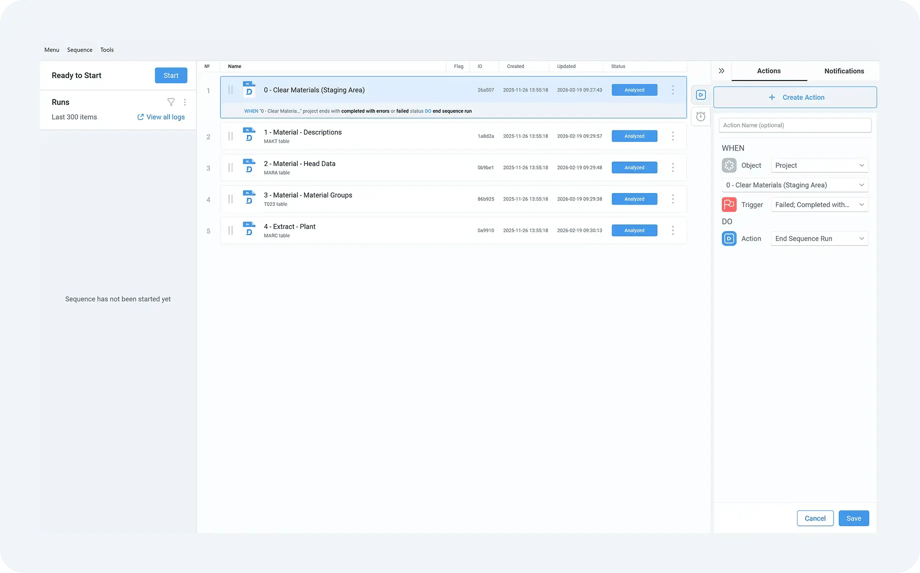
- Repeatable migration pipelines across environments
- Structured testing and validation phases
- Controlled access and security compliance
Without environment discipline, repeatability collapses. And without repeatability, predictability disappears.
Large-scale S/4HANA migration succeeds when orchestration, governance, transformation logic, and validation processes operate as a coordinated system — not as disconnected technical tasks.
Real-World Example: SAP S/4HANA Rollout & Multi-System Data Migration for a Defense & Advanced Technologies Group
The client is a large, MENA-based enterprise operating in the defense and advanced technologies sector, with over 10,000 employees across multiple legal entities and business units. The organization develops and manufactures complex, engineering-intensive products and provides related services for regional and international markets.
As part of a long-term digital transformation initiative, the group launched a SAP S/4HANA rollout aimed at standardizing business processes, consolidating IT landscapes, and enabling unified reporting and governance across its entities.
Prior to the rollout, individual business units were operating on heterogeneous legacy ERP systems, including Microsoft Dynamics GP, Oracle E-Business Suite (EBS), and Microsoft Dynamics 365. This fragmented landscape resulted in inconsistent data structures, duplicated master data, and limited cross-entity transparency. A scalable, controlled approach to enterprise data migration and harmonization was required to support a successful SAP S/4HANA go-live.
Challenge
The SAP S/4HANA rollout covered three major business units, each running a different legacy ERP system with its own data models, structures, and historical data quality issues. The main challenges included:
- Migrating data from multiple heterogeneous source systems into a single SAP S/4HANA landscape
- Harmonizing inconsistent master and transactional data structures across entities
- Identifying and resolving duplicate and conflicting records originating from decentralized legacy systems
- Supporting a broad functional scope, including finance, procurement, supply chain planning, production, sales, logistics, and quality management
- Ensuring data accuracy, reconciliation, and auditability to minimize go-live risks
- Delivering the migration within a tight timeline aligned with the overall SAP rollout program
Manual migration approaches or system-specific tools were not sufficient to handle the scale, complexity, and cross-system nature of the program.
Solution
The project team adopted DataLark as the central data migration and orchestration platform to support the SAP S/4HANA rollout.
Using DataLark, the team implemented an end-to-end migration framework covering:
- Automated data extraction from multiple legacy ERP systems.
- Centralized mapping and transformation, aligning source data structures with SAP S/4HANA target models.
- Data cleansing and enrichment, including normalization of key attributes and resolution of structural inconsistencies.
- Duplicate detection and consolidation that ensures a single, harmonized dataset across entities.
- Controlled data loading into SAP S/4HANA using standard SAP mechanisms such as SAP Migration Cockpit and BAPIs.
- Post-load validation and reconciliation that compares migrated data with legacy sources to ensure completeness and correctness.
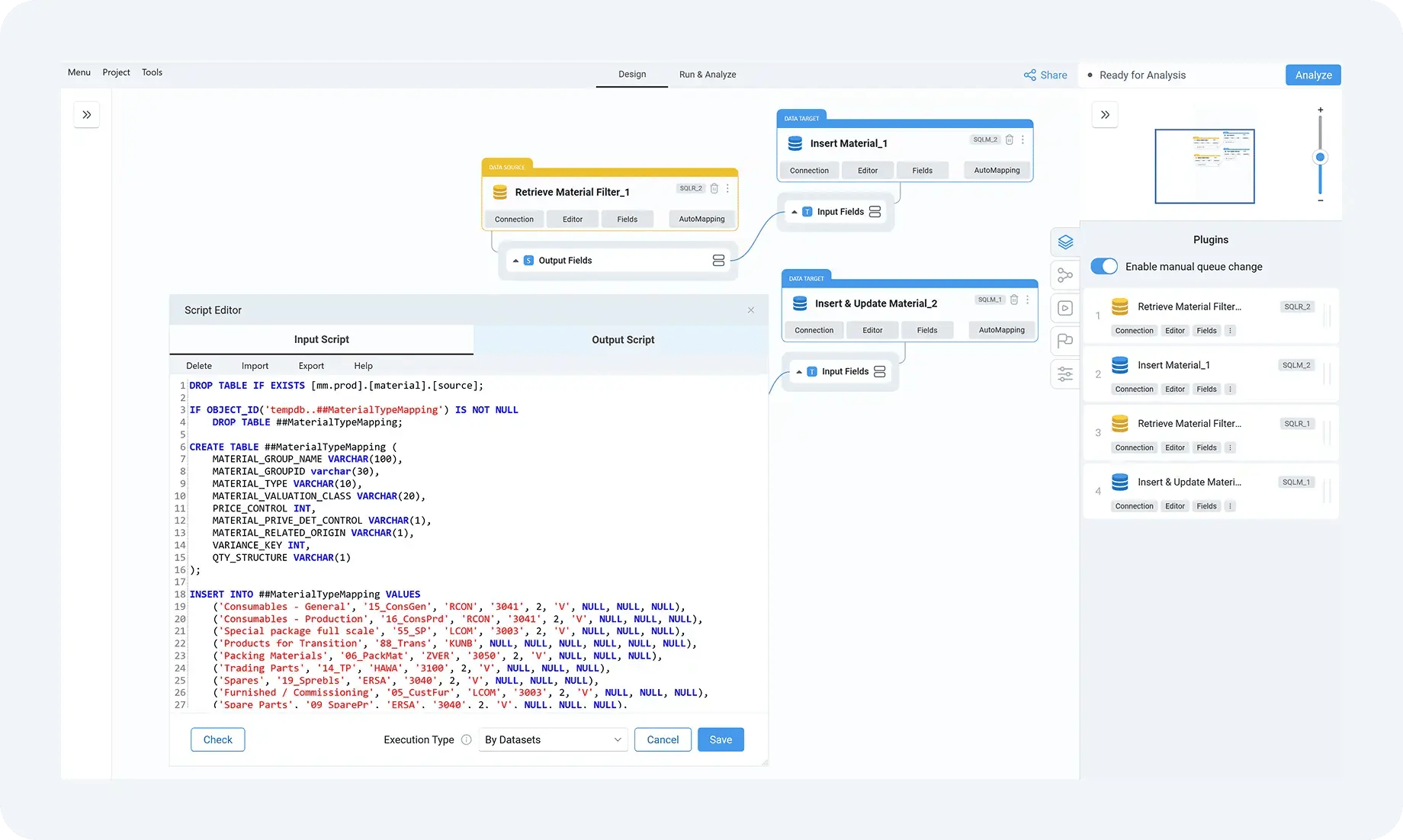
DataLark was primarily used for data extraction, transformation, cleansing, validation, and post-load reconciliation. For the SAP S/4HANA load phase, SAP Migration Cockpit served as the main loading mechanism, with DataLark preparing load-ready files fully aligned with Migration Cockpit templates. In selected scenarios, standard SAP BAPIs were used for controlled data creation and updates based on migration requirements.
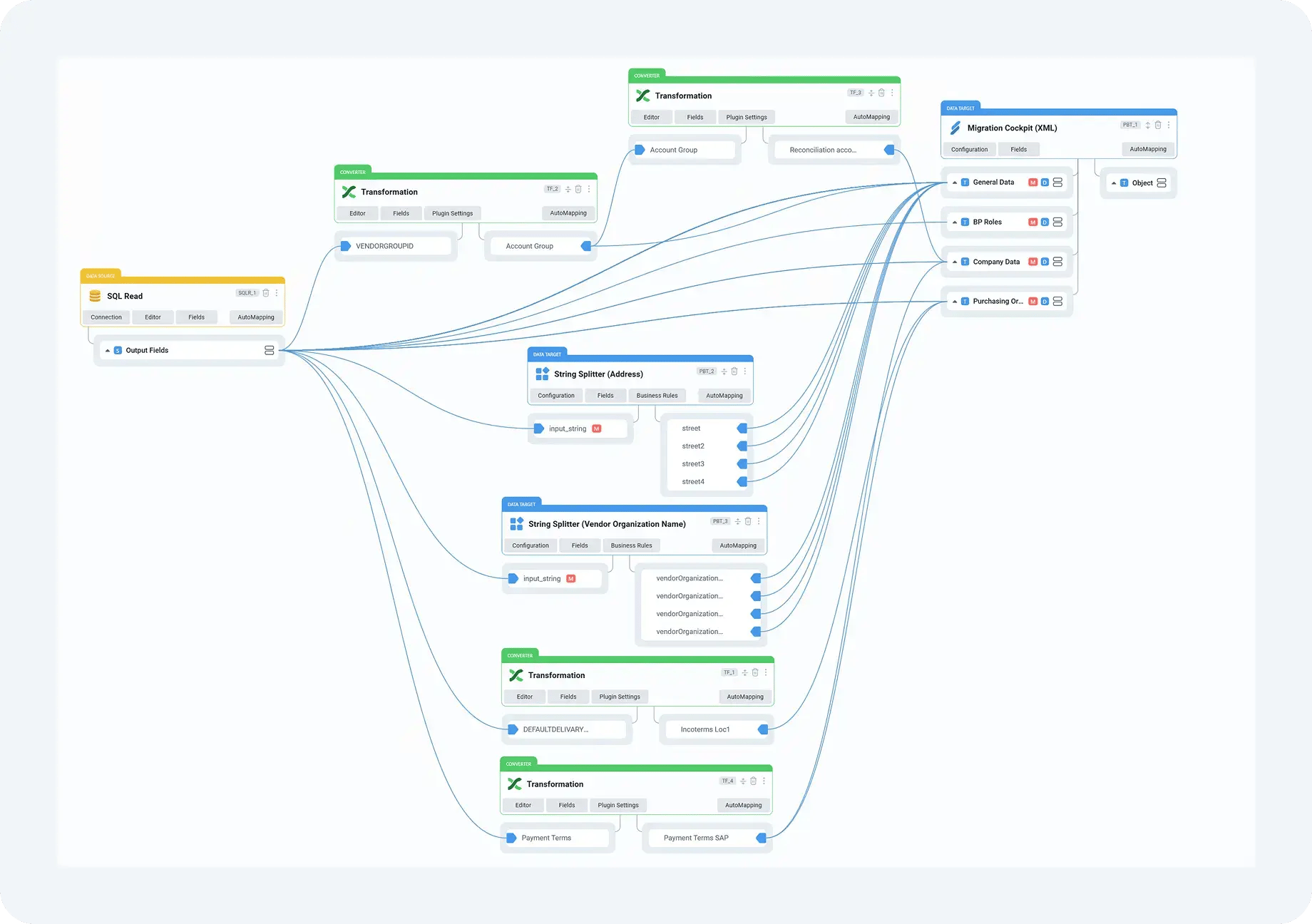
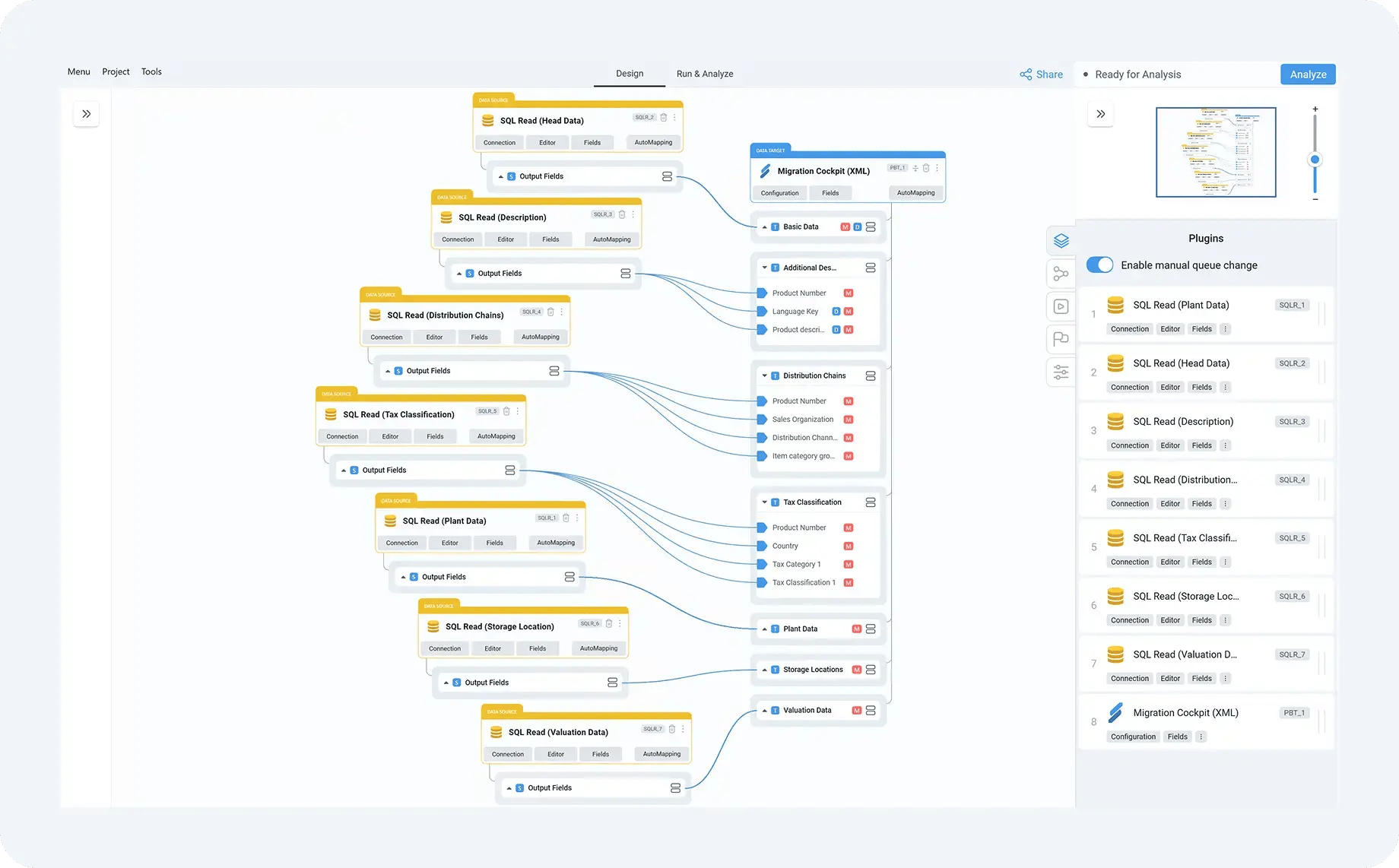
DataLark’s visual configuration, reusable transformation logic, and SAP-native integration allowed the team to standardize migration processes across all entities while still accommodating system-specific differences.
Technology Stack
The solution was implemented using a combination of SAP standard tools and DataLark capabilities:
- Target System: SAP S/4HANA (On-Premise).
- Source Systems: Microsoft Dynamics GP, Oracle EBS, and Microsoft Dynamics 365.
- SAP Data Load Tools: SAP Migration Cockpit and standard SAP BAPIs for controlled data loading.
- Deployment Model: Enterprise-grade, security-compliant deployment with isolated DEV, QA, and PROD environments on customer-managed infrastructure.
- DataLark: SAP-centric data migration and data management platform used for data extraction, transformation, validation, duplicate handling, orchestration, and preparation of load-ready datasets for SAP.
Results
The SAP S/4HANA rollout and data migration were successfully completed using DataLark as the core migration platform.
Key outcomes included:
- Migration of 150+ data objects across three legal entities
- Completion of the full migration cycle in under four months
- Standardized business processes and unified master data across all participating entities
- Clean, reconciled, and validated data that enables a smooth SAP S/4HANA go-live
- Reduced manual effort and migration risk through automation and repeatable migration logic
By leveraging DataLark, the organization was able to accelerate its SAP S/4HANA rollout while maintaining high data quality standards and full control over a complex, multi-system migration landscape.
Key Lessons for Enterprises Planning Multi-ERP Consolidation
Multi-ERP consolidation into SAP S/4HANA is one of the most structurally demanding transformation initiatives an organization can undertake. The technical migration effort is visible, but the strategic decisions behind it determine long-term success or failure.
Based on enterprise-scale programs, several lessons consistently emerge.
Lesson #1: Treat migration as a strategic transformation workstream — not a technical substream
One of the most common program risks is positioning data migration as a supporting activity to the functional rollout.
In reality, migration defines:
- The integrity of financial reporting
- The consistency of operational processes
- The reliability of analytics and planning
- The credibility of go-live
If data governance decisions are delayed or handled reactively, the organization risks compressing critical harmonization work into late project phases — precisely when timeline pressure is highest.
Migration should have:
- Executive sponsorship
- Dedicated governance forums
- Clear escalation paths
- Defined ownership of data objects
When treated as a core transformation pillar, migration supports standardization. When treated as a technical step, it amplifies risk.
Lesson #2: Standardize definitions before mappings are built
Organizations often rush into field-to-field mapping before agreeing on enterprise-wide definitions. This creates structural misalignment.
Before transformation logic is built, leadership must align on:
- What constitutes a “customer” or “vendor” at group level.
- How material hierarchies should be structured.
- What the unified chart of accounts should look like.
- How organizational elements (plants, sales orgs, company codes) relate.
Mapping without definition alignment simply translates legacy complexity into S/4HANA.
True consolidation requires:
- Target data model agreement
- Clear harmonization rules
- Defined exceptions and local deviations (if allowed)
This foundation must be established before technical transformation begins.
Lesson #3: Design for repeatability, not just cutover
Large S/4HANA programs rarely succeed in a single migration cycle.
They require:
- Multiple mock loads
- Iterative data cleansing
- Validation rounds
- User acceptance testing
- Dress rehearsals before go-live
If migration processes are manual or loosely structured, each cycle becomes unpredictable and produces variability. Variability, in turn, introduces risk.
Repeatability significantly reduces variability.
Repeatability requires:
- Automated extraction and transformation logic
- Version-controlled mapping rules
- Controlled environment promotion (DEV → QA → PROD)
- Documented validation procedures
Lesson #4: Separate harmonization decisions from load execution
Loading data into S/4HANA should be a controlled execution step — not a place where transformation logic is improvised.
Programs that blur the line between preparation and loading often experience:
- Inconsistent test results
- Difficulty reconciling data
- Reduced traceability
- Increased troubleshooting complexity
A clean architecture separates data preparation (extraction, transformation, cleansing, enrichment, validation) from SAP-native loading (Migration Cockpit, BAPIs, controlled APIs). This separation improves transparency, auditability, and issue resolution speed. It also protects the integrity of the S/4HANA core.
Lesson #5: Embed reconciliation into the architecture
Reconciliation is frequently underestimated until late project stages.
In enterprise consolidation programs, reconciliation must address:
- Record-level completeness
- Financial balance integrity
- Historical transaction traceability
- Alignment between legacy and S/4HANA structures
- Regulatory compliance requirements
If reconciliation is only performed during final cutover, structural errors are identified too late. Embedding reconciliation into every migration cycle helps to surface inconsistencies early and reduce go-live stabilization effort. That provides confidence to business stakeholders and strengthens audit defensibility.
At the end of the day, reconciliation is not about checking totals. It is about proving structural integrity.
Lesson #6: Plan governance beyond go-live
Consolidation does not end at go-live. If governance processes are not sustained, fragmentation can reappear within months.
Enterprises should establish:
- Ongoing master data governance frameworks
- Change control mechanisms for structural updates
- Defined stewardship roles
- Periodic data quality monitoring
S/4HANA standardization only holds if governance is institutionalized. Migration should, therefore, be designed for long-term structural stability — not just for deployment.
Lesson #7: Recognize that multi-ERP consolidation is organizational alignment
The most important lesson is often the least technical.
At its core, multi-ERP consolidation is an organizational alignment exercise. When multiple legacy systems are brought into SAP S/4HANA, long-standing differences in definitions, structures, and process ownership inevitably surface. What constitutes a “customer,” how financial hierarchies are structured, or how materials are categorized often varies across entities. These differences reflect years of local optimization.
Technology can enable harmonization, but it cannot create alignment. Organizations that treat S/4HANA consolidation as a cross-functional alignment effort build a coherent enterprise platform. Those that focus only on system migration risk centralizing legacy inconsistencies instead of resolving them.
Conclusion
Migrating multiple legacy ERPs into SAP S/4HANA is not a data transfer exercise. It is a structural transformation of how an organization defines, governs, and manages its enterprise data.
The technical challenges (e.g., extraction, mapping, loading) are only one layer. The real determinants of success lie in:
- Clear governance
- Enterprise-wide harmonization
- Repeatable transformation logic
- Structured validation and reconciliation
- Controlled, SAP-aligned execution
Without these elements, S/4HANA risks becoming a consolidated system built on fragmented foundations. With them, it becomes a unified platform for standardized processes, transparent reporting, and scalable growth.
This is precisely where a purpose-built, SAP-centric migration and data management platform such as DataLark delivers measurable value.
By orchestrating extraction, transformation, cleansing, duplicate handling, validation, and reconciliation in a controlled and repeatable framework, DataLark enables organizations to:
- Harmonize data across heterogeneous ERP landscapes
- Prepare load-ready datasets aligned with SAP standards
- Reduce manual effort and migration risk
- Execute multi-cycle migrations with confidence
- Maintain full traceability and governance throughout the process
Most importantly, DataLark helps enterprises move beyond technical conversion toward structured, enterprise-grade data transformation.
If your organization is planning a multi-ERP consolidation to SAP S/4HANA, let’s discuss how DataLark can support your migration with controlled orchestration, automation, and SAP-aligned data governance.