


Learn the difference between master data and transactional data in SAP and how SAP data quality impacts integrations and migrations.
Master Data vs Transactional Data in SAP: Key Differences, Examples, and Why They Matter
In SAP projects, few topics seem as basic — and yet cause as many issues — as the distinction between master data vs. transactional data in SAP. On the surface, the difference appears straightforward. In practice, misunderstandings around these data types lead to integration failures, broken business processes, inconsistent reporting, and painful migration projects.
Whether you are working with a single SAP system or a complex landscape that includes multiple SAP and non-SAP applications, understanding master data and transactional data in SAP is foundational. Transactional accuracy, process automation, and system interoperability all depend on clean, consistent master data.
This article explains the difference between master data and transactional data in SAP, provides real-world examples, and explores why data quality and synchronization matter long before analytics or reporting ever come into play.
What Is Master Data in SAP?
SAP master data refers to core business entities that are used repeatedly across multiple business processes and transactions. Master data provides context and structure for operational activities. It defines who you do business with, what you sell or buy, and how your organization is structured.
Master data is relatively stable compared to transactional data. While it does change over time, it is not created for every business event. Instead, it serves as a reusable foundation for day-to-day operations.
In SAP systems, master data is shared across modules, functions, and often across systems. Because of this shared nature, errors or inconsistencies in master data tend to propagate quickly and extensively.
Common examples of SAP master data
Some of the most common types of master data in SAP include:
- Business Partner (customer and vendor): The Business Partner (BP) master data stores core information about customers, vendors, and other partners, including legal details, addresses, tax data, and payment terms. This data is shared across sales, procurement, finance, and logistics, making consistency critical for accurate transactional processing.
- Material Master: The Material Master defines products, raw materials, and services. It contains procurement, sales, accounting, and logistics attributes that are reused across inventory management, production, sales, and financial postings. Incorrect material master data often leads to blocked transactions or valuation errors.
- Chart of Accounts and G/L accounts: The Chart of Accounts and General Ledger accounts define how financial transactions are classified and posted. This master data is referenced by invoices, journal entries, and asset postings, directly impacting financial accuracy and compliance.
- Cost centers and profit centers: Cost center and profit center master data represents the internal organizational structure used for cost allocation and controlling. Transactions rely on this data to ensure that expenses and revenues are assigned to the correct responsibility areas.
- Organizational structure master data: Organizational master data includes company codes, plants, storage locations, and sales or purchasing organizations. These elements are required for nearly every SAP transaction and determine how business processes are executed across the enterprise.
Each of these master data objects is referenced by countless transactions over time.
Key characteristics of master data in SAP
Master data in SAP represents stable, reusable business information that supports multiple processes and transactions. The following characteristics distinguish SAP master data from transactional data:
- Reusable across business processes: SAP master data is shared across multiple modules and functions. A single master data record, such as a business partner or material, can be referenced by thousands of transactions over time.
- Relatively stable over time: Unlike transactional data, master data does not change frequently. Updates typically occur due to structural or business changes, not daily operations.
- Long lifecycle: Master data is created once and remains active for months or years. Even inactive master records often need to be retained for historical and compliance purposes.
- Foundational for transactional processing: Transactional data in SAP cannot exist without master data. Every transaction depends on master data attributes such as identifiers, classifications, and organizational assignments.
- High impact of errors: Errors in SAP master data affect multiple processes simultaneously. A single incorrect master data attribute can cause repeated transactional failures across systems.
- Shared across systems: SAP master data is often synchronized with external and non-SAP systems. Inconsistent master data can lead to integration issues and data mismatches across the application landscape.
Because master data is reused so extensively, its quality directly affects system reliability and operational efficiency.
What Is Transactional Data in SAP?
Transactional data in SAP represents individual business events or activities. Each transaction captures something that happened at a specific point in time: a sale, a purchase, a financial posting, or a goods movement.
Transactional data is created continuously as part of daily operations. Unlike master data, it is not reused in the same way. Each transaction is unique, time-dependent, and typically references one or more master data objects.
Common examples of transactional data in SAP
Typical examples of transactional data in SAP include:
- Sales orders: Sales orders record customer purchase requests and include details, such as products, quantities, pricing, delivery dates, and organizational data. Each sales order relies on customer and material master data to be processed correctly.
- Purchase orders: Purchase orders document procurement activities with vendors. They reference vendor master data, material master data, pricing conditions, and delivery terms, making them highly dependent on master data accuracy.
- Invoices (customer and vendor): Invoices represent financial claims and obligations. Customer and vendor invoices reference business partner master data, tax classifications, and G/L accounts, directly impacting financial postings and compliance.
- Goods movements: Goods receipts, goods issues, and stock transfers record inventory changes. These transactions depend on material master data, plants, storage locations, and units of measure to ensure accurate stock and valuation updates.
- Financial postings and journal entries: Financial transactions capture accounting events, such as accruals, payments, and adjustments. They reference G/L accounts, cost centers, profit centers, and company codes from master data.
- Production and service orders: Production and service orders document manufacturing and service activities. These transactions rely on material master data, bills of materials, work centers, and organizational assignments.
Each of these transactions relies on master data to be processed correctly. For example, a sales order references customer master data, material master data, pricing conditions, and organizational structures.
Key characteristics of transactional data in SAP
Transactional data in SAP generally has these traits:
- Event-based and time-dependent: Each transactional record corresponds to a specific business event — such as a sale, purchase, or posting — and includes a timestamp that defines when the event occurred.
- High volume: Transactional data is generated in large quantities, especially in operational systems. Over time, transactional tables grow rapidly compared to master data tables.
- Shorter lifecycle: Transactional data is often created, processed, and completed within a short time frame. While it may be retained for legal or audit purposes, it is not reused in ongoing processes like master data.
- Always dependent on master data: Transactional data in SAP cannot exist without master data. Every transaction references master data objects, such as business partners, materials, accounts, and organizational units.
- Sensitive to master data quality: Transactional accuracy depends on master data consistency. Incorrect or incomplete master data often leads to repeated transactional errors, even when transaction logic is correct.
- Direct operational impact: Transactional data reflects real business activity. Errors in transactional data can block orders, delay deliveries, or cause posting failures that immediately affect operations.
Because transactional data is high-volume, time-dependent, and tightly linked to master data, transactional issues are often symptoms rather than root causes. Ensuring master data quality is essential for stable transactional processing.
Master Data vs. Transactional Data in SAP: Key Differences
Understanding the difference between master data vs. transactional data in SAP is essential for stable business processes and reliable system integrations. While both data types are critical, they serve very different purposes and follow different lifecycles. Master data defines the core business entities, while transactional data records individual business events that rely on that foundation.
The comparison table below summarizes the key differences:
| Aspect | Master Data in SAP | Transactional Data in SAP |
| Purpose | Defines core business entities and structures | Records individual business events |
| Reusability | Reused across multiple processes and transactions | Used once per business event |
| Change frequency | Updated periodically as business structures evolve | Generated frequently as business activities occur |
| Data volume | Relatively low | High |
| Lifecycle | Long-term, often lasting years | Short-term, event-based |
| Dependency | Independent foundation | Always depends on master data |
| Impact of errors | Causes recurring, system-wide issues | Causes immediate, operational disruptions |
In SAP systems, transactional data accuracy depends directly on master data quality. While transactional errors are often visible first, they frequently originate from inconsistencies or gaps in master data. Understanding master data and transactional data in SAP helps organizations address root causes instead of repeatedly fixing symptoms, which leads to more stable processes and more reliable integrations.
How Master Data and Transactional Data Work Together in SAP
In SAP systems, transactional data is always built on top of master data. Transactions do not exist independently; they reference master data objects to determine how business processes should be executed.
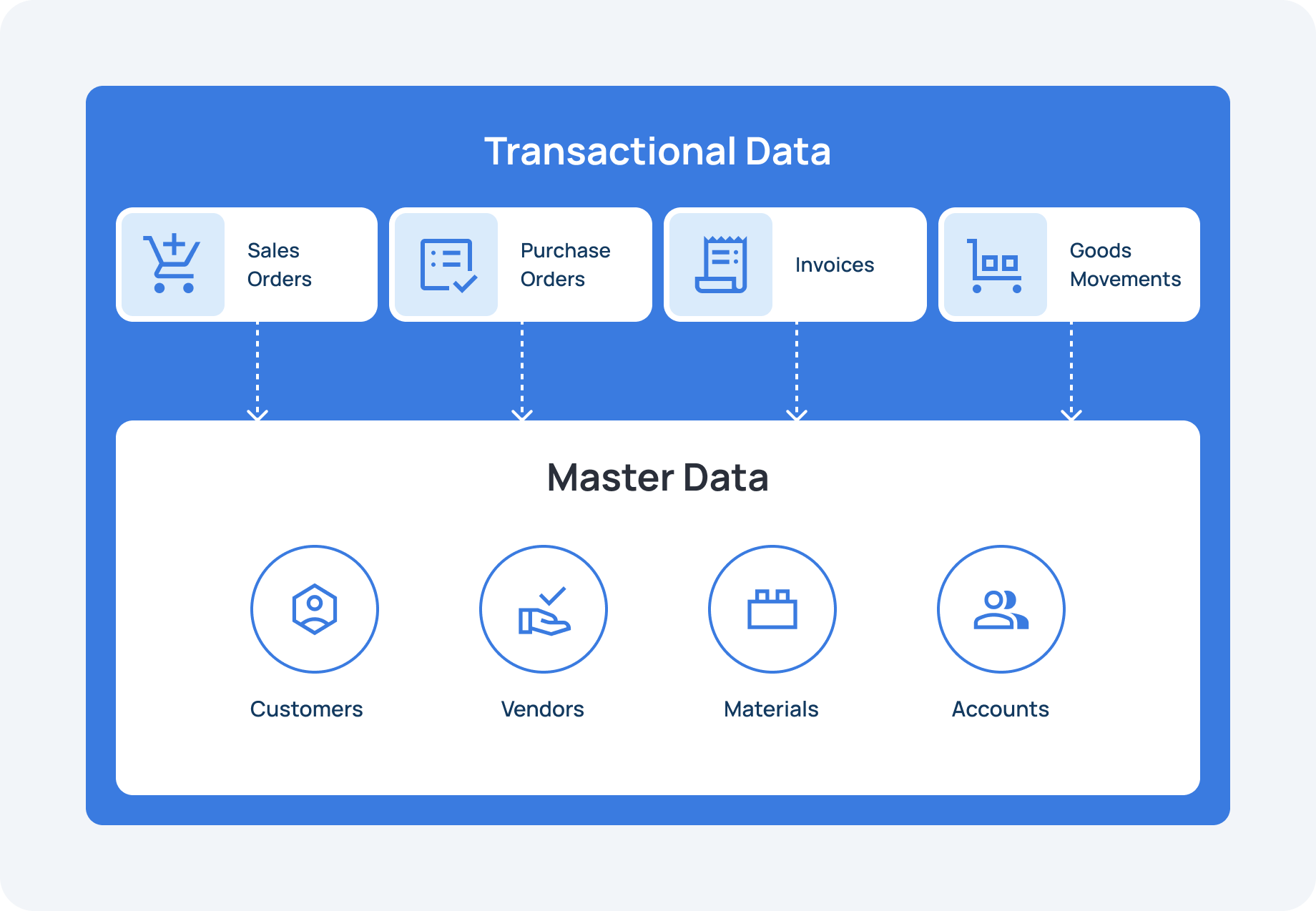
Every transactional document (e.g., sales order, purchase order, or financial posting) inherits key attributes from master data, including:
- Business partner details
- Material attributes
- Pricing and tax classifications
- Organizational assignments
Because of this dependency, the quality and structure of master data directly influence whether transactions can be created, processed, and completed successfully. When master data is incomplete or inconsistent, transactional processing may fail, produce incorrect results, or require manual intervention.
Real-world example: sales order processing
A sales order demonstrates how tightly master data and transactional data in SAP are linked.
When a sales order is created, SAP automatically pulls information from multiple master data objects:
- Customer master data provides addresses, payment terms, and tax classifications.
- Material master data defines product descriptions, units of measure, and pricing relevance.
- Organizational master data determines sales organization, plant, and shipping conditions.
- Pricing and condition records supply pricing logic and discounts.
If any of these master data elements are incorrect or missing, the sales order may be blocked, priced incorrectly, or fail during downstream processes such as delivery or billing. Although the issue appears in the transactional document, the root cause is typically master data.
Why transactional errors often point to master data problems
In many SAP environments, transactional errors are treated as isolated incidents. However, recurring transactional failures often indicate underlying master data issues.
Examples include:
- Repeated invoice failures due to missing or incorrect tax classifications in customer master data
- Goods movements failing because of inconsistent units of measure in material master data
- Financial postings misclassified due to incorrect G/L or cost center assignments
Correcting individual transactions may resolve the immediate issue, but the same problem will reappear unless the master data is fixed. This is why sustainable SAP operations require addressing master data quality rather than repeatedly correcting transactional data.
Why this relationship matters in complex SAP landscapes
In landscapes with multiple SAP systems or SAP and non-SAP integrations, the dependency between master and transactional data becomes even more critical. Inconsistent master data across systems leads to transactional mismatches, reconciliation issues, and integration failures.
Ensuring consistent master data helps to:
- Reduce transactional errors across systems
- Simplify integrations
- Improve process reliability without increasing manual effort
Understanding how master data vs transactional data in SAP work together enables organizations to focus on root causes, not just visible symptoms.
Common SAP Challenges Related to Master and Transactional Data
Many SAP data issues do not originate in system configuration or transaction logic, but in how master data and transactional data in SAP are created, maintained, and synchronized. Because transactional data depends on master data, weaknesses in master data management often surface as recurring operational problems.
Inconsistent master data across systems
In complex SAP landscapes, organizations often operate multiple SAP systems or integrate SAP with CRM, E-commerce, logistics, and finance platforms. When SAP master data is not consistently maintained across these systems, transactional data quickly becomes fragmented.
Common examples include:
- Different customer or vendor identifiers in separate systems
- Materials with mismatched descriptions or units of measure
- Organizational structures defined differently across environments
These inconsistencies lead to transactional failures such as rejected orders, incorrect postings, or failed data exchanges between systems. Resolving such issues manually is time-consuming and rarely scalable.
Duplicate and poor-quality master data
Duplicate master data records are among the most widespread SAP data quality challenges. Multiple versions of the same customer, vendor, or material often emerge due to decentralized data creation or weak validation rules.
The impact includes:
- Duplicate invoices or payments
- Inconsistent pricing or taxation
- Conflicting transactional results across departments
Because transactional data references master data automatically, duplication and poor data quality are repeatedly reflected in daily operations.
Transactional firefighting and operational “data debt”
In many SAP organizations, the biggest challenge isn’t that transactions fail — it’s that teams build workarounds to keep transactions moving when master data isn’t reliable. Over time, this creates operational “data debt”: manual steps, exceptions, and reconciliations that become part of the daily routine.
Common patterns include:
- Manual overrides and exception handling: Users bypass validations, select alternative items, or apply manual account assignments to get a document posted. The transaction completes, but the process becomes less controlled and harder to standardize.
- Rework loops across teams: A sales order is created, then corrected by customer service; billing is blocked and later released by finance; logistics updates delivery data to compensate for missing shipping attributes. The same issue triggers multiple handoffs.
- Downstream reconciliation: When master data isn’t consistent (e.g., partner IDs, material attributes, organizational assignments), organizations rely on periodic reconciliation between systems, plants, or company codes to “true up” operational reality.
- Inconsistent process outcomes: Two similar transactions can behave differently, depending on which master data record is referenced (duplicate vendors, inconsistent material units, outdated payment terms). This reduces predictability and increases support tickets.
The result is a system that works, but only because people continuously compensate for unreliable data. That’s why reducing operational friction often starts with strengthening master data governance, validation, and consistency — so transactions don’t require ongoing human correction.
Limited visibility into data dependencies
Another challenge is the lack of transparency into how master data changes affect transactional processes. A seemingly minor update to master data can have unintended consequences across multiple transactions and systems.
Without clear visibility into these dependencies, organizations struggle to:
- Predict the impact of master data changes
- Trace transactional errors back to their root cause
- Maintain consistency during system changes or migrations
This lack of visibility increases operational risk, especially in highly integrated SAP environments.
Why these challenges persist
The core reason these challenges persist is the tight coupling between master data vs. transactional data in SAP. Transactional issues are often addressed reactively, while master data quality is managed manually or inconsistently.
Addressing these challenges requires a shift in focus toward proactive master data quality, standardization, and synchronization across systems.
Why Master Data Quality Is Critical Before Transactions Scale
Master data quality becomes most visible when something breaks, but its true impact emerges as transactional volume, system integrations, and process automation increase. At scale, even minor inconsistencies in master data become systemic constraints.
Scale amplifies small inconsistencies
In early or low-volume SAP environments, teams can often compensate for imperfect master data. Users recognize exceptions, apply workarounds, and manually correct transactional outcomes. As transaction volumes grow, this approach stops working.
At scale:
- A single inconsistent master data attribute can affect thousands of transactions.
- Manual corrections become operational bottlenecks.
- Exceptions multiply faster than they can be resolved.
What was once a manageable issue becomes embedded into daily operations, thus increasing cost and reducing process reliability.
Transactional volume locks in data behavior
As transactional volumes increase, master data structures become embedded within historical transactional records. Later changes to master data definitions do not retroactively update previously created transactions, which leads to persistent inconsistencies over time.
Examples include:
- Materials reclassified after large volumes of inventory movements
- Business partners corrected after years of invoicing history
- Organizational assignments changed after extensive financial postings
At this point, organizations must manage both the corrected master data and the legacy transactional records, which significantly increases complexity.
Automation increases sensitivity to master data quality
Automation depends on predictability. As SAP processes become more automated — through integrations, workflows, or straight-through processing — tolerance for inconsistent master data drops sharply.
Automated processes:
- Do not recognize exceptions the way humans do
- Rely entirely on master data attributes to make decisions
- Fail or behave unpredictably when data assumptions are violated
This is why master data quality issues often surface during automation initiatives rather than during manual operations.
Integrations multiply the cost of inconsistency
Each new integration effectively multiplies the impact of master data quality issues. When master data is inconsistent, every connected system must either adapt, reconcile, or reject transactional data.
This results in:
- Complex transformation logic
- Increased reconciliation effort
- Fragile interfaces that break when master data changes
Addressing master data quality early reduces integration complexity and makes system landscapes more resilient.
Why timing matters
Improving master data quality after transactions have scaled is possible, but it is significantly more expensive and disruptive. Early intervention allows organizations to:
- Standardize master data definitions before high-volume usage
- Prevent exception-driven processes from becoming the norm
- Support growth without increasing operational friction
In SAP environments, master data quality is not just a technical concern; it is a scaling prerequisite.
Preparing SAP Data for Integration and Migration
Integration and migration initiatives place SAP data under conditions it was not originally designed to withstand. Processes that function acceptably within a single system often fail when data must move across system boundaries or be restructured for a new platform. In these contexts, the distinction between master data and transactional data becomes operationally critical.
Different preparation requirements for master and transactional data
Master data and transactional data require fundamentally different preparation approaches during integration and migration projects.
Master data must be:
- Standardized across systems and organizational units
- Cleansed to remove duplicates and inconsistencies
- Validated against target system requirements
- Harmonized to ensure consistent identifiers and classifications
By contrast, transactional data:
- Must align with the migrated master data structures
- Requires completeness and referential integrity
- Often needs selective transformation or filtering based on business scope
Attempting to migrate or integrate transactional data without first stabilizing master data significantly increases project risk.
Master data as the integration anchor
In integration scenarios, master data acts as the anchor that allows transactional data to be interpreted consistently across systems. When master data definitions differ between source and target systems, transactional records lose semantic clarity.
Common integration challenges include:
- Customer or vendor records that cannot be matched across systems
- Materials interpreted differently due to inconsistent attributes
- Organizational units that do not align between platforms
Establishing consistent master data definitions reduces the need for complex mapping logic and exception handling in integrations.
Migration complexity increases with transactional history
The volume and diversity of transactional data often exceed those of master data by orders of magnitude. As transactional history accumulates, so does the effort required to reconcile it with revised master data structures.
Key considerations include:
- Determining how much historical transactional data must be migrated
- Ensuring historical records remain interpretable after master data changes
- Preserving financial and regulatory consistency
Organizations that postpone master data alignment until late in the project frequently encounter delays, rework, and scope adjustments.
Sequencing Matters
Successful SAP data projects follow a deliberate sequence:
- Assess and stabilize master data
- Align master data with target system requirements
- Validate dependencies between master and transactional data
- Migrate or integrate transactional data
Reversing this sequence introduces avoidable complexity and often results in transactional reconciliation issues that are difficult to resolve post-go-live.
Reducing risk through proactive data preparation
Proactive data preparation shifts integration and migration efforts from reactive problem-solving to controlled execution. By addressing master data quality early, organizations can:
- Reduce dependency-related failures
- Simplify transformation logic
- Improve predictability during cutover and testing
In SAP environments, integration and migration success depends less on technical tooling and more on disciplined data readiness.
Conclusion
The distinction between master data vs. transactional data in SAP is often introduced as a basic concept, but its implications extend far beyond definitions. Throughout SAP landscapes, the relationship between these two data types determines whether systems scale smoothly or accumulate operational friction over time.
Master data defines the structure and semantics of business operations. Transactional data records how those operations unfold in practice. Because transactional processing depends entirely on master data, weaknesses in master data quality do not remain isolated — they surface repeatedly as exceptions, rework, reconciliation, and integration complexity.
This is why successful SAP programs address master data readiness before transactional scale, not after. Standardized, validated, and consistently synchronized master data reduces operational risk, simplifies integrations, and creates the conditions for stable transactional processing, regardless of system architecture or future change.
Preparing SAP data for integration, migration, and long-term scalability requires more than manual checks and one-off cleanups. It requires repeatable processes for validating, standardizing, and synchronizing master data across systems.
DataLark supports this approach by automating key aspects of SAP data preparation and quality management. By helping teams detect inconsistencies, align master data structures, and ensure readiness across system boundaries, DataLark enables organizations to address data issues at the source rather than downstream.
If your SAP initiatives involve integrations, migrations, or increasing transactional complexity, strengthening master data foundations early can significantly reduce risk and rework later. Learn how DataLark helps teams prepare and align SAP data before it becomes operationally embedded.