


Explore SAP master data governance, SAP MDG capabilities, and how DataLark prepares master data before SAP governance workflows.
SAP Master Data Governance and DataLark: Why Governance Must Start Before SAP MDG
In today’s digital enterprises, master data sits at the core of nearly every business process. Customer onboarding, supplier collaboration, product launches, financial reporting, compliance, and analytics all rely on the same foundational data objects. When master data is inaccurate, inconsistent, or incomplete, the impact is immediate and costly.
To address this challenge, many organizations invest in SAP master data governance. SAP Master Data Governance (SAP MDG) is a powerful solution designed to control how master data is created, approved, and distributed across the enterprise. It introduces governance, ownership, and process discipline, which are critical elements for maintaining long-term data consistency.
Yet despite these strengths, organizations often discover that SAP MDG alone cannot resolve the root causes of poor master data. In practice, governance processes only commence once data has already been collected and submitted for approval. By that point, the data has passed through multiple upstream systems and manual touchpoints (e.g., external partners, legacy applications, spreadsheets, and non-SAP tools), each introducing inconsistencies, gaps, and errors.
This upstream reality places SAP MDG in a difficult position. Instead of focusing on governance, ownership, and lifecycle control, MDG workflows become overloaded with data corrections and rework. Approval cycles slow down, data stewards spend excessive time fixing issues, and business users begin to view governance as an obstacle rather than an advantage. The problem is not the governance model itself, but the assumption that governance can compensate for unprepared data.
This is why successful SAP data governance initiatives increasingly look beyond MDG alone. To achieve sustainable results, organizations must ensure that data is standardized, validated, and enriched before it enters SAP MDG — so that governance can focus on control and accountability rather than cleanup.
In this article, we’ll explore:
- What SAP master data governance really is.
- Where SAP MDG excels and where it struggles.
- Why SAP data governance must start before MDG.
- How DataLark complements SAP MDG by automating data integration and data quality.
- How together they form a scalable, end-to-end master data foundation
Now, let’s get started.
What Is SAP Master Data Governance?
SAP Master Data Governance (SAP MDG) is SAP’s framework and solution for establishing centralized control over master data in SAP landscapes. Its primary purpose is to ensure that master data is created, changed, and maintained in a consistent, transparent, and controlled manner across the organization.
In large enterprises, master data is more than just a technical concern; it is a shared business asset. Customer, vendor, product, and financial master data are used by multiple teams and systems at the same time. Without a common governance approach, different departments typically introduce their own versions of the same data, which leads to fragmentation and loss of trust.
SAP master data governance addresses this challenge by defining standardized processes for how master data should exist and evolve over time. Instead of allowing data to be created or modified independently in each system, SAP MDG introduces a central point of coordination where rules, responsibilities, and processes are aligned.
A governance-centric approach to master data
Unlike traditional master data maintenance, SAP MDG is not primarily about where data is stored. It is about how data decisions are made.
From an SAP data governance perspective, this means:
- Establishing clear ownership for master data objects.
- Defining who is allowed to request changes.
- Ensuring that changes follow approved business processes.
- Making master data management auditable and repeatable.
For example, in an organization without SAP MDG, a new supplier might be created differently by procurement teams in different regions. With SAP MDG in place, supplier creation follows a single, governed approach, even if the data is ultimately consumed by multiple systems.
Master data domains covered by SAP MDG
SAP MDG supports governance for a broad range of master data domains that are critical to enterprise operations, including:
- Business Partner master data (customers and vendors): Governs shared data about external parties used across sales, procurement, finance, and logistics, thus helping to ensure consistent structures, naming conventions, and ownership for customer and supplier information.
- Material and product master data: Covers how products are defined and reused across planning, manufacturing, supply chain, and sales processes, thus reducing inconsistencies that can disrupt operations and reporting.
- Financial master data: Includes general ledger accounts, cost centers, profit centers, and hierarchies that underpin financial reporting, controlling, and compliance across organizational units.
- Custom and industry-specific master data: Extends SAP data governance to business-specific reference data and custom objects, ensuring governance principles are applied consistently beyond standard SAP domains.
By covering these domains, SAP MDG enables organizations to apply a consistent governance model across different areas of the business, even when data responsibilities are distributed.
SAP MDG in the context of the SAP landscape
In practice, SAP MDG operates as a central governance component within the SAP ecosystem. It connects business users, data stewards, and IT teams around a shared understanding of how master data should be managed.
Organizations typically introduce SAP MDG as part of the following:
- A broader SAP data governance initiative
- An SAP S/4HANA transformation
- A drive toward harmonization after mergers or system consolidation
Understanding SAP master data governance as a governance framework rather than a technical feature set is key to setting realistic expectations. SAP MDG establishes the structure within which master data decisions are made. Its value lies in coordination, consistency, and control — elements that must exist before capabilities and outcomes can be fully realized.
With this foundation in place, we can now look more closely at what SAP MDG actually does in practice.
Core Capabilities of SAP MDG
Once SAP master data governance is established as a central framework, SAP MDG provides a set of core capabilities that turn governance principles into operational reality. These capabilities are designed to ensure that master data changes are controlled, transparent, and repeatable across the enterprise.
Rather than focusing on data manipulation itself, SAP MDG focuses on process enforcement; it ensures that every creation or change follows the same structured path.
Centralized master data creation and change
One of the foundational capabilities of SAP MDG is the ability to centralize how master data is created and modified. Instead of allowing changes to be made independently in multiple systems, SAP MDG introduces a single, governed entry point.
In practice, this means that requests for new customers, vendors, materials, or financial objects are initiated through standardized processes. These requests are managed centrally, even if the data will ultimately be consumed by multiple SAP or non-SAP systems.
This centralization reduces inconsistencies and helps organizations move away from fragmented, system-specific master data maintenance.
Workflow-based approval processes
The heart of SAP MDG is its workflow engine, which supports structured approval processes aligned with business responsibilities.
SAP MDG workflows allow organizations to:
- Route master data requests to the appropriate reviewers.
- Enforce segregation of duties.
- Reflect organizational hierarchies and approval chains.
- Adapt approval paths based on data attributes or business context.
For example, a simple change to descriptive data may require minimal review, while the creation of a new vendor or financial object may involve multiple stakeholders. SAP MDG ensures that these approval paths are followed consistently, providing clarity and accountability.
Business rules and validation
Another key capability of SAP master data governance is the enforcement of business rules during the data maintenance process.
SAP MDG enables organizations to define:
- Mandatory fields and completeness checks
- Field dependencies and logical validations
- Allowed values and domain restrictions
These validations are applied before data is approved, which helps prevent incorrect or incomplete records from entering operational systems. From an SAP data governance perspective, this ensures that governance policies are embedded directly into day-to-day data maintenance activities.
Versioning and change traceability
SAP MDG provides built-in support for tracking changes to master data over time. Every request, approval, and activation is logged, creating a clear history of how master data has evolved.
This capability is especially important in environments where:
- Auditability is required.
- Data ownership must be clearly demonstrated.
- Historical transparency supports compliance or internal controls.
By maintaining a complete change history, SAP MDG makes master data governance measurable and defensible.
Data distribution to target systems
Once master data changes are approved, SAP MDG supports the controlled distribution of that data to consuming systems. This ensures that downstream systems receive consistent, governed master data rather than independently maintained copies.
In SAP-centric landscapes, this often includes replication to SAP S/4HANA or ECC systems, while hybrid environments may also involve non-SAP applications. SAP MDG acts as the authoritative source that coordinates this distribution, reinforcing its role within broader SAP data governance initiatives.
A foundation for governed operations
Together, these capabilities enable organizations to implement SAP master data governance across domains and systems. SAP MDG provides the structure needed to control master data changes, align stakeholders, and ensure consistency, which forms the technical backbone of governed master data processes.
With these capabilities in place, organizations can begin to realize the intended benefits of SAP MDG, which we will explore next.
The Promise of SAP Master Data Governance
Organizations invest in SAP master data governance to achieve concrete, business-relevant outcomes, not simply to introduce controls. SAP MDG is expected to elevate master data from a collection of system records to a trusted, governed enterprise asset that supports operations, compliance, and growth.
When implemented successfully, SAP MDG promises to bring the following benefits:
- A single, trusted view of master data: SAP MDG is intended to serve as the central authority for master data, reducing duplicates and conflicting definitions across systems and regions. The expected result is that business users, applications, and reporting processes rely on the same consistent customer, vendor, product, and financial data, improving confidence in day-to-day operations.
- Improved data quality and consistency: By enforcing governance standards, SAP MDG aims to raise the overall quality of master data. Organizations expect master data to be more complete, structured, and aligned with agreed business rules, reducing downstream errors and manual corrections across SAP and non-SAP systems.
- Clear ownership and accountability: A key promise of SAP data governance is transparency around responsibility. SAP MDG establishes defined roles for requesting, reviewing, and approving data changes, making it clear who owns master data decisions and providing traceability for audits and internal controls.
- More predictable business processes: With standardized governance in place, master data-driven processes (e.g., customer or vendor onboarding) are expected to become more consistent and reliable. While not necessarily instantaneous, these processes should follow clear, repeatable paths that reduce uncertainty and ad hoc exceptions.
- Reduced operational and compliance risk: In many organizations, master data errors translate directly into financial, legal, or regulatory risk. SAP MDG promises to mitigate these risks by ensuring that data meets defined standards before it is activated and used in operational processes.
- A scalable foundation for SAP data governance: As organizations grow, reorganize, or move toward SAP S/4HANA, SAP MDG is expected to scale with them. The governance framework should support new regions, systems, and data domains without requiring a complete redesign of master data processes.
In theory, these outcomes represent the full value of SAP master data governance. In practice, however, many organizations find that achieving them consistently is more difficult than expected. The reason is not a lack of governance controls, but a gap that exists before those controls are applied.
The Hidden Gap in SAP Data Governance
The promise of SAP master data governance is compelling: trusted data, clear ownership, predictable processes, and reduced risk. Yet in practice, many organizations find that these outcomes remain difficult to achieve consistently — even after SAP MDG has been carefully implemented.
This disconnect is not caused by a lack of governance capabilities. Instead, it stems from a gap that exists before SAP MDG workflows ever begin. SAP data governance often starts too late in the master data lifecycle, after critical quality issues have already been introduced.
Where master data really originates
A common assumption in SAP MDG initiatives is that master data is primarily created within SAP systems. In reality, much of the data governed by SAP MDG originates elsewhere.
Typical sources include:
- External customers, suppliers, and partners
- Legacy ERP systems
- Non-SAP applications
- Partner portals and onboarding forms
- Files and spreadsheets maintained by business teams
- APIs and third-party data providers
By the time this data reaches SAP MDG, it has often passed through multiple systems and manual touchpoints, each adding its own inconsistencies, gaps, and interpretations.
The reality of upstream data
Data coming from upstream sources is rarely ready for governance. It may follow different naming conventions, use incompatible formats, or lack required attributes altogether. Even when data appears complete on the surface, subtle inconsistencies can prevent it from aligning with SAP MDG’s governance rules.
As a result, SAP MDG is frequently asked to compensate for issues it was not designed to solve at scale. Instead of acting purely as a governance layer, it becomes the first line of defense against poor data quality.
Common challenges before data reaches SAP MDG
Organizations implementing SAP master data governance repeatedly encounter the same upstream challenges:
- Inconsistent formats and structures: Data arrives in different layouts, languages, and standards depending on its source, making harmonization difficult.
- Missing or incomplete attributes: Required fields are often empty or inconsistently populated, especially in externally sourced data.
- Duplicate and conflicting records: The same customer, vendor, or product may appear multiple times with slight variations, creating ambiguity before governance even begins.
- Heavy manual data preparation: Data stewards and IT teams spend significant time cleaning, mapping, and reformatting data to make it acceptable for SAP MDG workflows.
- High rejection rates in SAP MDG workflows: When unprepared data enters governance processes, validation failures and approval rework become common, which slows down business processes.
When governance becomes a bottleneck
These upstream challenges have a direct impact on how SAP data governance is perceived. Instead of enabling efficiency and trust, SAP MDG workflows become overloaded with corrections and exceptions. Approval cycles stretch longer than expected, onboarding processes stall, and business users begin to see governance as an obstacle rather than a safeguard.
This does not mean that SAP MDG is failing! It means that SAP master data governance is being asked to deliver outcomes without the necessary upstream preparation.
As long as data quality issues are addressed only at the governance stage, organizations remain trapped in a reactive model: they fix problems after they surface rather than prevent them at the source. Closing this gap requires extending SAP data governance beyond approvals and workflows to include data integration, standardization, and validation before data reaches SAP MDG.
Why SAP Data Governance Must Start Before SAP MDG
Master data typically passes through several stages before it reaches SAP MDG, including collection from multiple sources and initial preparation. If these upstream stages are unmanaged, key decisions about structure, format, and completeness are made inconsistently and often manually. By the time data enters SAP MDG, many issues are already embedded and difficult to correct efficiently.
SAP MDG is designed to govern decisions, not to compensate for unprepared data at scale. When it becomes the first checkpoint for quality, approval workflows slow down and governance efforts shift from control to correction. This limits the effectiveness of SAP master data governance and places unnecessary strain on data stewards.
Addressing this challenge requires capabilities that SAP MDG was not designed to provide at scale, including:
- Flexible ingestion from multiple sources, such as external systems, files, and non-SAP applications.
- Automated data cleansing and normalization to align formats, structures, and standards.
- Pre-validation and enrichment to ensure data meets governance expectations before approval.
- Repeatable, low-code data preparation that reduces manual effort and one-off integrations.
Starting SAP data governance earlier in the lifecycle allows organizations to apply these capabilities before formal approvals begin. This ensures that data entering SAP MDG is already aligned with governance standards, enabling SAP MDG to focus on what it does best: governance, accountability, and control.
Recognizing the need for earlier governance clarifies the role of complementary solutions that operate upstream of SAP MDG. DataLark is designed to address this part of the lifecycle by automating how master data is collected, prepared, and validated before it enters SAP master data governance processes.
DataLark’s Role in the SAP Master Data Landscape
Once SAP data governance is extended beyond approval workflows, the question becomes how to implement governance in the early stages of the master data lifecycle. This is where DataLark plays a distinct and complementary role within the SAP master data landscape.
DataLark operates upstream of SAP MDG, focusing on the automation of data integration and data quality processes that prepare master data before it enters formal governance. Let’s take a closer look at DataLark’s key capabilities which enable this.
Automating data collection across diverse sources
In real-world SAP environments, master data rarely comes from a single, well-controlled system. Supplier data may arrive from onboarding portals, customer data from CRM platforms, and product data from external catalogs or legacy systems.
DataLark provides flexible data extraction mechanisms that allow organizations to collect master data from multiple sources (e.g., files, APIs, and non-SAP systems) without building one-off integrations for each source. This flexibility is especially important in hybrid SAP landscapes, where master data spans both SAP and non-SAP applications.
By automating ingestion, DataLark removes a major source of manual effort and inconsistency at the very beginning of the data lifecycle.
Standardizing and normalizing data before governance
One of the most common reasons SAP MDG workflows slow down is that incoming data does not conform to expected formats or structures. Address formats vary by country, naming conventions differ across regions, and classification fields are populated inconsistently.
DataLark addresses this challenge by applying standardized transformation and normalization rules before data is submitted to SAP MDG. For example, supplier addresses can be standardized to a common format, product descriptions aligned to naming conventions, and codes mapped to internal reference values.
This early standardization ensures that SAP MDG validations reinforce governance policies rather than repeatedly reject misaligned data.
Pre-validation and enrichment to reduce rework
Another key aspect of DataLark’s role is pre-validation. Instead of waiting for SAP MDG workflows to surface missing or incorrect data, DataLark checks data quality earlier in the process.
This includes verifying completeness, validating field values, and identifying inconsistencies, before approval workflows are triggered. In practice, this significantly reduces the number of records that need to be sent back for correction during SAP MDG processing.
DataLark can also enrich master data by filling in missing attributes or aligning values to enterprise standards, further increasing the readiness of data for governance.
Enabling repeatable, scalable data preparation
In many organizations, upstream data preparation relies on ad hoc scripts, spreadsheets, or manual processes that are difficult to scale or reuse. Each new data source or onboarding initiative often triggers a new round of custom work.
DataLark introduces repeatable, low-code data preparation processes that can be reused across domains and sources. This allows SAP data governance teams to scale data preparation efforts without continuously increasing complexity or technical debt.
Over time, this repeatability becomes a critical enabler for sustainable SAP master data governance.
Strengthening SAP MDG
Perhaps the most important aspect of DataLark’s role is what it does not attempt to do. DataLark does not replace SAP MDG’s governance model, approval workflows, or lifecycle management. Instead, it ensures that these mechanisms operate on data that is already fit for governance.
By clearly separating responsibilities — DataLark for data preparation and SAP MDG for governance — organizations can create a cohesive master data architecture where each component focuses on what it does best.
This separation is essential for realizing the full value of SAP master data governance in complex, real-world environments.
How DataLark and SAP MDG Work Together
When combined, DataLark and SAP MDG form a cohesive, end-to-end master data flow that spans from initial data collection to governed distribution. Each step in this flow has a clear owner and purpose, ensuring that data quality and governance reinforce one another rather than compete for attention.
Step 1: Master data is collected from source systems
The process begins when master data is received from internal or external sources. These may include supplier onboarding portals, customer management systems, product catalogs, legacy applications, or structured files shared by business partners.
At this stage, data is typically heterogeneous in structure, format, and completeness, reflecting the diversity of its origins.
Primary responsibility: source systems and business teams.
Step 2: Data is prepared and aligned upstream
Before any governance workflows are triggered, incoming data is prepared to align with enterprise standards. This includes harmonizing formats, mapping values to internal conventions, and ensuring that required attributes are present.
By addressing these issues early, organizations prevent avoidable friction later in the process and reduce the need for corrective actions during approval.
Primary responsibility: data preparation layer (DataLark).
Step 3: Data enters SAP MDG for governance
Once data is aligned with governance expectations, it is passed to SAP MDG. At this point, SAP MDG can operate as intended — managing approvals, enforcing governance rules, and assigning accountability — without being burdened by fundamental data quality issues.
Because the data is already structured and validated, governance workflows tend to be faster, more predictable, and easier to manage.
Primary responsibility: SAP MDG and data governance roles.
Step 4: Approved master data is activated
After completing SAP MDG approval workflows, master data is formally activated. This activation confirms that the data complies with governance policies and is ready for operational use.
This step marks the transition from governed decision-making to operational consumption.
Primary responsibility: SAP MDG.
Step 5: Master data is distributed to target systems
Finally, approved master data is distributed to consuming systems across the SAP and non-SAP landscape. These systems receive consistent, governed data from a single authoritative source, reducing the risk of divergence over time.
By maintaining this clear separation between preparation and governance, organizations create a stable and scalable master data architecture.
Primary responsibility: SAP MDG and consuming systems.
A continuous, repeatable process
Together, DataLark and SAP MDG enable a repeatable master data lifecycle in which data quality and governance are applied at the right stages. Data is prepared before governance, governed before use, and consistently distributed afterward.
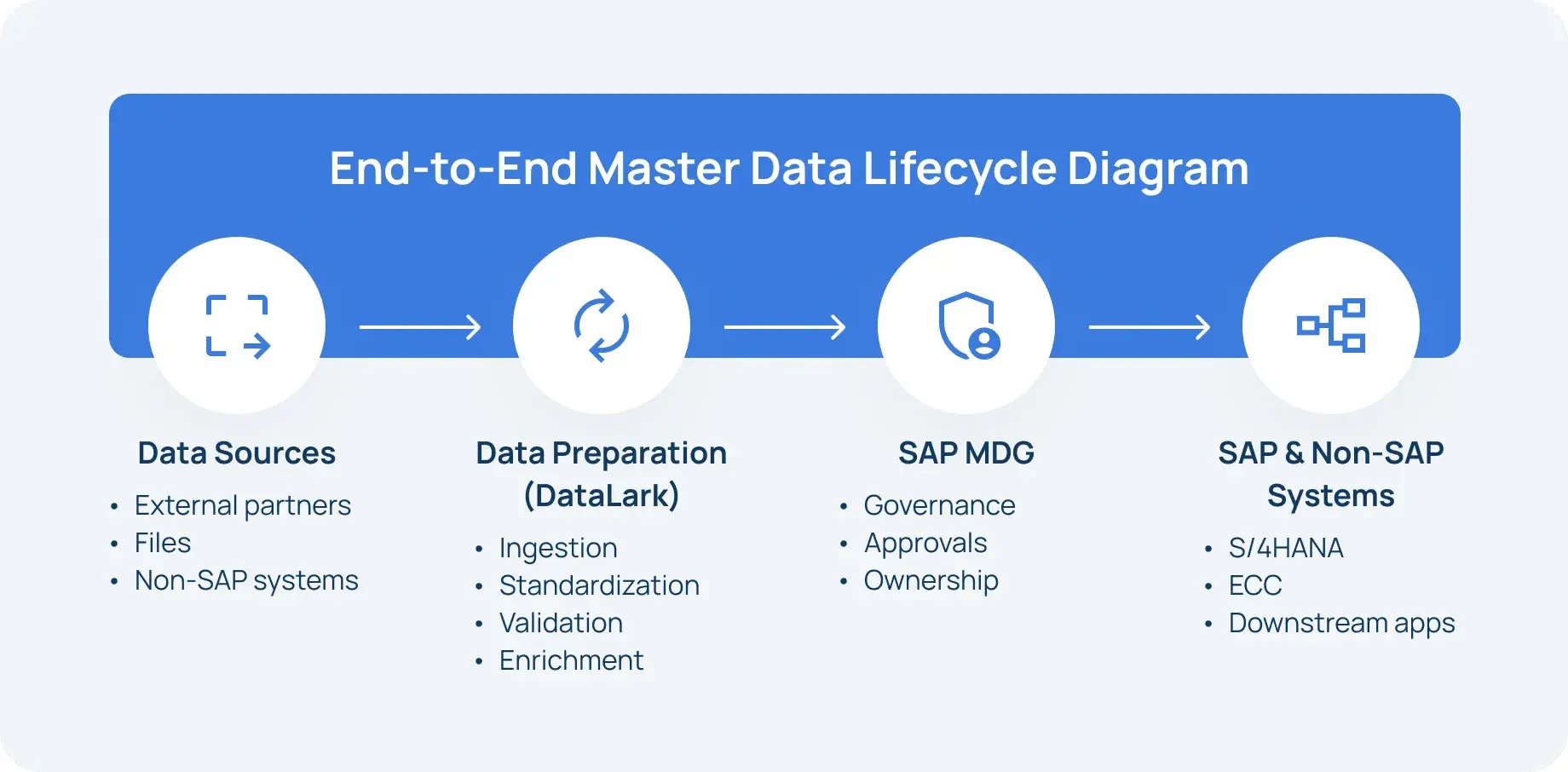
This step-by-step alignment allows SAP master data governance to function as a strategic capability rather than a corrective mechanism.
Business Benefits of Combining DataLark with SAP MDG
Combining DataLark with SAP MDG changes the nature of SAP master data governance from a corrective, exception-driven effort into a proactive and scalable capability. Rather than relying on SAP MDG to absorb upstream complexity, organizations allow governance to operate on data that is already aligned with enterprise standards.
The key benefits of this combined approach include:
- Sustained improvements in master data quality: By addressing inconsistencies and gaps before data enters SAP MDG, organizations reduce the number of errors that surface during governance workflows. For example, supplier records arriving with standardized addresses, classifications, and mandatory attributes are far less likely to be rejected during approval, leading to cleaner data without additional manual checks.
- Faster and more predictable governance cycles: When incoming data already meets governance expectations, SAP MDG approval workflows become more consistent and easier to plan around. In scenarios, such as customer onboarding or product creation, this predictability helps business teams understand timelines and reduces delays that can impact revenue or operations.
- Reduced operational burden on data stewards and IT teams: Data stewards spend less time fixing basic data issues and more time on governance decisions, while IT teams are less dependent on custom scripts and ad hoc integrations. For instance, instead of repeatedly reformatting supplier files, teams can rely on automated preparation, which frees capacity for higher-value initiatives.
- Higher adoption and acceptance of SAP MDG processes: Governance is more likely to be embraced when it is perceived as enabling rather than obstructive. By minimizing rework and approval delays, the combination of DataLark and SAP MDG helps business users see governance as a supportive framework rather than a barrier, increasing compliance with SAP data governance policies.
- Greater resilience in complex and evolving SAP landscapes: As organizations introduce new systems, regions, or data sources, the separation between data preparation and governance reduces disruption. New sources can be onboarded without destabilizing existing SAP MDG configurations, which makes master data governance more adaptable over time.
- Stronger return on SAP MDG investments: Many organizations invest significantly in SAP MDG, but struggle to realize its full potential. By ensuring that SAP MDG operates on well-prepared data, DataLark helps organizations achieve the outcomes SAP MDG was designed for: improving consistency, control, and efficiency without adding governance complexity.
By combining DataLark with SAP MDG, organizations create a foundation where data quality, efficiency, and control reinforce one another; they turn governance into a long-term business asset rather than a recurring challenge.
Conclusion
SAP Master Data Governance plays a critical role in establishing control, accountability, and consistency across enterprise master data. Its workflows, validations, and approval mechanisms provide the structure organizations need in order to manage master data responsibly at scale. Yet, as many SAP initiatives demonstrate, governance alone does not guarantee high-quality or business-ready data.
The core challenge is not a lack of governance capabilities, but the point at which governance begins. When SAP MDG becomes the first place where data quality issues are addressed, governance teams are forced into a reactive role: they have to correct problems that were introduced much earlier in the data lifecycle. This slows down approvals, increases manual effort, and ultimately limits the value organizations expect from SAP master data governance.
A more effective approach is to extend SAP data governance upstream. By ensuring that data is collected, standardized, validated, and enriched before it enters SAP MDG, organizations allow governance to focus on what it does best: decision-making, ownership, and control. This shift transforms SAP MDG from a bottleneck into an enabler.
This is where DataLark fits naturally into the SAP master data landscape. DataLark complements SAP MDG by automating the integration and preparation of master data before governance workflows begin. It ensures that SAP MDG operates on data that is already aligned with enterprise standards, reducing friction, improving efficiency, and strengthening trust in governed data.
Together, DataLark and SAP MDG enable a more sustainable model for SAP master data governance — one where data quality is addressed proactively, governance processes run predictably, and master data becomes a reliable foundation for business operations and growth.
If your SAP MDG initiative is struggling with slow approvals, high rejection rates, or excessive manual effort, the issue may not be governance itself — but what happens before governance begins. DataLark helps close that gap.
Explore a demo or talk to our experts to see how DataLark fits into your SAP landscape.