


Learn how to modernize SAP master data maintenance with structured workflows, automation, and validation to improve data quality and streamline operations.
SAP Master Data Maintenance: A Complete Guide to Modernizing Your Processes
Master data is the backbone of every SAP landscape. Materials, customers, vendors, financial objects, equipment — these records drive operational processes in manufacturing, supply chain, finance, and sales. But despite its importance, master data maintenance in SAP is often one of the most manual and error-prone activities inside an enterprise.
Organizations rely heavily on email-driven requests, Excel templates, LSMW scripts, and tribal knowledge. The result? Slow cycle times, inconsistent data, compliance challenges, and frustrated teams.
This guide explains what SAP master data maintenance really involves, explores the challenges companies face today, and introduces a modern approach to building an efficient, scalable master data maintenance process – without rebuilding your SAP system or investing in large, multi-year programs.
What Is Master Data Maintenance in SAP?
Master data in SAP defines the core business objects your organization depends on, from materials and business partners to cost centers, equipment, plants, and more. These records form the reference layer that every SAP transaction relies on. Because they are shared across modules, even small inaccuracies can disrupt multiple business processes. This interconnected nature is what makes master data maintenance in SAP so critical.
At its essence, master data maintenance is the continuous effort to keep these foundational records accurate, complete, and aligned with the operational realities of the business. It includes creating new master data when new products, vendors, or organizational units are introduced; updating existing records as business conditions evolve; and ensuring that all required fields, dependencies, and values follow internal and regulatory standards. A well-functioning maintenance discipline prevents issues that would otherwise surface in production planning, procurement, sales, finance, and logistics.
SAP amplifies the importance of this process because its modules do not function in isolation. A missing plant view on a material can halt manufacturing. Incorrect partner functions in a customer record can block deliveries. Misaligned account assignments can interrupt financial postings. Each small error creates operational friction, which highlights the need for a structured, reliable master data maintenance process.
When designed and executed well, master data maintenance becomes a stabilizing force within the SAP environment. It ensures that data is captured consistently, validated against business rules, and kept current as the organization grows and changes. In turn, this strengthens overall SAP data maintenance practices and helps maintain a clean, predictable system, where transactions behave as expected and teams can operate without unnecessary interruptions.
Core Elements of SAP Data Maintenance
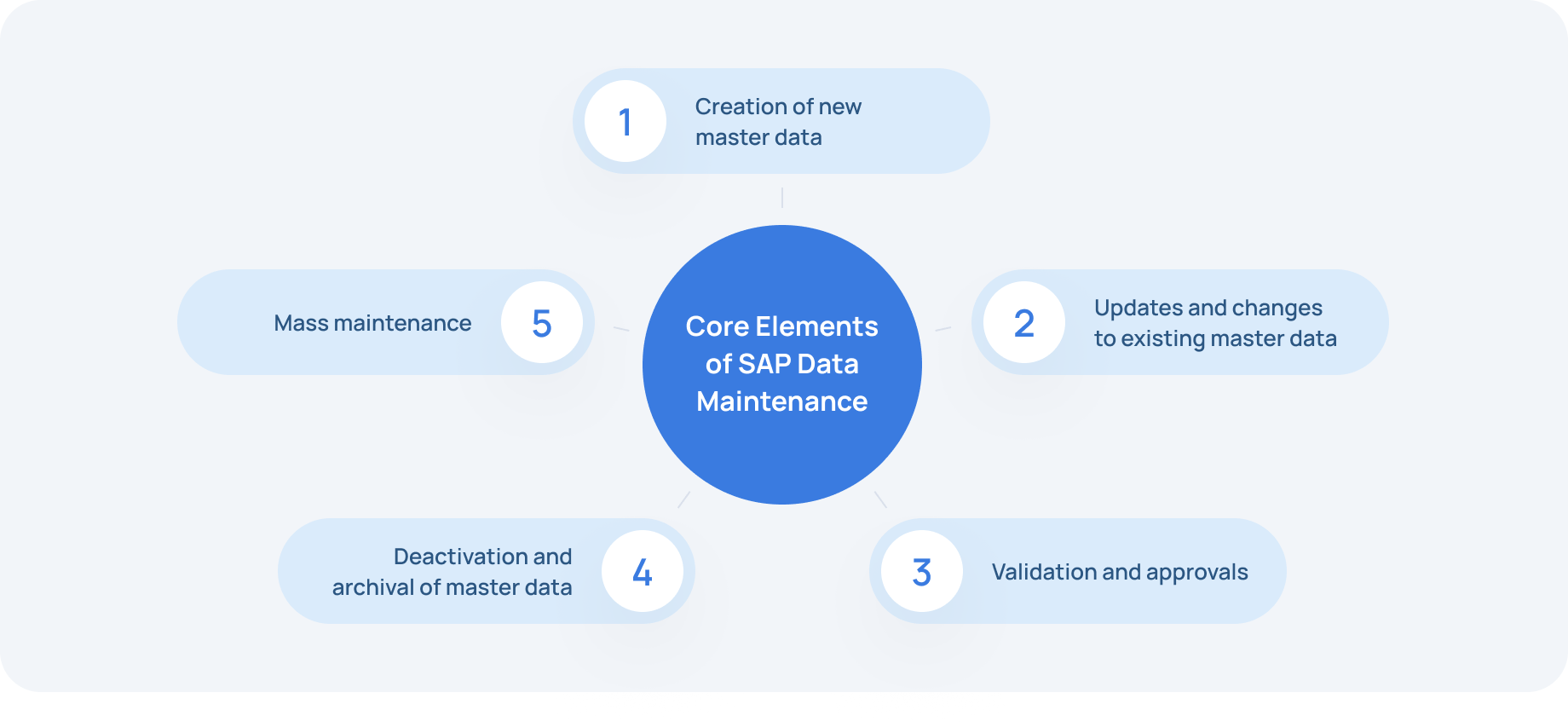
Once you understand what master data represents in SAP, the next step is to break down the full scope of work involved in maintaining it. The SAP data maintenance lifecycle is not a single task; it’s a series of interconnected activities that ensure master data remains accurate, relevant, and operationally reliable. Each component requires its own set of checks, handoffs, and governance practices.
Below are the key elements that make up an effective master data maintenance process.
Creation of new master data
Creating new master records is one of the most involved aspects of master data maintenance in SAP because it establishes the foundation for all future transactions.
This step includes:
- Determining which organizational levels (plant, sales area, company code, etc.) the data applies to
- Capturing all mandatory fields based on the master data type (e.g., material type, account group)
- Applying business rules, naming conventions, number range logic, and classification structures
- Coordinating input across multiple departments (e.g., procurement, planning, sales, finance)
- Ensuring the new object integrates correctly with downstream processes
A new material master alone may require 10+ views and involve 5-7 different teams. Without structured workflows and validation, this step is prone to incomplete or inconsistent data, which creates problems later.
Updates and changes to existing master data
Master data is not static; it evolves as the business evolves. Updating existing records forms a significant part of daily SAP data maintenance.
Common updates include:
- Adding new plants or sales areas to existing materials or customers
- Adjusting purchasing or sales data due to vendor/customer changes
- Updating planning parameters to reflect new manufacturing strategies
- Revising tax data or payment terms
- Maintaining lifecycle changes (e.g., material status updates, discontinuation)
While these edits may seem small, their operational impact can be significant. A single incorrect MRP type or pricing group, for example, can disrupt procurement or sales order processing across an entire region.
A strong maintenance process ensures that updates follow a controlled path with checks, approvals, and documentation.
Validation and approvals
One of the most overlooked components of master data maintenance is the governance layer — the structured validation that ensures data is correct before it ever reaches SAP.
Validation typically includes:
- Format checks (e.g., units of measure, tax IDs, bank data)
- Logical dependencies (e.g., material type → required views)
- Cross-field consistency (e.g., plant/storage conditions)
- Compliance requirements (e.g., financial controls, audit rules)
Approvals often involve multiple teams:
- Data stewards
- Business owners
- Compliance or finance
- Supply chain or manufacturing
- IT, in certain scenarios
Because SAP alone cannot enforce all business logic, organizations rely on external workflows or pre-processing steps. This is where many companies begin to recognize the need for automation to standardize how master data flows through validation and approval.
Deactivation and archival of master data
As companies grow, reorganize, or change product lines, some master data becomes irrelevant or obsolete. Properly retiring this data is essential for maintaining a clean and efficient SAP environment.
Activities include:
- Updating material or customer statuses
- Closing purchasing or sales views
- Blocking vendors for procurement or payment
- Archiving unused or inactive materials
- Ensuring no open transactions link to the object
If not performed thoughtfully, deactivating master data can cause unintended consequences, such as blocking production orders or causing reconciliation discrepancies. A disciplined archival strategy is necessary to ensure clarity and avoid clutter in reporting and planning processes.
Mass maintenance
Mass maintenance is one of the most resource-intensive areas of master data maintenance in SAP. It involves applying changes across hundreds, or even thousands, of master records at once.
Typical scenarios include:
- Updating procurement or sales conditions
- Adjusting planning parameters (lot sizes, lead times, MRP types)
- Changing tax indicators or pricing groups
- Migrating data during reorganizations or plant expansions
Challenges in mass maintenance often include:
- Reliance on Excel files that lack validation
- Heavy IT involvement (LSMW scripts, custom programs, BAPIs)
- Limited auditability of who changed what and why
- Need for comprehensive testing before posting to SAP
This makes mass maintenance a prime candidate for automation and standardization, especially when organizations need to reduce risk and improve cycle times.
Why these components matter
Each of these elements — creation, updates, validation, archival, and mass changes — operates like a gear in the broader master data maintenance process. When one gear is inefficient or error-prone, the entire system can feel the impact.
A holistic approach to SAP data maintenance ensures:
- Clean, consistent master data
- Faster and more controlled change cycles
- Fewer transaction errors
- Higher process reliability across all SAP modules
- Reduced dependency on IT for routine tasks
This foundation sets the stage for modernizing and automating SAP master data processes, which is essential for scaling operations and improving business performance.
Common Challenges in SAP Master Data Maintenance
Managing master data in SAP is inherently complex because it spans multiple departments, touches every major business process, and relies on precise standards to function correctly. Yet most organizations still depend on manual tools, fragmented workflows, and inconsistent validation practices. These gaps make it difficult to maintain clean, accurate, and dependable master data, no matter how experienced the team may be. Below are the challenges that most commonly disrupt effective SAP data maintenance and slow down business operations.
Key challenges in master data maintenance:
- Manual and spreadsheet-driven data collection: Many organizations still capture master data inputs through Excel files that vary by team or region. These spreadsheets typically lack validation checks, logical dependencies, or version control. As a result, stewards must spend significant time cleaning data before it can be posted to SAP, increasing both cycle times and error risk.
- Lack of standardized, cross-functional workflows: Master data creation and updates often involve procurement, supply chain, finance, sales, compliance, and IT. Without a shared workflow to coordinate these groups, requests arrive through emails, chats, or fragmented templates. This leads to unclear responsibilities, missing approvals, and inconsistent processing steps that slow down the entire master data maintenance process.
- Insufficient validation rules and inconsistent data quality: While SAP enforces technical field requirements, it cannot enforce all business-specific or cross-functional rules. Missing tax indicators, incorrect material groups, or incomplete plant views are common examples. Without automated validation, stewards must check these details manually, which is time-consuming and prone to variability.
- Fragmented approvals and limited governance: Approval processes for master data changes often rely on informal communication. Emails get buried, required sign-offs are missed, and there is no consolidated audit trail. This lack of structure undermines governance and increases compliance risks, especially in regulated industries.
- Dependence on IT for routine maintenance tasks: Activities such as mass updates, complex field adjustments, or specialized data loads often require IT intervention through LSMW, BAPIs, or custom Z-programs. This dependency creates bottlenecks, reduces agility, and distracts IT from higher-value work, even though these tasks should ideally be owned by business teams.
- Limited visibility into request status and data changes: Without dashboards or tracking mechanisms, teams have little visibility into where requests stand, who is responsible for the next step, or whether a record has passed validation. This lack of transparency leads to duplicate requests, delays, and unnecessary back-and-forth across departments.
- High error rates and downstream operational disruptions: When issues slip through validation, the consequences affect every corner of SAP: blocked production orders, failed deliveries, incorrect purchase orders, misaligned financial postings, and more. Because SAP processes are interconnected, even a single erroneous field can create wide-ranging operational friction.
These challenges persist not because organizations lack SAP expertise, but because the processes supporting master data maintenance in SAP often rely on outdated tools and manual coordination. As businesses scale, diversify, and operate across more systems, traditional approaches become increasingly unsustainable. To keep SAP stable and efficient, companies must rethink how master data is captured, validated, approved, and maintained, thus setting the stage for true modernization.
What a Modern Master Data Maintenance Process Should Look Like
As organizations mature, the limitations of manual spreadsheets, informal approvals, and unstructured communication become increasingly unsustainable. A modern master data maintenance process is designed not only to reduce errors, but also to improve cycle times, strengthen governance, and align master data activities with the pace of the business. Rather than relying on individual expertise or tribal knowledge, a modernized approach creates consistency, transparency, and control across all elements of SAP data maintenance. The components below represent the core capabilities that enable cleaner, more reliable, and more scalable master data operations.
Key components of a modern master data maintenance process:
- Centralized and structured request intake: Instead of collecting data through spreadsheets or emails, modern organizations use standardized forms or interfaces that guide users through required fields and logic. These forms reduce variability and eliminate the guesswork that often leads to errors. Centralization also ensures that all requests enter the process through a single, controlled entry point.
- Automated validation of business and technical rules: Automated checks evaluate data before it ever reaches SAP, ensuring compliance with both technical requirements and business-specific rules. These validations can include field dependencies, naming standards, permitted value ranges, tax logic, plant-specific rules, and more. By catching issues early, organizations dramatically reduce downstream rework and posting errors.
- Workflow orchestration with approvals and SLAs: A structured workflow routes master data requests to the right stakeholders (procurement, planning, sales, finance, or compliance) based on object type or organizational context. Automatic reminders, SLA tracking, and escalation mechanisms ensure timely progress and accountability. This replaces fragmented email chains with a predictable, documented approval process.
- Guided user interfaces for data stewards and business users: Instead of navigating dozens of SAP screens or field groups, users interact with guided, role-based interfaces that present only the fields and steps relevant to them. This reduces training requirements, speeds up onboarding, and significantly lowers the chance of data entry errors.
- Real-time dashboards and process visibility: Modern master data maintenance requires full transparency. Dashboards show request statuses, bottlenecks, pending approvals, cycle times, and error trends. This visibility helps teams prioritize work, monitor compliance, and identify where process improvements are needed.
- Event-driven integration with SAP and other systems: Once data is validated and approved, it should flow into SAP through standardized, automated integrations using BAPIs, IDocs, or APIs. This ensures that data is posted consistently and eliminates the need for manual uploads or IT-driven scripts. For organizations operating multiple systems, integrations extend to upstream or downstream platforms to keep data synchronized.
- Governance, versioning, and auditability: Strong governance requires a clear record of who changed what, when, and why. Modern processes include audit trails, version history, standardized documentation, and compliance checkpoints. These capabilities are critical not only for regulatory purposes, but also for maintaining operational trust in the data.
A modern master data maintenance process does far more than streamline data entry. It creates a predictable, controlled framework that ensures data is captured correctly, validated intelligently, approved consistently, and integrated automatically. By transitioning from manual coordination to structured automation, organizations improve data quality, reduce operational risks, and strengthen the reliability of every SAP-driven process. This foundation is essential for scaling efficiently and supporting continuous business growth.
Modernizing Your SAP Master Data Maintenance: Tools and Approaches
Modernizing master data maintenance in SAP is not about adopting a single tool. It’s about choosing the right combination of capabilities that match your organization’s size, landscape complexity, governance needs, and operational maturity. SAP offers a range of native options, and the ecosystem provides numerous complementary automation platforms. The challenge is selecting the right mix so the master data maintenance process becomes scalable, controlled, and efficient without introducing unnecessary complexity.
Below are the primary categories of tools and approaches organizations rely on when modernizing SAP data maintenance, along with expert insights into when each approach is most effective.
SAP native tools for master data maintenance
SAP provides several built-in transactions and utilities that support basic data creation, editing, and mass updates. These include:
- MM01 / BP / XD01 / XK01 for manual creation of individual records
- MASS for mass-change activities
- LTMC (Legacy Transfer Migration Cockpit) for structured data loads
- Batch input sessions and direct input programs for standardized uploads
Native tools are reliable, well-integrated, and secure, but their limitations become evident when processes require cross-functional collaboration, customized validation logic, or governed approvals. They are best suited for organizations with low-to-medium data volumes and stable, predictable maintenance processes.
SAP MDG (Master Data Governance)
SAP MDG is SAP’s flagship governance platform, designed to enforce strict standards, harmonize global data, and manage golden records across complex organizations.
MDG offers:
- Rule-based data validations
- Extensible data models
- Workflow capabilities
- Versioning and audit trails
- Consolidation and mass processing features
MDG is a powerful solution, but it is also heavy. Implementations often require significant investment, multi-month deployments, and specialized expertise. MDG is ideal for enterprises that need centralized governance, multi-system synchronization, and strict compliance, particularly those running multiple SAP and non-SAP systems.
However, it may be overly complex for organizations primarily focused on operational master data updates rather than enterprise-level data governance.
Custom development and enhancements
Many SAP teams rely on custom ABAP programs, Z-transactions, LSMW scripts, or bespoke interfaces to support mass changes or specialized data logic.
Common use cases include:
- Customized workflows
- Specialized mass maintenance utilities
- Automation of repeatable updates
- Data remediation projects
- Integration with niche systems
Custom development fills immediate gaps, but becomes expensive to maintain. As business rules evolve, custom objects must be updated, retested, and redeployed. Over time, organizations accumulate “technical debt” that slows down innovation and increases IT dependency.
Custom tools should be used sparingly for edge cases, not as a general solution for ongoing master data processes.
Low-code / no-code workflow automation platforms
A growing number of organizations modernize SAP data maintenance by adopting workflow and automation platforms that sit alongside SAP and orchestrate the process around it.
These platforms typically enable:
- Guided, structured intake forms
- Automated validation rules
- Multi-step approvals with SLA tracking
- Integration with SAP via BAPIs, IDocs, or APIs
- Audit trails and dashboards
- Reusable logic for mass updates
- Reduced reliance on IT
This approach offers the fastest time-to-value and the greatest flexibility. Modern workflow automation platforms like DataLark excel here: they do not replace SAP functionality but augment it by providing structure, governance, automation, and validation where SAP’s native tools fall short.
Low-code/no-code solutions are ideal for organizations seeking agility, strong data quality controls, and efficient collaboration across teams – without committing to the cost or complexity of MDG.
Hybrid approaches (the most common real-world scenario)
In practice, most organizations use a blend of tools:
- SAP native tools for basic maintenance
- Automation platforms for workflow and validation
- MDG for enterprise-level governance (when applicable)
- Selective custom development for niche requirements
A hybrid approach ensures that each component of the SAP data maintenance process is handled by the tool best suited for it. The most successful organizations avoid relying on a single monolithic system. Instead, they design a layered architecture where SAP handles transactions, governance platforms enforce standards, and workflow automation orchestrates processes end-to-end.
This gives both business and IT teams the flexibility and control needed to scale.
Choosing the right combination of tools determines how efficiently your organization can maintain master data and how reliably SAP processes will run. A modernized approach not only reduces errors and cycle times but also strengthens cross-functional collaboration, compliance, and operational resilience.
A Side-by-Side Look at Traditional vs. Modern SAP Master Data Maintenance
Modernizing master data maintenance in SAP is easiest to understand when comparing the typical legacy workflow to a modernized, automated approach. Most organizations recognize symptoms of inefficiency (e.g., slow cycle times, inconsistent data quality, reliance on spreadsheets) but struggle to envision what a streamlined process actually looks like. The table below illustrates how modernization transforms each step of the master data maintenance process.
| Area | Before Modernization | After Modernization |
| Request intake | Requests submitted via email, spreadsheets, or chat; inconsistent formats; missing information common. | Centralized, structured request forms with guided fields; required data captured upfront; reduced back-and-forth. |
| Validation | Manual checks performed by stewards; dependent on individual expertise; high variability in data quality. | Automated technical + business-rule validation; dependencies enforced; consistent quality across all records. |
| Approvals | Informal email chains; unclear ownership; no audit trail; approvals frequently delayed or overlooked. | Workflow-driven approvals with defined steps, SLAs, reminders, and full auditability. |
| Posting to SAP | IT-dependent (LSMW, BAPIs, Z-programs); manual uploads; queueing and bottlenecks around technical resources. | Automated posting via APIs, IDocs, or BAPIs; reduced IT involvement; faster cycle times. |
| Visibility & tracking | Little to no visibility into request status; difficult to identify bottlenecks or progress; duplication common. | Real-time dashboards showing progress, bottlenecks, cycle times, and workload distribution. |
| Error rates | Frequent downstream issues (blocked orders, planning errors, invoice mismatches) due to poor data quality. | Dramatically reduced errors thanks to upstream checks and standardized workflows. |
| Collaboration | Cross-functional coordination handled manually; miscommunication and delays typical. | Structured collaboration supported by workflow orchestration, clear ownership, and automated handoffs. |
| Governance | Limited or inconsistent documentation; difficult audits; unclear version history. | Complete audit trails, versioning, and documented decision points built into the process. |
| Overall process efficiency | Slow, unpredictable, and heavily reliant on individuals; high operational risk. | Fast, consistent, scalable, and governed; strong foundation for business growth and operational reliability. |
A modernized master data process is not simply a cleaner workflow; it fundamentally strengthens the integrity of SAP operations. By shifting from manual, error-prone activities to structured automation and governance, organizations reduce operational risk, accelerate time-to-market, and ensure higher-quality data flows into every SAP module. This transformation enables the business to scale confidently, react quickly to change, and maintain a stable, reliable SAP environment.
Best Practices for Ongoing SAP Data Maintenance Success
Modernizing the master data maintenance process is only the first step; sustaining high-quality master data over time requires strong governance, continuous improvement, and well-defined ownership. As organizations expand, introduce new products, or adjust their operating models, the demands on SAP master data evolve as well.
The following best practices help ensure that master data maintenance in SAP remains consistent, reliable, and scalable long after the initial modernization effort is complete:
- Define clear data ownership and stewardship: Establishing accountable roles is essential. Each master data object (e.g., materials, customers, or vendors) should have designated owners responsible for data accuracy and lifecycle decisions. Clear stewardship reduces ambiguity, accelerates decision-making, and improves cross-functional collaboration.
- Create and enforce data standards: Document standards such as naming conventions, number ranges, mandatory fields, business validation rules, and approved values. Standards should be easily accessible and embedded into the tools and workflows that support day-to-day data maintenance, ensuring consistency beyond individual expertise.
- Integrate data quality checks into daily operations: Periodic audits alone are not enough. Automated, ongoing checks for completeness, duplicate detection, classification accuracy, and logical consistency help catch problems early. Proactive data quality monitoring reduces downstream operational issues.
- Automate recurring or high-volume changes: Many updates (e.g., adjusting planning parameters, enabling new plants, updating pricing indicators) follow predictable patterns. Automating these scenarios reduces IT dependency, shortens cycle times, and minimizes manual errors. Automating mass maintenance workflows is particularly impactful in fast-changing business environments.
- Regularly review exceptions and edge cases: Even with strong processes, exceptions arise: new product types, industry-specific regulations, or one-off customer requirements. Periodic reviews of exception logic and special handling rules ensure they remain relevant and aligned with business strategy.
- Align master data processes with organizational changes: As companies undergo restructuring, acquisitions, plant expansions, or market entry initiatives, master data requirements evolve. Revisiting master data models and workflows during organizational changes prevents misalignment and helps maintain clean integration between SAP modules.
- Maintain comprehensive audit trails and documentation: Every change should be traceable: what was changed, who changed it, when it was changed, and why. Complete auditability not only supports compliance but also builds operational trust and speeds up root-cause analysis when issues occur.
- Continuously optimize processes using performance metrics: Track KPIs, such as cycle time, approval bottlenecks, error rates, and data quality trends. These insights help identify opportunities to refine workflows, add validations, or redistribute stewardship responsibilities. Modern organizations treat master data as an evolving discipline, not as a static responsibility.
Sustaining high-quality master data is not merely a technical activity; it is an ongoing organizational capability. By defining ownership, enforcing standards, automating repetitive tasks, and continuously monitoring data quality, companies ensure that their SAP environment remains stable and trustworthy. These practices create a long-term foundation that supports efficient operations, cleaner integrations, and smoother business growth, thus making the most out of the modernized master data maintenance process, once it is put in place.
Conclusion
Master data is the connective tissue that holds an SAP ecosystem together; the way an organization maintains it has a direct impact on operational efficiency, data quality, and business agility. Traditional approaches rooted in spreadsheets, emails, and manual coordination simply can’t keep pace with the complexity and speed of modern enterprises. As a result, master data issues surface not only as technical glitches, but as real business bottlenecks: delayed launches, blocked orders, planning failures, financial inconsistencies, and customer dissatisfaction.
Modernizing the master data maintenance process is therefore not an optional improvement — it’s a strategic necessity. By adopting structured intake, automated validation, governed workflows, real-time visibility, and intelligent integration with SAP, organizations create a stable, predictable framework for maintaining high-quality data. This shift strengthens every downstream process, from supply chain execution to financial reporting, while reducing IT dependency and operational risk.
Equally important, modernization establishes a foundation for continuous improvement. With clear ownership, consistent standards, automated quality checks, and performance metrics, organizations can evolve their master data practices as the business grows. Whether entering new markets, expanding their product portfolio, or integrating new systems, companies with mature SAP master data maintenance are better positioned to scale without compromising stability.
In the end, master data maintenance is more than a technical workflow. It’s an organizational capability that fuels resilience, efficiency, and informed decision-making. By investing in modern, automated, and well-governed processes today, businesses ensure their SAP landscape remains an asset rather than an obstacle, empowering teams to move faster, operate smarter, and support the company’s long-term success. Request a DataLark demo and explore automated SAP data maintenance in further detail.