


Learn how to implement DataOps in SAP environments using proven frameworks, tools, and best practices for automated, reliable SAP data operations.
SAP DataOps: How to Build Reliable SAP Data Pipelines with the Right Frameworks, Tools, and Best Practices
Enterprise organizations rely on SAP systems to run their most critical business processes, from finance and supply chain to manufacturing and procurement. Yet, while SAP is often the system of record, getting SAP data reliably into downstream systems remains a persistent challenge.
As SAP landscapes grow more complex, traditional approaches to data integration and management are no longer sufficient. Static ETL jobs, manual validation, and reactive troubleshooting lead to fragile pipelines, poor data quality, and operational bottlenecks.
This is where SAP DataOps comes in.
SAP DataOps applies modern DataOps principles — automation, observability, continuous improvement, and collaboration — to the design and operation of SAP data pipelines. Instead of treating data movement as a one-time technical task, SAP DataOps treats data pipelines as living, operational products that must be reliable, scalable, and resilient to change.
In this article, we explore the following aspects:
- What SAP DataOps really means.
- Why SAP data pipelines fail without a DataOps approach.
- Frameworks and tools for implementing SAP DataOps.
- Best practices for building reliable SAP data pipelines.
- How platforms like DataLark enable SAP DataOps at scale.
Now, let’s dig in.
What Is SAP DataOps?
SAP DataOps is the application of DataOps principles to SAP-centric data environments, with a focus on the continuous and reliable operation of SAP data pipelines. It brings together automation, monitoring, and data quality management to ensure that SAP data is trustworthy, consistently delivered, and resilient to change.
Rather than treating SAP data integration as a one-time technical implementation, SAP DataOps approaches it as an ongoing operational discipline. SAP data pipelines are designed, deployed, and managed as long-lived assets that must perform reliably as SAP systems, business rules, and enterprise architectures evolve.
In this context, SAP DataOps addresses several foundational requirements of modern SAP landscapes:
- Maintaining consistent data delivery across multiple SAP and non-SAP systems
- Ensuring data quality and integrity throughout the pipeline lifecycle
- Detecting and managing the impact of SAP system changes
- Providing visibility into pipeline health, performance, and failures
By embedding these capabilities directly into SAP data pipelines, SAP DataOps enables organizations to move beyond fragile integrations and toward stable, scalable, and continuously improving SAP data operations.
From one-time integration to continuous operations
Traditional SAP data integration typically treats pipelines as static technical implementations. The goal is to extract data from SAP, transform it, and load it into a target system. Once the pipeline is live, it is often considered “done”, unless it fails.
SAP DataOps takes a different perspective. It treats SAP data pipelines as long-lived operational assets that must be actively managed throughout their lifecycle.
This shift introduces several key principles that define SAP DataOps:
- Automation instead of manual intervention: Repetitive tasks such as pipeline execution, validation, and error handling are automated to reduce risk and dependency on individuals.
- Continuous validation instead of periodic checks: Data quality rules are applied automatically as data flows through SAP data pipelines — not only after issues appear in reports.
- Monitoring and observability instead of reactive troubleshooting: Teams gain real-time visibility into pipeline health, data freshness, and anomalies, allowing them to detect problems early.
- Adaptability instead of rigid, hard-coded logic: Pipelines are designed to accommodate SAP changes (e.g., schema updates or system upgrades) without constant rework.
Together, these principles enable SAP data pipelines to function as reliable, scalable components of enterprise data architecture.
SAP DataOps vs. traditional SAP data integration
The difference between SAP DataOps and traditional SAP data integration becomes clear when comparing their focus and outcomes.
Traditional SAP data integration typically emphasizes:
- Extracting data from SAP systems
- Transforming it to meet target requirements
- Loading it into data warehouses or applications
This approach is often successful at the initial setup stage, but it struggles over time as SAP environments evolve.
SAP DataOps extends beyond integration and focuses on operational excellence by ensuring that:
- SAP data pipelines are continuously monitored and measurable.
- Data quality is enforced automatically, not manually.
- Changes in SAP systems are detected and assessed early.
- Failures are identified and resolved before business users are affected.
Instead of reacting to broken pipelines and inconsistent data, SAP DataOps enables organizations to prevent issues proactively and maintain trust in SAP data across all consuming systems.
Why SAP Data Pipelines Are So Hard to Get Right
Building reliable SAP data pipelines is fundamentally more complex than integrating data from most non-SAP systems. SAP environments combine technical complexity, frequent change, and high business criticality, which places unique demands on how data pipelines are designed and operated. Without a dedicated SAP DataOps approach, even well-engineered pipelines tend to become fragile over time.
Several factors consistently make SAP data pipelines difficult to get right:
- Highly complex and tightly coupled SAP data models: SAP systems rely on deeply normalized schemas with thousands of interrelated tables and technical field names that often lack direct business meaning. Master data, transactional data, and configuration data are tightly connected, which means that extracting a single business entity usually requires joining multiple tables. Small modeling errors or misunderstandings of SAP relationships can easily propagate incorrect data downstream, making pipeline logic difficult to maintain and validate.
- Frequent structural and functional changes in SAP systems: SAP environments are rarely static. System upgrades, enhancement packs, S/4HANA migrations, and custom ABAP developments regularly introduce changes to tables, fields, and business logic. When SAP data pipelines are built with rigid, hard-coded assumptions, these changes often go undetected until pipelines fail or reports show inconsistencies. The lack of automated change detection is one of the most common causes of broken SAP data pipelines.
- High expectations for data accuracy and consistency: SAP data underpins core enterprise processes such as financial close, regulatory reporting, procurement, and supply chain execution. As a result, tolerance for data errors is extremely low. Even minor inconsistencies in SAP data pipelines can lead to incorrect financial statements, compliance risks, or operational disruptions. This makes reactive, manual data validation approaches insufficient in SAP-driven organizations.
- Hybrid architectures and growing integration scope: Modern SAP landscapes extend far beyond a single system. SAP data is increasingly consumed by cloud data platforms, data lakes, planning systems, and external applications. Each additional integration increases operational complexity and creates more points of failure. Without end-to-end visibility and orchestration, issues in one part of an SAP data pipeline can silently affect multiple downstream systems.
- Operational silos between SAP, data, and business teams: Responsibility for SAP data pipelines is often fragmented. SAP teams focus on system stability, data teams manage pipelines, and business users consume the data — often with limited shared visibility. This lack of alignment makes it difficult to define ownership, enforce data quality standards, and respond quickly to issues. As a result, problems are discovered late and resolved reactively.
SAP data pipelines are difficult to get right — not because of a single technical limitation — but because of the combined impact of SAP’s complexity, constant change, and business criticality. Without automation, continuous data quality, and operational visibility, even robust pipelines degrade over time. This is precisely why SAP DataOps is essential: it provides the structure and practices needed to operate SAP data pipelines reliably, at scale, and with confidence.
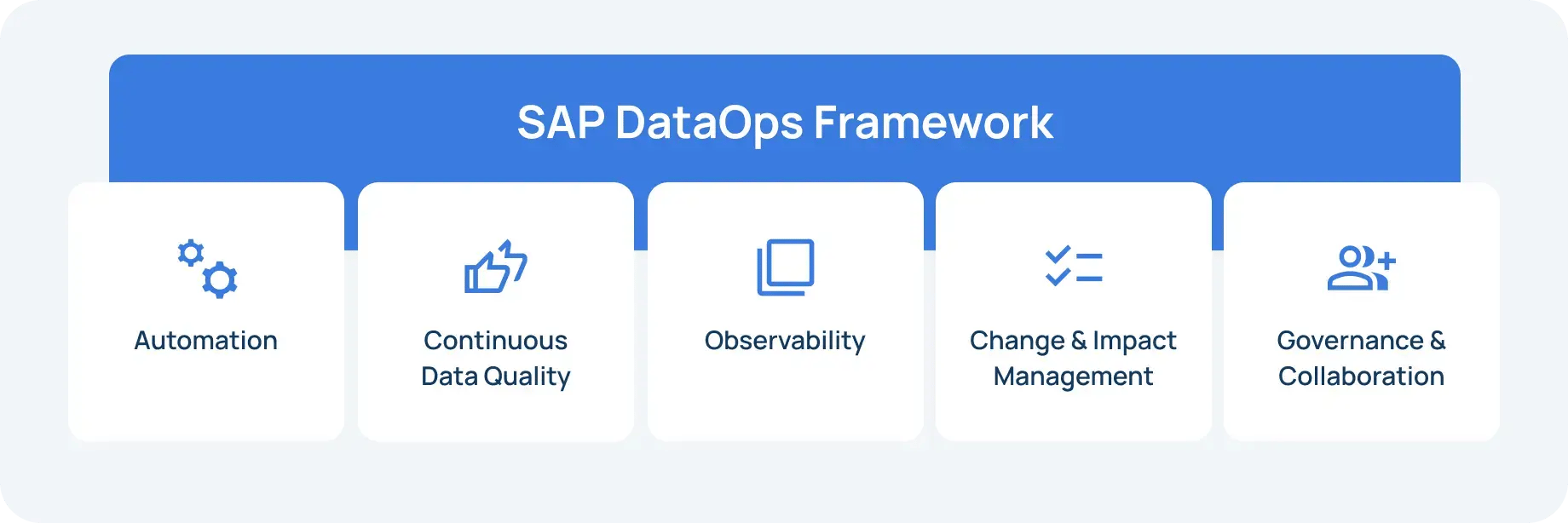
SAP DataOps Framework: Core Pillars
A successful SAP DataOps framework is not defined by a single tool or process. Instead, it emerges from a set of closely connected capabilities that together make SAP data pipelines reliable, adaptable, and operationally manageable over time. These pillars reinforce one another; weakness in one area inevitably undermines the others.
At its foundation, SAP DataOps recognizes a simple reality: SAP systems are complex, constantly changing, and business-critical. Any framework designed to operate SAP data pipelines must therefore prioritize automation, continuous validation, visibility, and resilience to change.
Automation as the operational backbone
Automation is the cornerstone of SAP DataOps, because manual processes cannot keep pace with the scale and volatility of SAP environments. In many organizations, SAP data pipelines still rely on a combination of scheduled jobs, custom scripts, and human intervention when something goes wrong. This approach does not scale and introduces operational risk.
In an SAP DataOps framework, automation extends across the entire pipeline lifecycle:
- Data extraction from SAP systems is standardized and repeatable.
- Transformations are driven by metadata rather than hard-coded logic.
- Pipeline deployments and updates follow controlled, automated processes.
- Failures trigger predefined recovery or alerting mechanisms.
For example, when a new field is added to a finance table during an S/4HANA upgrade, an automated pipeline can detect the schema change, validate its impact, and either adapt or flag the issue before downstream systems are affected. Automation turns SAP data pipelines from fragile constructs into resilient operational assets.
Continuous data quality embedded in the pipeline
In SAP environments, data quality cannot be treated as a downstream reporting problem. By the time inconsistencies appear in reports or dashboards, the business impact has often already occurred. SAP DataOps embeds data quality directly into the data pipeline itself.
This means that data quality rules are:
- Defined in collaboration with SAP and business domain experts.
- Applied automatically as data moves through the pipeline.
- Monitored continuously rather than checked periodically.
Typical examples include validating the completeness of financial postings, ensuring consistency of master data attributes across systems, or verifying referential integrity between transactional and master data. By enforcing these rules early and automatically, SAP DataOps prevents low-quality data from propagating across the enterprise.
Observability across SAP data pipelines
Without observability, SAP data pipelines operate as black boxes. Teams may know that a report is wrong, but not where or why the issue occurred. SAP DataOps introduces observability as a first-class capability, providing continuous insight into how data flows through SAP pipelines.
Observability in a SAP DataOps framework includes:
- Monitoring pipeline execution and performance
- Tracking data freshness and delivery SLAs
- Detecting unusual volume changes or anomalies
- Providing lineage and traceability across systems
For instance, a sudden drop in transaction volume from an SAP logistics module may indicate a failed extraction, a business process issue, or a change in filtering logic. Observability allows teams to detect and investigate such anomalies proactively, rather than responding after business users raise concerns.
Change management and impact awareness
Change is constant in SAP landscapes, whether due to upgrades, custom developments, or organizational restructuring. A core pillar of SAP DataOps is the ability to manage change deliberately and predictably.
Rather than reacting to broken pipelines, a mature SAP DataOps framework:
- Detects changes in SAP schemas, data volumes, and structures
- Assesses their potential downstream impact
- Triggers automated testing or validation workflows
- Notifies relevant teams before failures occur
For example, if an SAP table used in multiple pipelines is modified, impact analysis helps teams understand which downstream systems are affected and prioritize remediation. This proactive approach significantly reduces downtime and improves trust in SAP data pipelines.
Governance and collaboration by design
Finally, SAP DataOps recognizes that reliable data pipelines require more than technical controls — they require clear ownership and collaboration. Governance is not enforced through rigid processes alone, but through transparency and shared accountability.
In practice, this means:
- Clear ownership of SAP data pipelines and quality rules
- Role-based access to pipeline configuration and monitoring
- Audit trails for changes and executions
- Shared visibility between SAP, data, and business teams
By embedding governance into daily operations, SAP DataOps enables organizations to maintain compliance and control without slowing data delivery.
Bringing the pillars together
Individually, each pillar improves a specific aspect of SAP data operations. Together, they form a cohesive SAP DataOps framework that allows organizations to operate SAP data pipelines with confidence.
Automation enables scale, continuous data quality ensures trust, observability provides visibility, and change management ensures resilience. When these capabilities are combined, SAP data pipelines evolve from fragile integrations into stable components of enterprise data architecture that are continuously improving.
Tools in a SAP DataOps Stack
Implementing SAP DataOps requires more than selecting a single integration tool. An SAP DataOps stack is a combination of complementary technologies that support the continuous operation, monitoring, and improvement of SAP data pipelines. The goal is not to replace existing SAP tools, but to orchestrate and operationalize them within a broader DataOps framework.
In practice, most organizations already have some SAP-native data tools in place. The challenge is that these tools are often designed for connectivity and performance, not for day-to-day operational reliability. SAP DataOps tools fill this gap by adding automation, observability, and control across the entire pipeline lifecycle.
SAP native tools: strong foundations with operational gaps
SAP provides a range of native solutions for extracting and moving data, such as SAP SLT, SAP Data Services, and SAP Datasphere. These tools are well-suited for connecting to SAP systems and handling SAP-specific data structures, which makes them a natural foundation for SAP data pipelines.
In real-world environments, however, teams often encounter limitations when relying on SAP-native tools alone. While they excel at data movement, they typically offer limited support for:
- End-to-end pipeline observability across multiple systems
- Continuous, automated data quality validation
- Proactive detection of schema and volume changes
- Coordinated orchestration of complex, multi-step pipelines
As a result, operational issues are frequently discovered late — often after a pipeline has failed or business users have reported inconsistencies. This is where additional SAP DataOps capabilities become essential.
DataOps platforms as the operational layer
A modern SAP DataOps stack introduces a dedicated DataOps platform that sits above and alongside existing SAP tools, acting as an operational control layer. Rather than duplicating extraction or transformation logic, this layer focuses on how SAP data pipelines are run, monitored, and improved.
Key responsibilities of this operational layer include:
- Orchestrating SAP and non-SAP pipeline steps consistently
- Applying metadata-driven logic to reduce hard-coded dependencies
- Embedding automated data quality checks into pipeline execution
- Monitoring pipeline health, data freshness, and anomalies
- Detecting changes in SAP systems and assessing downstream impact
For example, when SAP data is extracted using native tools and then transformed or loaded into cloud platforms, an SAP DataOps platform ensures that each step is coordinated, validated, and observable. This prevents silent failures and reduces the operational burden on engineering teams.
Supporting tools across the pipeline lifecycle
In addition to core SAP and DataOps platforms, a mature SAP DataOps stack often includes supporting tools that strengthen specific aspects of pipeline operations.
These may include:
- Metadata and cataloging tools, which provide context, lineage, and business meaning for SAP data
- Monitoring and alerting systems integrated with enterprise operations workflows
- Version control and deployment tooling to manage changes to pipeline logic and configuration
- Security and access management tools aligned with SAP governance requirements
The key is not the number of tools, but how well they are integrated into a cohesive operational model. Disconnected tools increase complexity, while a well-integrated stack improves transparency and control.
How DataLark enhances SAP DataOps stack
Within this architecture, DataLark plays the role of an SAP DataOps automation and orchestration platform. It complements SAP-native tools by focusing on the operational aspects that are typically hardest to manage at scale.
DataLark supports SAP DataOps by enabling organizations to:
- Automate SAP data ingestion and transformation workflows
- Embed continuous data quality validation into SAP data pipelines
- Monitor pipelines end-to-end across SAP and non-SAP environments
- Detect and respond to changes in SAP data structures
- Reduce manual effort and operational risk in SAP data operations
By acting as an operational layer, DataLark helps organizations stabilize and scale their SAP data pipelines without disrupting existing architectures.
Building a cohesive SAP DataOps tooling strategy
A successful SAP DataOps stack is not defined by any single product, but by how effectively tools work together to support reliable data operations. Organizations that succeed with SAP DataOps focus on:
- Leveraging SAP-native tools for what they do best
- Introducing DataOps platforms to manage operational complexity
- Integrating governance, monitoring, and automation into daily workflows
When these elements are aligned, SAP data pipelines become easier to operate, easier to adapt, and easier to trust, thus creating a strong foundation for enterprise data initiatives.
Common SAP DataOps Pitfalls (and How to Avoid Them)
Even when organizations adopt modern tooling and processes, SAP DataOps initiatives can stall due to a small number of recurring execution pitfalls. These issues are rarely visible at the start of a project. Instead, they emerge over time as SAP data pipelines grow in number, span more systems, and become embedded in daily business operations.
Understanding these pitfalls helps teams move from short-term stabilization to long-term operational maturity.
Pitfall #1: Over-customizing SAP data pipelines
Customization has long been part of SAP implementations, and despite SAP Clean Core policy, in many cases it is still unavoidable. However, when SAP data pipelines rely heavily on custom ABAP logic, bespoke transformations, or one-off scripts, operational complexity increases rapidly.
Highly customized pipelines are difficult to standardize, making it harder to apply consistent monitoring, validation, and change management. Over time, pipeline behavior becomes opaque, documentation lags behind reality, and knowledge concentrates in the hands of a few individuals. As SAP systems evolve, these pipelines require disproportionate effort to adapt, increasing both cost and risk.
How to avoid it: Limit customization to cases where it clearly adds long-term value. Favor repeatable, metadata-driven patterns that can be applied consistently across pipelines. When custom logic is necessary, ensure that it is observable, well-documented, and integrated into shared operational processes rather than treated as a special case.
Pitfall #2: Treating data quality as a reporting problem
In many SAP-driven organizations, data quality is addressed only after data reaches reports, dashboards, or downstream applications. When discrepancies surface, teams investigate the issue retroactively, often under pressure from business stakeholders.
This approach is especially problematic in SAP environments, where data frequently supports financial close, regulatory reporting, and operational execution. By the time data quality issues are visible in reports, incorrect data may already have influenced decisions or compliance outcomes.
How to avoid it: Reframe data quality as an operational concern rather than a reporting issue. Validation should occur as part of pipeline execution, using business-aligned rules that reflect how SAP data is actually used. Early detection reduces remediation effort and prevents low-quality data from propagating across systems.
Pitfall #3: Lack of cross-team collaboration
SAP data pipelines sit at the intersection of multiple teams: SAP functional and technical teams, data engineering groups, and business users. When these teams operate in silos, pipeline issues are discovered late and resolved inefficiently.
Misalignment often leads to unclear ownership, inconsistent definitions of data quality, and delayed responses to change. Each group may optimize for its own priorities, but the end-to-end reliability of SAP data pipelines suffers as a result.
How to avoid it: Establish shared visibility and accountability across teams involved in SAP data operations. Clear ownership, common metrics, and transparent pipeline monitoring help align expectations and accelerate issue resolution. SAP DataOps works best when it is treated as a collaborative discipline rather than a purely technical function.
These three pitfalls rarely occur in isolation. In practice, they reinforce one another and gradually undermine the reliability of SAP data pipelines as environments scale and change. Left unaddressed, they turn SAP DataOps into a series of tactical fixes rather than a sustainable operating model.
The good news is that these challenges are not inevitable. They are symptoms of missing operational discipline rather than fundamental limitations of SAP or DataOps. By applying a consistent set of practical practices focused on ownership, automation, early validation, and shared visibility, organizations can systematically eliminate failure patterns.
Best Practices for Building Reliable SAP Data Pipelines
Reliable SAP data pipelines do not emerge from isolated technical decisions or one-time implementations. They are the result of disciplined operational practices that take into account the unique characteristics of SAP environments: long system lifecycles, frequent structural change, and high business criticality. Within an SAP DataOps framework, these best practices help ensure that SAP data pipelines remain stable, trustworthy, and scalable over time.
The following practices consistently distinguish robust SAP data pipelines from those that become fragile and costly to maintain:
- Treat SAP data pipelines as long-lived products, not one-off integrations: SAP data pipelines require clear ownership, defined service expectations, and continuous improvement. When pipelines are managed as products, teams establish accountability for data freshness, completeness, and quality. This mindset shifts operations away from reactive firefighting and toward proactive reliability management.
- Focus first on business-critical SAP data domains: Attempting to operationalize all SAP data at once often introduces unnecessary complexity. Mature SAP DataOps initiatives prioritize high-impact domains such as finance, controlling, core master data, and supply chain operations. These domains have well-defined business rules and low tolerance for errors, making them ideal candidates for early automation, validation, and monitoring.
- Embed data quality validation directly into the SAP data pipeline: In SAP environments, downstream data quality checks are insufficient. Best practice is to apply business-aligned validation rules as data flows through the pipeline, not after it has been consumed. Automated checks for completeness, consistency, and referential integrity prevent incorrect data from propagating and reduce the need for manual reconciliation.
- Design SAP data pipelines with change as an expected condition: SAP systems evolve continuously through upgrades, enhancements, and custom developments. Pipelines built on rigid, hard-coded assumptions are especially vulnerable to failure. Reliable SAP data pipelines rely on metadata-driven logic, automated change detection, and impact awareness to adapt to evolving SAP structures with minimal disruption.
- Prioritize observability over reactive troubleshooting: Traditional SAP data operations often rely on business users to report issues after data has already been used. SAP DataOps emphasizes observability, which means continuous insight into pipeline execution, data freshness, and volume patterns. This enables teams to detect anomalies early, investigate root causes faster, and maintain confidence in SAP data delivery.
- Align pipeline operations with SAP governance and compliance requirements: SAP data frequently supports regulated and audit-sensitive processes. Best practices therefore include role-based access control, audit trails for pipeline changes, and traceable data lineage. Embedding governance into daily operations ensures that reliability and compliance reinforce one another rather than compete.
- Enable collaboration across SAP, data, and business teams: Many SAP data pipeline issues stem from organizational silos rather than technical limitations. Effective SAP DataOps practices promote shared visibility into pipeline health and data quality, clear ownership, and faster feedback loops. This alignment reduces delays in issue resolution and improves overall trust in SAP data.
Building reliable SAP data pipelines requires more than technical expertise; it requires an operational mindset shaped by SAP DataOps principles. By consistently applying these best practices, organizations can reduce pipeline fragility, improve data quality, and maintain stability as SAP systems and business requirements evolve. Together, these practices form the practical foundation for operating SAP data pipelines with confidence and control.
Conclusion
As SAP landscapes grow more complex, the reliability of SAP data pipelines becomes an operational priority, rather than a technical afterthought. SAP DataOps provides the structure needed to operate these pipelines consistently: through automation, early data validation, visibility, and clear ownership.
Many challenges associated with SAP data pipelines are predictable and preventable. When organizations address over-customization, reactive data quality, and fragmented collaboration with disciplined best practices, SAP DataOps evolves from ad-hoc problem solving into a sustainable capability.
DataLark helps organizations put SAP DataOps into practice by supporting automated, observable, and resilient SAP data pipelines that work alongside existing SAP tools. If you want to strengthen the operational reliability of your SAP data pipelines and move SAP DataOps from concept to execution, explore how DataLark supports SAP DataOps across complex SAP environments.