


Learn how data lineage and observability extend SAP data quality: reducing migration risk, improving governance, and building trusted enterprise data.
Data Lineage & Observability: The Next Step After Quality Checks
For years, data quality has been the cornerstone of enterprise data management. Organizations invested heavily in validation rules, profiling, reconciliation processes, and cleansing routines to ensure that data entering their systems was accurate, complete, and consistent. In SAP-centric landscapes especially, data quality checks became a standard requirement for migrations, integrations, and reporting initiatives.
Yet despite these efforts, many organizations still struggle with recurring data incidents, long troubleshooting cycles, and uncertainty about the true reliability of their data. Quality dashboards may show that data passes validation rules, but business users continue to ask uncomfortable questions, such as:
- Where did this value come from?
- Why did this number change after last night’s load?
- What systems will be affected if we modify this SAP object?
These questions point to a deeper issue. While data quality determines whether data meets defined rules at a specific point in time, it does not explain how data moves through the enterprise, how it is transformed, or what downstream processes depend on it.
Modern enterprise environments make this gap more visible than ever:
- SAP systems rarely operate in isolation anymore.
- Core ERP data flows through integration layers, cloud platforms, industry solutions, and custom applications.
- Event-driven architectures introduce real-time data movement.
- AI initiatives demand transparency into training data sources.
- Regulatory requirements increasingly focus on traceability, not just correctness.
In this context, data quality is necessary but no longer sufficient.
To truly trust enterprise data, organizations need continuous visibility into how data flows, changes, and behaves across systems. This is where data lineage and data observability come into play. Together, they represent the next stage in the evolution of enterprise data management moving from reactive checks to proactive control.
What Data Lineage Is (and What It Is Not)
At its core, data lineage describes the journey of data from its origin to its final destination. It provides traceability across systems, transformations, and processes, showing how data elements are created, modified, combined, and consumed over time.
In practical terms, data lineage answers questions like:
- Which source system produced this data?
- What transformations were applied along the way?
- Which downstream systems, reports, or processes rely on it?
Types of data lineage
While often discussed as a single concept, data lineage exists on multiple levels, each serving a different purpose.
- Technical lineage focuses on the physical movement and transformation of data. It captures tables, fields, mappings, joins, filters, and transformation logic across systems. In SAP environments, this might include lineage from SAP tables through integration middleware, into cloud platforms or downstream applications.
- Business lineage connects technical elements to business concepts. It explains how fields relate to business objects, processes, and definitions. For example, it links a “Customer” concept to the underlying technical structures across SAP and non-SAP systems.
- Operational lineage reflects runtime behavior. It shows which integration flows executed, when they ran, whether they succeeded or failed, and how data moved during actual operations. This is especially important in event-driven or near-real-time architectures.
Together, these perspectives provide a comprehensive understanding of enterprise data flows.
Common misconceptions about data lineage
Despite its growing importance, data lineage is often misunderstood.
One common misconception is that lineage is simply documentation. While documentation may describe intended data flows, lineage reflects actual behavior. Static diagrams quickly become outdated as systems evolve.
Another misconception is that lineage is a one-time mapping exercise. In reality, enterprise landscapes are constantly changing. SAP upgrades, new integrations, schema changes, and evolving business requirements all affect data flows. In order to remain useful, lineage must be continuously maintained.
Finally, lineage is sometimes viewed as an analytics or reporting concern. In practice, lineage is most valuable earlier in the data lifecycle during integration design, migration planning, and operational monitoring.
From Data Quality to Data Observability
Data observability extends the principles of monitoring and diagnostics into the data layer, which has long been established in infrastructure and application management.
Instead of checking data only at predefined points, observability focuses on continuously understanding the health and behavior of data as it flows through the system.
The core pillars of data observability
Most data observability frameworks revolve around several key dimensions:
- Freshness measures whether data arrives when it is expected, not just whether a job technically succeeds. In SAP-centric landscapes, delays can be caused by source system slowdowns, integration bottlenecks, or broken dependencies between batch and event-driven processes. Freshness observability tracks actual data arrival times across the pipeline, allowing teams to quickly identify where delays occur and whether they originate in the source system, the integration layer, or downstream processing.
- Volume focuses on monitoring the amount of data flowing through systems and detecting anomalies such as sudden drops, unexpected spikes, or gradual drift. In SAP environments, volume changes may result from extraction issues, filtering logic changes, or partial loads. Observability tools compare current volumes against historical patterns. When combined with lineage, these tools make it possible to pinpoint the exact integration flow or transformation responsible for the anomaly and assess downstream impact.
- Schema observability detects unexpected structural changes, such as fields that have been added, removed, or modified. While SAP systems often enforce strict governance, schema drift is common in hybrid landscapes involving APIs, cloud platforms, or external systems. Monitoring schema changes helps prevent silent failures caused by data type mismatches or deprecated fields; lineage allows teams to understand which mappings, integrations, or consumers are affected before issues propagate.
- Distribution examines how data values behave over time, identifying shifts in ranges, frequencies, or null rates that may indicate upstream changes. These issues often pass basic validation rules but still signal underlying problems, such as logic changes or incomplete data. In SAP master data scenarios, distribution monitoring can reveal subtle degradations in data consistency; lineage helps trace these shifts back to their source.
- Lineage provides the context that connects all other observability signals by showing where data originates, how it is transformed, and which systems depend on it. While freshness, volume, schema, and distribution indicate that something has changed, lineage explains why it changed and what is impacted. In complex SAP-centric environments, automated lineage transforms observability from isolated metrics into actionable insight, enabling faster root-cause analysis and more confident change management.
Lineage acts as the connective tissue between these dimensions. Without lineage, observability signals remain isolated metrics. With lineage, organizations can understand cause-and-effect relationships across systems.
For example, a sudden drop in data volume becomes far more actionable when lineage shows which upstream SAP extraction or integration flow is responsible.
Observability builds on data quality — it does not replace it
It is important to clarify that data observability does not replace traditional data quality practices. Validation rules, checks, and profiling remain essential.
What observability adds is context. It explains why quality issues occur, where they originate, and what they affect. This context is what enables faster resolution and more informed decision-making.
Why Lineage Matters in SAP-Centric Landscapes
SAP environments are uniquely complex. Over time, many organizations accumulate layers of customization, interfaces, and extensions around their core ERP systems. As SAP landscapes evolve toward S/4HANA, cloud integration, and real-time processing, this complexity increases.
Typical SAP data flow complexity
A simplified example of a modern SAP data flow might include:
- SAP S/4HANA as the system of record.
- Integration middleware handling transformations and routing.
- Cloud platforms consuming data for downstream processes.
- Industry solutions and partner systems receiving subsets of data.
- Event streams publishing changes in near real time.
Each step introduces transformation logic, dependencies, and potential failure points.
Without lineage, understanding these flows often relies on tribal knowledge or outdated documentation. When issues arise, teams must manually trace data paths across systems, slowing down resolution and increasing risk.
Challenges without lineage
The absence of reliable lineage creates several recurring problems:
- Migration risk: SAP migrations — particularly moves to SAP S/4HANA — require careful analysis of existing data structures, integrations, and dependencies. Without lineage, teams struggle to understand which tables, fields, or objects are actively used downstream. As a result, legacy elements may be retired prematurely, breaking integrations that were not fully documented. Conversely, teams may over-preserve obsolete structures out of caution, increasing migration scope, cost, and complexity. The absence of lineage turns migration planning into an assumption-driven exercise rather than a fact-based one.
- Change uncertainty: Even small changes in SAP environments can have far-reaching consequences. Modifying a field, adjusting a transformation rule, or changing extraction logic may seem harmless in isolation, but without lineage, it is difficult to assess downstream impact. Teams often lack clarity on which integrations, systems, or business processes depend on specific data elements. This uncertainty leads to either overly cautious change management, which slows innovation, or risky deployments that introduce unexpected failures.
- Slow root-cause analysis: When data issues (e.g., missing records, incorrect values, or delayed updates) surface, teams without lineage must manually trace data paths across systems. This process typically involves reviewing logs, consulting documentation, and relying on institutional knowledge spread across teams. Root-cause analysis becomes time-consuming and error-prone, often taking days or weeks to resolve issues that could otherwise be diagnosed quickly. During this time, business users may lose trust in data and resort to workarounds.
- Ownership gaps: In complex enterprise landscapes, data flows across multiple teams, platforms, and organizational boundaries. Without lineage, it is often unclear who owns a particular data issue or who is responsible for fixing it. Problems may be passed between SAP teams, integration teams, and downstream system owners without resolution. Lineage helps establish clear accountability by making data dependencies and handoffs visible, reducing friction and improving collaboration.
Lineage provides a shared, factual view of data dependencies, reducing reliance on assumptions and manual investigation.
SAP Data Lineage and Observability in Practice: Real-World Scenarios
Data lineage and data observability deliver the greatest value when applied to real operational challenges. In SAP-centric enterprise landscapes, these capabilities directly influence migration success, integration reliability, master data governance, and readiness for advanced initiatives, such as automation and AI. The following real-world scenarios illustrate how lineage and observability work together in practice.
SAP S/4HANA migration: reducing risk through lineage and observability
SAP S/4HANA migrations go far beyond technical system conversion. They require organizations to reassess long-standing data models, custom objects, and integration dependencies that have accumulated over many years.
Without reliable data lineage, migration teams typically face:
- Unclear visibility into which SAP tables and fields are actively used downstream.
- Dependence on outdated documentation or institutional knowledge.
- Over-retention of obsolete data structures to avoid risk.
- Accidental disruption of active integrations during system cleanup.
Automated lineage provides a fact-based view of SAP data usage, showing exactly which objects are extracted, transformed, and consumed. When combined with observability, teams can:
- Distinguish theoretical dependencies from actual runtime usage.
- Identify unused or low-risk objects for decommissioning.
- Detect inactive or rarely used integrations.
- Reduce post-migration integration failures.
This approach enables safer landscape simplification and more predictable migration outcomes.
Event-driven SAP integration: maintaining control in real-time architectures
Event-driven and near-real-time integrations allow SAP data to move continuously, rather than in scheduled batches. While this increases responsiveness, it also introduces new operational challenges.
Common risks in event-driven SAP architectures include:
- Messages published but not consumed downstream
- Partial or delayed event processing
- Duplicate events caused by retries or reprocessing
- Hidden dependencies between event-driven and batch flows
Data lineage maps how events propagate across producers, transformations, and consumers, while observability tracks:
- Event freshness and delivery latency
- Message volume trends and anomalies
- Processing failures at each integration stage
Together, these capabilities help teams detect issues early, understand downstream impact, and resolve problems without manual log correlation — especially in hybrid environments where batch and real-time integrations coexist.
Master data management across SAP and non-SAP systems
Master data consistency remains one of the most persistent enterprise challenges. Core business objects such as customers, materials, and suppliers are often created or governed in SAP, then replicated across dozens of connected systems.
Without lineage, organizations typically experience:
- Inconsistent attribute values across systems
- Unclear ownership of master data issues
- Reactive fixes applied downstream rather than at the source
- Recurring quality problems after each integration change
End-to-end data lineage enables teams to:
- Trace master data attributes back to their authoritative source
- Understand how transformations affect downstream representations
- Identify where inconsistencies are introduced
- Align data quality rules with actual data flows
Observability adds continuous monitoring of value distributions and update patterns, helping teams detect gradual degradation before it becomes a widespread issue.
AI and automation readiness in SAP-centric data landscapes
AI and automation initiatives place higher demands on enterprise data than traditional reporting or operational use cases. Organizations must ensure not only correctness, but also transparency, stability, and traceability.
Data lineage supports AI readiness by:
- Documenting data provenance across SAP and non-SAP systems
- Making transformation logic transparent and auditable
- Enabling impact analysis when upstream data changes
Data observability complements this by monitoring:
- Changes in data volume, freshness, and distribution
- Behavioral shifts caused by SAP upgrades or integration changes
- Early signals that data stability is degrading
Together, lineage and observability help organizations treat AI data foundations as a continuously managed asset rather than a one-time preparation effort.
Regulatory compliance and auditability in SAP data environments
Regulatory and audit requirements increasingly focus on traceability, explainability, and control across the full data lifecycle. In complex SAP-centric landscapes, meeting these expectations without automation can be costly and error-prone.
Without lineage and observability, compliance teams often rely on:
- Fragmented documentation maintained by multiple teams
- Manual evidence collection during audits
- Point-in-time explanations that do not reflect runtime behavior
With automated lineage and observability, organizations can:
- Provide clear evidence of data origin and transformation paths
- Demonstrate consistent operational controls
- Respond more quickly and confidently to audit requests
These capabilities reduce audit effort, while strengthening overall data governance.
From isolated use cases to an operational data discipline
Across all scenarios, a consistent pattern emerges. Data lineage and observability move SAP data management away from reactive problem-solving and toward proactive operational control.
Organizations gain the ability to:
- Assess change impact before deployment
- Detect data issues early, before business disruption
- Resolve incidents faster with clear ownership and context
- Support modernization initiatives with greater confidence
In modern SAP-centric enterprise environments, lineage and observability are no longer optional enhancements; they form a foundational capability for sustainable integration, governance, and data-driven transformation.
How Automated Lineage Complements Data Quality Automation
Data quality automation is essential for detecting issues. On its own, however, it rarely explains why those issues occur or what they affect. Automated data lineage fills this gap by adding context, which transforms isolated quality signals into actionable operational insight.
In many enterprise environments, a typical data quality workflow stops at detection. When a rule fails, an anomaly is flagged and a ticket is created. The actual investigation then begins, often involving manual log analysis, stakeholder interviews, and guesswork across multiple systems. This reactive process is slow and error-prone, particularly in SAP-centric landscapes with complex integration chains.
Automated lineage changes this dynamic by connecting data quality results directly to the underlying data flows. When a quality issue is detected, lineage immediately shows the following information:
- Where the affected data originated
- Which transformations were applied along the way
- Which downstream systems and processes are impacted
This context allows teams to move from detection to diagnosis much faster, reducing both resolution time and business disruption.
From isolated checks to end-to-end visibility
Traditional data quality checks are typically applied at specific points in the pipeline: during extraction, transformation, or loading. While these checks are valuable, they provide only local insight. Automated lineage stitches these checkpoints together into an end-to-end view of how data actually moves through the enterprise.
In SAP environments, this is especially important because:
- Data often passes through multiple integration layers.
- Transformations may differ by downstream consumer.
- Hybrid batch processes coexist with event-driven processes.
Lineage ensures that quality issues are not treated as isolated failures, but as part of a broader data flow that can be understood, analyzed, and systematically improved.
Why automation is critical at scale
Manual lineage documentation does not scale in modern enterprise landscapes. SAP upgrades, transport cycles, new integrations, and evolving business requirements continuously change how data flows. Any lineage that relies on manual updates quickly becomes outdated.
Automated lineage continuously captures metadata and execution behavior directly from integration processes. This ensures that lineage reflects runtime reality, not just design intent. When combined with automated data quality monitoring, lineage creates a living view of the data ecosystem that remains current as systems evolve.
Capabilities that make lineage and quality work together
To effectively complement data quality automation, lineage must be tightly integrated with data movement and monitoring processes. Key capabilities to look for include:
- Automatic metadata capture from SAP and non-SAP integrations, without manual modeling.
- Field-level lineage that enables precise impact analysis when quality issues occur.
- Runtime awareness, so lineage reflects what actually happened, not just what was designed.
- Change impact visibility allows teams to assess downstream effects before deploying changes.
- Direct alignment with quality checks and alerts, so investigation starts with context, not guesswork.
When these capabilities are in place, lineage becomes an operational tool rather than a static reference.
A practical example in integration-centric environments
In integration-heavy SAP landscapes, lineage is most effective when derived directly from integration pipelines and quality controls, rather than reconstructed after the fact. In such setups, lineage naturally reflects:
- Source-to-target mappings
- Transformation logic
- Execution timing and failures
- Quality rule outcomes
This unified view allows teams to answer questions like:
- Is this a source system issue or a transformation problem?
- Did the issue affect all downstream consumers or only specific ones?
- When did the behavior change, and what else changed at that time?
Instead of adding another layer of tooling, automated lineage becomes part of the same operational fabric as data integration and quality automation.
Getting Started: A Practical Adoption Path
Adopting data lineage and observability does not require a full-scale transformation from day one. In fact, the most successful organizations take an incremental, use-case-driven approach that delivers value early, while building toward broader coverage. The following steps outline a practical path for introducing lineage and observability in SAP-centric enterprise environments.
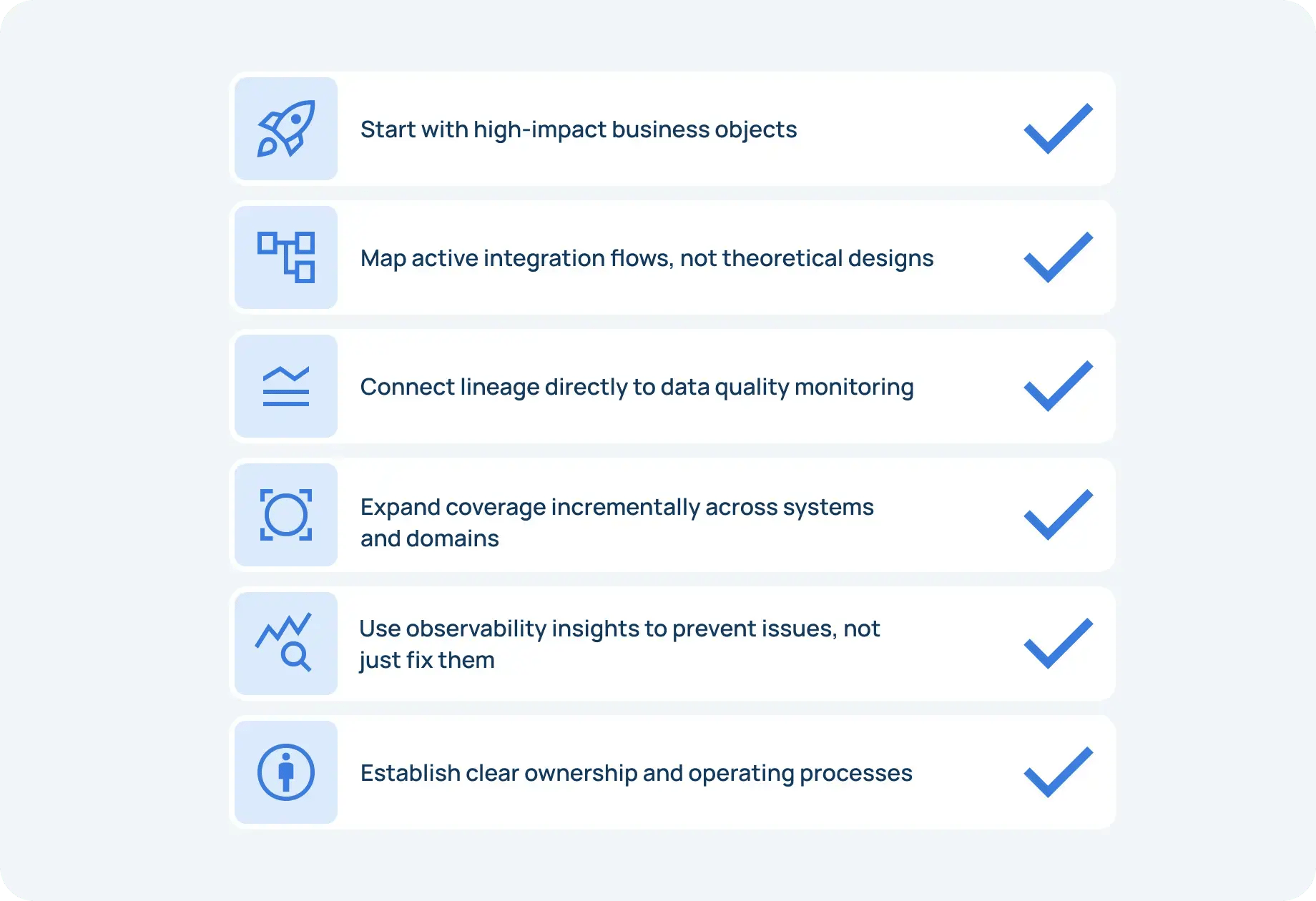
Step 1: Start with high-impact business objects
Rather than attempting to map the entire data landscape upfront, focus first on a small set of business objects that are critical to operations or compliance. These typically include customers, materials, suppliers, financial postings, or other data that flows across multiple systems.
When selecting initial objects, consider:
- Which data is most frequently involved in incidents or rework
- Which objects are central to ongoing SAP initiatives (e.g., S/4HANA migration)
- Which data is shared across the highest number of downstream systems
Starting with high-impact objects ensures that lineage and observability efforts quickly demonstrate tangible value and gain stakeholder support.
Step 2: Map active integration flows, not theoretical designs
Once key business objects are identified, focus on the integrations that actively move this data across systems. Prioritize what is actually running in production, rather than what is described in architecture diagrams or design documents.
Effective mapping at this stage includes:
- Capturing source-to-target relationships
- Documenting transformations applied in each integration step
- Identifying conditional logic that affects data movement
- Distinguishing between batch, near-real-time, and event-driven flows
By concentrating on active integrations, teams avoid investing effort in obsolete or unused processes and ensure that lineage reflects real operational behavior.
Step 3: Connect lineage directly to data quality monitoring
Lineage delivers the most value when it is tightly linked to data quality automation. Rather than treating lineage as a separate initiative, integrate it directly with quality checks and alerts.
Practical actions include:
- Associating quality rules with specific fields and transformations
- Ensuring quality alerts surface upstream and downstream dependencies
- Using lineage to automatically identify impacted systems when issues occur
This integration allows teams to move seamlessly from detection to diagnosis, reducing investigation time and improving resolution consistency.
Step 4: Expand coverage incrementally across systems and domains
After proving value with initial objects and integrations, gradually expand lineage and observability coverage. This phased approach helps to manage complexity while maintaining accuracy.
Expansion can be guided by:
- Additional business domains with similar data patterns
- New integrations introduced as part of modernization efforts
- Systems with high change frequency or operational risk
Incremental expansion also allows teams to refine governance practices, ownership models, and monitoring thresholds as coverage grows.
Step 5: Use observability insights to prevent issues, not just fix them
The ultimate goal of lineage and observability is not faster troubleshooting; it’s prevention. Once sufficient visibility is in place, organizations can proactively begin using insights.
Preventive practices include:
- Performing impact analysis before SAP transports or integration changes
- Monitoring trends in freshness, volume, and distribution to detect early warning signs
- Identifying fragile integrations that require redesign or optimization
Over time, this shifts data management from a reactive support function to a proactive operational discipline.
Step 6: Establish clear ownership and operating processes
As lineage and observability mature, it is essential to define how insights are used and who is responsible for acting on them. Without clear ownership, visibility alone will not drive improvement.
Key considerations include:
- Assigning ownership for critical data flows and objects
- Defining escalation paths for different types of data issues
- Embedding lineage insights into change management and release processes
This step ensures that lineage and observability become part of everyday operations rather than an isolated technical capability.
From initial visibility to sustainable practice
By following this adoption path, organizations can introduce data lineage and observability in a controlled, value-driven way. Each step builds on the previous one, gradually increasing coverage, confidence, and operational maturity.
In SAP-centric environments where data complexity is unavoidable, this approach allows teams to gain control without disrupting ongoing transformation initiatives and to establish a foundation for trusted, well-governed enterprise data.
Conclusion
As enterprise data landscapes continue to grow in complexity, especially in SAP-centric environments, traditional approaches to data management are reaching their limits. Data quality checks remain essential. But on their own they no longer provide the level of transparency, control, and confidence that modern organizations require.
Data lineage and observability address this gap by making data behavior visible, explainable, and actionable. Lineage answers critical questions about origin, transformation, and impact; observability ensures that data continues to behave as expected over time. Together, they shift data management from a reactive exercise — fixing issues after they disrupt the business — to a proactive discipline that focuses on prevention, accountability, and informed change.
From a business perspective, the value is tangible:
- Lower risk during SAP migrations and system changes
- Faster resolution of data issues and reduced operational downtime
- Greater trust in enterprise data used for automation and AI
- Improved auditability and regulatory confidence
- Clear ownership across teams and systems
Most importantly, lineage and observability help organizations move faster without sacrificing control. Changes can be assessed before deployment, issues can be detected early, and data-driven initiatives can scale on a foundation of transparency rather than assumptions.
Adopting these capabilities does not require a disruptive overhaul. As outlined in this article, a focused, incremental approach — starting with high-impact data and active integrations — allows organizations to realize value quickly while building toward long-term maturity.
Effectively implementing data lineage and observability requires more than tooling; it requires experience with real-world SAP landscapes, integration complexity, and enterprise-scale data operations.
The DataLark team works closely with SAP-focused organizations to help design and implement practical, automation-first approaches to data integration, quality, and lineage. If you are exploring how to bring greater visibility and control to your SAP data flows, get in touch with the DataLark experts to discuss your data integration and governance challenges.