


SAP Joule highlights why AI depends on integrated, high-quality data. Learn what AI-ready data foundations look like and how SAP teams can prepare.
Why SAP Joule Is a Wake-Up Call for Data Foundations
Enterprise AI has officially moved out of experimentation mode. With the introduction of SAP Joule, SAP has made it clear that artificial intelligence is no longer a side capability or an innovation lab experiment — it is becoming a built-in layer of everyday business processes. Joule promises to help users interact with SAP systems through natural language, automate tasks, surface relevant information, and guide decision-making across finance, supply chain, HR, procurement, and more.
For many organizations, this is an exciting development. AI copilots feel intuitive, accessible, and powerful. They lower the barrier between people and complex systems, offering a glimpse into a future where enterprise software finally adapts to how humans work, not the other way around.
But beneath this excitement lies a less glamorous truth: AI copilots do not create value on their own. They do not fix broken processes, reconcile inconsistent records, or magically unify fragmented data landscapes. Instead, they rely entirely on the quality, structure, and accessibility of the data they are connected to.
In that sense, SAP Joule is more than just a new AI feature. It is a wake-up call. It exposes the state of an organization’s data foundations, sometimes uncomfortably so. Companies with clean, integrated, well-governed data will see immediate benefits. Those with fragmented systems, inconsistent master data, and manual data preparation will quickly discover that AI amplifies existing problems rather than solving them.
This article explores why SAP Joule makes data foundations impossible to ignore, what challenges most SAP organizations face today, and why automated data integration and data quality are becoming prerequisites for enterprise AI success.
What SAP Joule Is — and What It Is Not
SAP Joule is best described as an AI copilot embedded across the SAP ecosystem. Rather than being a standalone chatbot or analytics interface, Joule is designed to operate within business applications, understanding both user intent and business context.
At a high level, Joule allows users to:
- Ask questions in natural language
- Trigger or guide business actions
- Navigate complex processes more intuitively
- Receive context-aware responses grounded in enterprise data
This is a significant shift from traditional SAP user experiences, which often rely on predefined reports, rigid transactions, and specialized knowledge of system structures.
However, it is equally important to understand what Joule is not.
Joule is not an independent intelligence layer that reasons abstractly about a business. It does not generate answers based on generic knowledge or public information. Its responses are grounded in the data, documents, and process context that SAP systems and connected systems provide.
In other words, Joule’s intelligence is only as good as the data it can access.
This distinction matters because it reframes AI from being a “smart tool” to being a mirror. Joule reflects back the current state of an organization’s data landscape, governance practices, and integration maturity. Where data is consistent and well-connected, AI feels powerful. Where data is fragmented or unreliable, AI feels confusing, inconsistent, or even misleading.
The Illusion of AI as a Shortcut
One of the most persistent misconceptions around enterprise AI is the idea that it can compensate for weak data foundations. The narrative often sounds like this:
“We know our data isn’t perfect, but AI will help us make sense of it.”
In reality, the opposite is usually true.
AI systems, especially those embedded in operational workflows, do not clean data by default. They do not resolve duplicates, harmonize definitions, or correct inconsistencies unless explicitly designed and governed to do so. Instead, they consume whatever data is available and generate outputs that appear coherent, even when the underlying information is flawed.
This is where tools like SAP Joule raise the stakes. Because Joule operates inside transactional and decision-making processes, its outputs are more likely to be trusted and acted upon. That trust magnifies the impact of poor data.
A recommendation based on inconsistent master data is not just an inconvenience — it can lead to incorrect decisions, process breakdowns, and loss of confidence in AI as a whole.
Rather than being a shortcut around data challenges, AI copilots make those challenges visible and urgent.
Why Data Quality and Integration Are the Real Linchpins
As already mentioned, AI copilots like SAP Joule feel intelligent and conversational, but their effectiveness is determined entirely by the data that already exists. This creates three fundamental reasons why data integration and data quality are imperative for AI success.
Reason #1: AI needs a complete business context
Enterprise questions are rarely limited to a single system. When users ask why something happened, what is at risk, or what should be done next, the answer typically depends on data that is spread across multiple applications.
In SAP landscapes, data is almost always fragmented:
- Core processes run in SAP systems.
- Related operational or customer data lives in non-SAP platforms.
- Supporting documents and reference information sit outside transactional systems.
If these sources are not properly integrated, AI copilots operate with an incomplete view of reality. They may generate answers that are correct within one system, yet wrong or misleading when viewed in the full business context.
AI does not recognize missing information as a problem. It simply works with what it can see. This makes data integration essential: without it, AI decisions are based on partial context from the very start.
Reason #2: AI can only be as reliable as the data it uses
Generative AI is designed to produce fluent and confident responses. In enterprise environments, that strength becomes a weakness when underlying data is inconsistent, outdated, or duplicated.
SAP systems rely heavily on master data, such as customers, suppliers, materials, and organizational structures. When this data differs across systems or business units, AI copilots do not inherently know which version is correct.
Instead, they produce answers based on whatever data appears most relevant at the moment. The result is plausible, albeit incorrect outputs — responses that sound correct, but are built on flawed assumptions.
This is why data quality matters so deeply for AI. Poor-quality data does not stop AI from answering; it simply causes AI to answer incorrectly, while appearing confident. Over time, this quietly erodes trust in both the AI and the underlying systems.
Reason #3: AI makes data problems much more visible and impactful
Before AI, many data issues were manageable. Users learned which reports to trust, which systems to double-check, and where manual corrections were needed.
AI changes this dynamic because it surfaces data directly and immediately. There is no intermediary layer of interpretation. AI responses are delivered with authority, often in the context of decision-making or action.
As a result, data issues that were previously tolerable become disruptive. Inconsistent or incomplete data leads to faster confusion, contradictory answers, and higher operational risk.
AI does not correct data problems or smooth them out. It accelerates their impact. The better the data foundation, the more useful the AI becomes; the weaker the foundation, the more quickly problems surface.
The core point
These three reasons explain why data quality and data integration are not optional in an AI-driven SAP environment. AI copilots like SAP Joule depend on complete context, reliable data, and consistency at scale. When those conditions are not met, AI does not fail quietly — it exposes the weaknesses immediately and turns them into business problems.
Common Data Challenges in SAP Environments
Most organizations using SAP do not struggle with a lack of data. They struggle with fragmented, inconsistent, and operationally misaligned data. Several data challenges appear repeatedly across SAP landscapes, regardless of industry or company size.
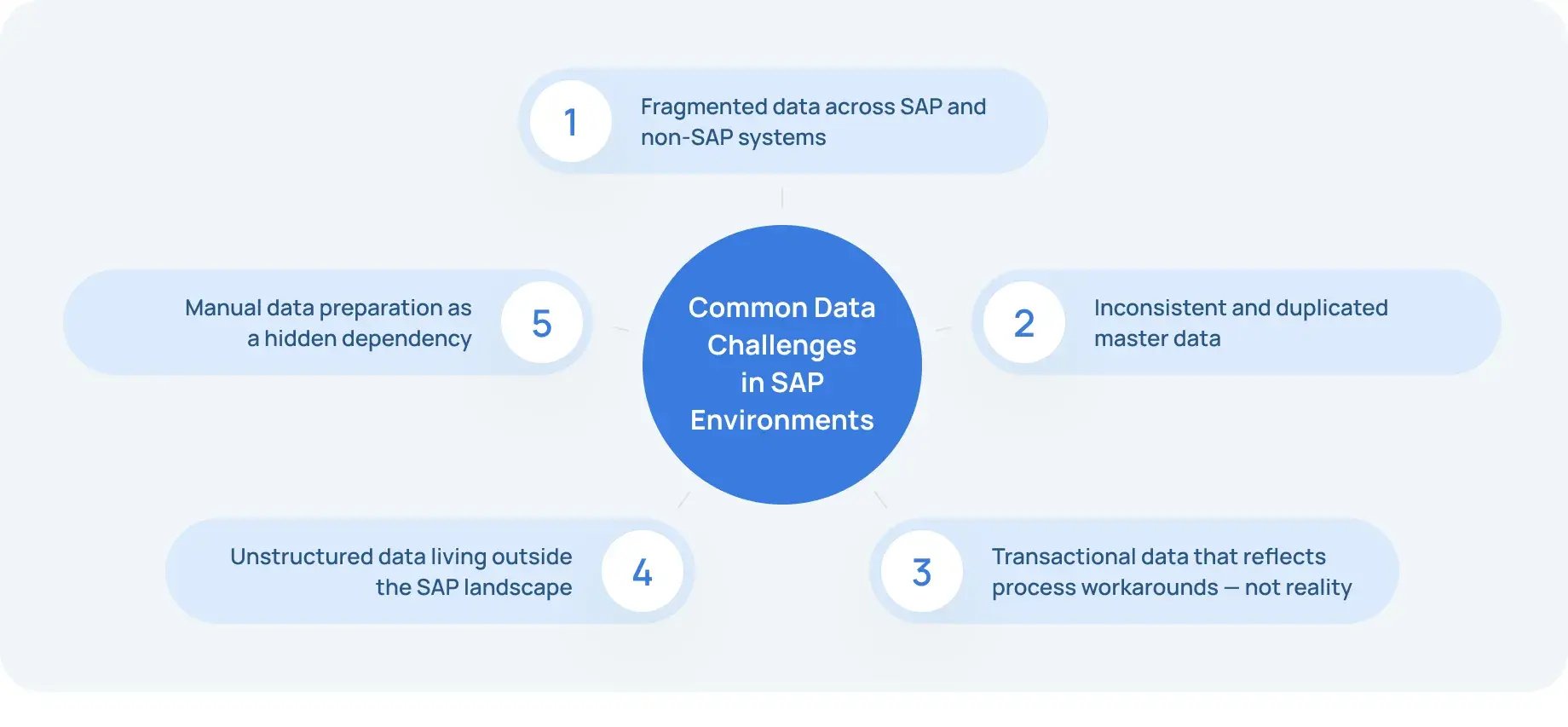
Fragmented data across SAP and non-SAP systems
SAP rarely operates alone. Even in heavily standardized environments, SAP systems coexist with CRM platforms, logistics providers, manufacturing execution systems, financial tools, and industry-specific applications.
A common real-world scenario looks like this:
- Sales orders are created in SAP.
- Customer interactions and contract details live in a CRM system.
- Shipment status comes from an external logistics provider.
- Customer complaints are tracked in a separate service platform.
Each system is internally consistent, but the business process spans all of them. When these systems are not properly integrated, no single application reflects the full reality of the process.
For human users, this often means switching between systems and reconciling information manually. For AI copilots, it means operating with partial context. An AI response may be accurate based on SAP data alone, yet incorrect when external events or customer interactions are taken into account.
This fragmentation is one of the most common reasons AI outputs feel “almost right”, but not quite trustworthy.
Inconsistent and duplicated master data
Master data is the backbone of SAP processes and one of the most persistent sources of problems.
In real projects, master data inconsistencies often emerge from:
- Multiple SAP systems or instances.
- Regional or business unit autonomy.
- Mergers, acquisitions, or divestitures.
- Legacy systems that were never fully retired.
A typical example involves customer data. The same customer may exist under different names, identifiers, or classifications across systems. In one system, the customer is marked as active; in another, inactive. Credit limits, payment terms, or organizational assignments may differ.
Experienced SAP users often know which system or report to trust. AI copilots do not. When asked about customer status, risk, or performance, they rely on whichever data appears most relevant — even if it contradicts another system.
The result is not a system error; it’s an answer that seems reasonable while being fundamentally unreliable.
Transactional data that reflects process workarounds — not reality
Transactional data in SAP systems is often assumed to be clean because it is system-generated. In practice, it frequently reflects process compromises and workarounds.
Common real-world examples include:
- Manual postings to close periods on schedule.
- Temporary corrections entered to bypass system constraints.
- Transactions completed out of sequence to meet operational deadlines.
Over time, these practices accumulate. The data technically balances, but it no longer tells a clear or consistent story about what actually happened.
When AI copilots analyze transactional history to explain delays, forecast outcomes, or recommend actions, they inherit these distortions. What looks like an anomaly to a human expert may appear as a valid pattern to AI.
Transactional data quality is especially critical, when AI is expected to support operational decision-making.
Unstructured data living outside the SAP landscape
Some of the most important business information never enters SAP in structured form. Contracts, technical specifications, policy documents, pricing agreements, and compliance records often live in document repositories, shared drives, or collaboration tools.
In real organizations:
- Contract terms may explain why a customer receives special treatment.
- Technical specifications may clarify production constraints.
- Regulatory documents may define what actions are permissible.
When this information is disconnected from transactional systems, AI copilots lack crucial context. They may correctly interpret what happened in SAP, but fail to understand why it happened or what constraints apply.
This gap becomes particularly visible when users expect AI to provide explanations rather than just retrieve data.
Manual data preparation as a hidden dependency
Despite years of automation, many SAP environments still rely on manual data preparation:
- Spreadsheets to reconcile discrepancies
- Periodic uploads to align systems
- Manual checks to validate critical records
These steps are often undocumented and handled by a small number of experts. AI copilots cannot replicate this hidden knowledge. They consume the data as it exists in systems, not as it is mentally corrected by experienced users.
When AI surfaces inconsistencies that humans have learned to work around, it reveals how fragile the underlying data processes actually are.
AI-Ready Data Foundations: What They Really Look Like
When organizations talk about being “AI-ready,” the discussion often centers on models, platforms, or governance frameworks. In practice, AI readiness is far more concrete. It is determined by the condition of the data that AI systems consume every day. For AI copilots like SAP Joule, strong data foundations are not abstract ideals; they are specific, observable characteristics of how enterprise data is structured, managed, and maintained.
AI-ready data foundations share several defining traits:
- Integrated data across SAP and non-SAP systems: AI requires a complete view of business processes, not isolated system snapshots. In AI-ready environments, data flows consistently across SAP and non-SAP systems, allowing information from sales, logistics, finance, operations, and external partners to align. Integration is therefore the foundation of contextual accuracy.
- Consistent and governed master data: Master data defines how the enterprise understands customers, suppliers, products, employees, and organizational structures. In AI-ready organizations, this data is consistent across systems, governed by clear rules, and maintained as a shared asset rather than a local convenience. Consistency here is critical. AI copilots rely on master data to interpret relationships and apply logic. When definitions vary or records are duplicated, AI cannot reliably distinguish between correct and incorrect information, which leads to confident but flawed outputs.
- Reliable transactional data that reflects reality: Transactional data tells the story of how the business operates. For AI to be useful, this story must be accurate and complete. AI-ready environments minimize manual workarounds, late postings, and corrective entries that distort the sequence of events. When transactional data reflects operational reality, AI can explain outcomes, identify risks, and support decisions. When it does not, AI inherits the noise and amplifies it.
- Accessible structured and unstructured information: Business decisions are rarely driven by structured data alone. Contracts, policies, specifications, and other documents often explain why processes behave the way they do. In AI-ready foundations, this information is accessible and connected to operational data. This does not mean turning every document into a dataset, but ensuring that AI systems can reference relevant unstructured information when interpreting business situations. Without this, AI responses lack nuance and context.
- Automated data preparation and validation: AI-ready data is prepared continuously, not periodically. Integration, validation, and synchronization are automated processes rather than manual tasks performed by experts behind the scenes. Automation reduces errors, enforces consistency, and ensures that data quality does not depend on individual knowledge. For AI, this means dependable inputs and predictable behavior.
- Clear ownership and accountability for data: Finally, AI-ready foundations require clarity around who owns data and who is responsible for its accuracy. When data ownership is ambiguous, quality deteriorates over time. Clear accountability ensures that issues are addressed systematically rather than reactively, creating a stable environment in which AI systems can operate reliably.
AI-ready data foundations are not defined by advanced algorithms or sophisticated dashboards. They are defined by integrated systems, consistent master data, reliable transactions, accessible information, automation, and clear accountability.
When these conditions are in place, AI copilots like SAP Joule can operate with confidence and deliver meaningful value. When they are not, AI exposes the gaps quickly and visibly.
In the end, AI readiness is less about intelligence and more about discipline in how data is managed.
Where DataLark Fits in the AI Readiness Equation
As organizations grapple with AI adoption, a key realization emerges: success depends less on adding new intelligence and more on removing friction from data operations.
This is where automated data integration and data quality solutions play a critical role.
DataLark is designed to address exactly this challenge. Its role in AI readiness can be understood through the specific problems it addresses and the concrete capabilities it provides.
Automating integration across SAP and non-SAP systems
As mentioned, one of the biggest obstacles to AI readiness is fragmented data across heterogeneous systems. DataLark is designed to connect SAP and non-SAP sources into a unified data foundation, without heavy custom development.
In practice, this means:
- Ingesting data from multiple SAP systems and external platforms.
- Harmonizing formats, identifiers, and structures.
- Keeping data synchronized across systems as changes occur.
For AI copilots, this automated integration ensures access to a complete and up-to-date business context rather than isolated system snapshots.
Enforcing consistent master data across systems
AI reliability depends heavily on master data consistency. DataLark helps establish and maintain that consistency by automating master data validation and synchronization.
Typical use cases include:
- Detecting and resolving duplicate customer or supplier records.
- Ensuring that key attributes remain aligned across systems.
- Preventing conflicting updates from silently propagating.
By continuously enforcing these rules, DataLark reduces the risk of AI generating plausible – but incorrect – answers based on inconsistent master data.
Improving transactional data reliability at the source
Transactional data often reflects operational workarounds rather than clean process execution. DataLark enhances AI readiness by applying validation and reconciliation logic as data moves between systems.
Examples include:
- Identifying incomplete or out-of-sequence transactions.
- Flagging inconsistencies between operational and financial systems.
- Ensuring that transactional data is complete before it is consumed by downstream processes.
This results in transactional datasets that better reflect operational reality, which is a critical requirement for AI-driven explanations and recommendations.
Preparing data continuously, not periodically
AI readiness cannot rely on monthly clean-ups or manual reconciliation. DataLark automates data preparation as a continuous process.
This includes:
- Automated ingestion pipelines
- Ongoing quality checks and rule enforcement
- Near real-time synchronization
For AI copilots, this means the data they rely on is consistently prepared and does not depend on hidden manual steps or individual expertise.
Reducing dependency on manual data expertise
In many organizations, data quality depends on a small number of experienced users who know how to interpret or correct inconsistencies. DataLark reduces this dependency by embedding rules and validations directly into data pipelines.
As a result:
- Data quality becomes repeatable and auditable.
- AI systems consume data that reflects agreed rules, not personal judgment.
- Organizations reduce operational risk as AI usage scales.
This is especially important when AI tools are exposed to a broad user base, not just data specialists.
Creating stable data inputs for AI copilots
Taken together, these capabilities allow DataLark to act as a stabilizing layer between operational systems and AI tools.
Rather than asking AI to compensate for fragmented or unreliable data, DataLark ensures that:
- Data is integrated before AI consumes it.
- Quality issues are addressed upstream.
- Changes propagate predictably across systems.
This creates the conditions under which AI copilots like SAP Joule can operate consistently, reliably, and at scale.
Practical Steps for SAP Organizations Preparing for AI
Preparing an SAP landscape for AI copilots requires more than technical enablement. It involves putting specific practices in place that make data dependable at the moment AI starts using it.
The steps below focus on how SAP organizations can move from abstract readiness to practical preparation:
- Map where AI will source its data before enabling it: Start by listing the SAP and non-SAP systems that AI copilots will query for a given use case. Identify which tables, objects, and documents are involved, and how data flows between them today. This exercise often reveals missing integrations, unclear ownership, or outdated assumptions long before AI exposes them to end users.
- Select a small number of high-impact data objects to fix first: Rather than trying to improve all data at once, focus on a limited set of objects that AI will reference most frequently, such as customers, materials, orders, or suppliers. Review how these objects are created, updated, and synchronized across systems. Small improvements here often produce disproportionately large gains in AI reliability.
- Define a single “source of truth” for each critical data object: For every prioritized data object, explicitly decide which system is authoritative and under what conditions. Document how changes should propagate and which system wins in case of conflict. AI copilots need this clarity, even if the organization has historically relied on informal agreements or manual reconciliation.
- Replace spreadsheet-based reconciliation with automated checks: Identify where teams currently reconcile data manually (e.g., aligning customer records, validating postings, or correcting inconsistencies at period end). Replace these steps with automated validations and alerts where possible. AI should consume data that has already been checked, not data that requires human interpretation to make sense.
- Clean transactional data by improving process discipline, not just data: Review where transactions are delayed, reversed, or entered out of sequence to meet operational deadlines. Work with process owners to reduce these patterns rather than masking them with corrections. AI interprets transaction history literally, so improving process execution directly improves AI output quality.
- Make data ownership explicit and operational: Assign clear responsibility for maintaining key data objects, including who approves changes, who monitors quality, and who resolves issues. Avoid abstract ownership statements and focus on day-to-day accountability. When AI surfaces a data issue, there should be no ambiguity about who addresses it.
- Introduce continuous data validation instead of periodic clean-ups: Move away from monthly or quarterly data quality reviews. Implement validation checks that run continuously or at defined integration points. This ensures that issues are detected close to their source, rather than after AI has already used the data.
- Pilot AI with real users and capture where data breaks down: Start AI usage in controlled scenarios and observe how users interact with the outputs. Pay attention to where AI responses cause confusion, require explanation, or trigger manual corrections. These moments highlight exactly where data foundations need reinforcement before broader rollout.
These steps turn AI preparation into a series of manageable actions rather than a large transformation program. They help SAP organizations surface and address data issues incrementally, in direct response to how AI actually uses the data.
Instead of preparing data in theory, teams improve it where it matters most — at the point where AI meets real business decisions.
Conclusion
SAP Joule signals a clear shift in how enterprise software is evolving. AI is moving closer to daily work, closer to operational decisions, and closer to execution. As this happens, the condition of enterprise data stops being a background concern and becomes immediately visible.
What determines whether AI copilots deliver value is not the sophistication of the AI itself, but the dependability of the data it consumes. When data is fragmented, inconsistent, or reliant on manual interpretation, AI exposes those weaknesses quickly. When data is integrated, validated, and continuously prepared, AI becomes a practical and trustworthy part of everyday work.
The examples and steps outlined in this article point to a simple reality: AI readiness is built through disciplined data operations. It requires knowing where data comes from, ensuring that critical objects are consistent across systems, reducing manual reconciliation, and maintaining data quality as an ongoing process rather than a periodic effort.
This is where tools like DataLark play a foundational role. By automating data integration, synchronization, and quality enforcement across SAP and non-SAP systems, DataLark helps organizations create the stable data foundation AI depends on. Not to make AI smarter, but to make it usable and reliable at scale.
SAP Joule is not a shortcut around data challenges. It is a clear indicator that those challenges can no longer be postponed. Organizations that invest now in making their data dependable will be in a position to realize real value from AI as it becomes further embedded into enterprise operations.