


Learn how utilities can manage data fragmentation with automated integration and data quality across SAP IS-U, S/4HANA Utilities, MDM, and EAM.
How Utilities & Energy Companies Can Fix Data Fragmentation and Data Quality at Scale
Utilities and energy companies have always been data-driven organizations — long before “data-driven” became a buzzword. Meter readings, asset records, consumption profiles, maintenance logs, billing data, and regulatory reports have formed the backbone of daily operations for decades.
What has changed is the scale, speed, and fragmentation of that data.
Smart meters generate continuous streams of readings. Grid infrastructure is increasingly sensor-based. Asset fleets are distributed across regions and managed by a mix of internal teams and external contractors. Customer interactions span digital portals, call centers, and third-party service providers. At the same time, utilities must operate under strict regulatory oversight, where data accuracy and traceability are non-negotiable.
In this environment, the biggest challenge is no longer collecting data; it is connecting it, validating it, and trusting it.
Many utility companies now find themselves managing dozens (sometimes hundreds) of interconnected systems, such as:
- ERP platforms, such as SAP IS-U or SAP S/4HANA Utilities
- Meter Data Management (MDM) systems
- Asset and Enterprise Asset Management (EAM) solutions
- Geographic Information Systems (GIS)
- Billing, CRM, and customer portals
- Partner and contractor systems
- Legacy platforms that were never designed to integrate at scale
Each system may work well in isolation, but problems arise between them when data is transferred, transformed, duplicated, or manually adjusted. This is where data fragmentation and data quality issues quietly accumulate, often remaining invisible until they cause real operational or financial damage.
The Hidden Cost of Fragmented Data in Utilities
In utility and energy landscapes, data fragmentation is not an isolated data management issue. It is a structural characteristic of environments built around multiple operational systems with overlapping data ownership and asynchronous update cycles. Over time, this fragmentation introduces systemic inefficiencies, increases operational risk, and forces manual controls into otherwise automated processes.
Because core utility processes (e.g., billing, asset management, regulatory reporting, and service operations) depend directly on cross-system data consistency, fragmentation affects day-to-day execution as well as downstream analytics.
Inconsistent master data across systems
Utility master data is typically distributed across SAP IS-U or SAP S/4HANA Utilities, Meter Data Management platforms, EAM systems, CRM solutions, and GIS. These systems maintain parallel representations of customers, service points, meters, assets, and network elements, often with different primary keys, lifecycle states, and validation rules.
Master data divergence is usually caused by:
- Decentralized data ownership
- Event-driven updates without guaranteed synchronization
- One-directional or batch-based integrations
- Manual corrections applied locally in source systems
Typical issues include:
- Service location or premise data updated in CRM but not propagated to SAP IS-U
- Meter exchanges recorded in MDM while legacy meter installations remain active in ERP
- Asset lifecycle changes reflected in EAM but misaligned with accounting or capitalization status in SAP
At a system level, each platform may remain internally consistent. At a landscape level, however, no single system reliably represents the current operational state. This misalignment propagates into billing, maintenance, settlement, and reporting processes.
Manual reconciliation as a compensating control
As cross-system inconsistencies accumulate, manual reconciliation becomes a compensating control embedded in operational workflows.
Common patterns include:
- Pre-billing validation of meter-to-installation assignments outside SAP
- Cross-system asset status checks using extracts from EAM and ERP
- Additional validation layers introduced by finance or compliance teams prior to reporting
These controls are typically:
- Process-driven rather than system-driven
- Dependent on individual expertise
- Implemented using spreadsheets or ad hoc scripts
- Difficult to audit or standardize
While manual reconciliation may reduce immediate downstream errors, it increases operational complexity and obscures root causes. From an architectural perspective, it represents a shift from automated control mechanisms to human-based exception handling.
Amplification of minor data defects at scale
Utility data defects often originate as low-level inconsistencies (e.g., incorrect identifiers, missing attributes, delayed updates). Due to the scale and repeatability of utility processes, these defects amplify rapidly.
Examples include:
- Incorrect meter-installation relationships affecting recurring billing cycles
- Delayed meter updates triggering estimated billing and subsequent corrections
- Inconsistent contract or tariff attributes impacting pricing logic across large customer populations
Each defect introduces downstream correction costs across billing, customer service, and financial reconciliation. These costs are typically absorbed into operational overhead and are therefore underestimated in system-level assessments.
Compliance and audit exposure
Regulatory reporting in utilities depends on consistent master data definitions, controlled transformation logic, and traceable data lineage. Fragmented landscapes undermine these requirements.
Key risk factors include:
- Divergent master data states across source systems
- Manual data adjustments without standardized logging
- Inability to reconstruct transformation and validation logic end-to-end
Even when reported values are correct, insufficient traceability and process transparency increase audit exposure. From a compliance standpoint, data quality issues are often less problematic than undocumented remediation processes.
Degraded decision-making and reduced system agility
Fragmented data landscapes also constrain operational and architectural decision-making. When data consistency cannot be assumed, organizations introduce additional verification layers before executing changes or initiatives.
Typical impacts include:
- Delayed asset investment decisions due to unreliable lifecycle data
- Conservative maintenance planning driven by uncertainty rather than system state
- Extended timelines for SAP migrations or landscape transformations due to prolonged data validation phases
In effect, fragmentation reduces system agility by increasing the cost and risk of change.
Why Traditional Data Management Approaches No Longer Work
Once data fragmentation is accepted as a structural reality of modern utility landscapes, the question becomes whether existing data management approaches are capable of operating effectively under these conditions. In most cases, they are not. Approaches that were originally designed to support stable, tightly controlled environments struggle to cope with distributed ownership, continuous data flows, and frequent system change.
Structural limitations of traditional data management approaches in energy and utilities enterprises include:
- Point-to-point integration architectures do not tolerate change well: Traditional utility landscapes rely heavily on direct integrations between systems, such as SAP IS-U, MDM, EAM, CRM, and partner platforms. These interfaces typically encode assumptions about source structures, target validations, and processing sequences. While manageable on a small scale, this model becomes fragile as landscapes evolve. Adding new systems, extending data models, or modifying existing processes requires synchronized changes across multiple interfaces, which increases coordination overhead and regression risk.
- Validation and transformation logic is tightly coupled to specific systems and flows: In many environments, data validation rules are implemented within SAP custom code, middleware mappings, or interface-specific scripts. This creates strong coupling between data quality logic and individual integrations. As a result, rules are duplicated, inconsistently applied, and difficult to evolve. Introducing a new validation requirement often means updating multiple code paths rather than adjusting a single, reusable rule set.
- Batch-oriented processing limits responsiveness and control: Batch processing remains common in utility data flows, particularly for master data synchronization and billing-related processes. While batch execution may align with certain ERP constraints, it limits the ability to detect and respond to data issues early. Errors propagate until batch completion, at which point correction affects multiple downstream processes. This reduces control over data quality enforcement and complicates exception handling.
- Manual data remediation is used as an architectural workaround: Instead of being treated as a failure condition, data inconsistencies are often addressed through manual remediation steps embedded in operational processes. These steps compensate for architectural gaps rather than resolve them. From a systems perspective, this shifts responsibility for data integrity from automated controls to human intervention, which increases variability and reduces scalability.
- Existing approaches do not support SAP S/4HANA-driven architectural change: SAP S/4HANA transformations require decoupled integrations, consistent data models, and clear data ownership. Traditional approaches — particularly those relying on legacy SAP ECC structures and custom interfaces — are poorly suited to this transition. Without a more centralized and configurable approach to integration and data quality, transformation initiatives accumulate additional complexity rather than reduce it.
- Limited observability restricts proactive data governance: Traditional data management approaches lack centralized visibility into data flows, rule execution, and data quality status across systems. Monitoring is fragmented, lineage is implicit rather than explicit, and impact analysis is largely manual. This prevents proactive management of data health and limits the ability to systematically improve data processes over time.
Traditional data management approaches were effective in environments where system landscapes changed slowly and integration complexity was limited. In modern utility architectures, these same approaches introduce rigidity, increase operational risk, and constrain transformation initiatives. Addressing this mismatch requires architectural patterns that decouple systems, centralize validation logic, and provide continuous visibility into data flows without reintroducing manual controls as a primary means of governance.
Core Data Challenges Specific to Utilities & Energy
Utility and energy companies face data challenges that go beyond general enterprise complexity. These challenges are rooted in the industry’s operational model: asset-intensive operations, regulated processes, long system lifecycles, and a mix of real-time and transactional data. Even well-architected landscapes must address these constraints explicitly.
Key data challenges in utility and energy landscapes include:
- Overlapping system responsibility for core business objects: Utilities typically manage customers, service points, meters, installations, and assets across multiple systems, each optimized for a specific function. SAP IS-U or S/4HANA Utilities may be the contractual and billing authority, MDM systems handle meter readings and events, EAM systems manage physical assets, and GIS defines network topology. These systems legitimately own different aspects of the same objects, but without explicit orchestration, overlapping responsibility leads to ambiguity around ownership, update sequencing, and conflict resolution.
- Mixed data lifecycles and update frequencies: Utility landscapes combine slow-changing master data (customers, contracts, assets) with high-frequency operational data (meter readings, grid events, status updates). Traditional ERP-centric data models were not designed for continuous data ingestion at scale. As a result, utilities must manage different latency and validation requirements within the same end-to-end processes, which complicates integration and quality enforcement.
- Event-driven processes spanning transactional and operational systems: Many core utility processes are triggered by events rather than scheduled transactions, such as meter exchanges, outages, asset failures, or customer move-in/move-out events. These events often originate outside SAP but have downstream impact on billing, asset accounting, and reporting. Ensuring that event data is complete, correctly ordered, and consistently interpreted across systems is a recurring challenge.
- Heterogeneous data models across SAP and non-SAP platforms: Even within SAP-centric landscapes, utilities operate across different modules and solutions with distinct data models. When combined with non-SAP systems (e.g., MDM, GIS, partner platforms), semantic alignment becomes a major challenge. Identical concepts (e.g., installation, service point, asset) may be represented differently, requiring explicit mapping and validation to prevent semantic drift.
- Regulatory requirements embedded in operational data flows: Unlike many industries where compliance is largely a reporting concern, utilities embed regulatory requirements directly into operational processes. Data used for billing, asset management, and service delivery often feeds regulatory submissions with minimal transformation. This increases the need for accuracy, traceability, and controlled data changes at the operational level rather than only at reporting stages.
- Long system lifecycles and coexistence of legacy platforms: Utility systems are rarely replaced wholesale. Legacy platforms often coexist with modern solutions for extended periods. During this time, data must flow reliably between systems built on different architectural paradigms. Managing integration and data quality across such hybrid landscapes requires approaches that tolerate heterogeneity rather than assume uniform modernization.
The core data challenges in utilities and energy are the result of industry-specific requirements that push traditional data management approaches beyond their limits. Overlapping ownership, mixed data lifecycles, event-driven processes, and regulatory constraints demand architectures that can enforce consistency, validation, and traceability across heterogeneous systems. Addressing these challenges requires treating data integration and data quality as operational capabilities, not auxiliary functions.
The Role of Automated Data Integration in Utility Operations
Given the structural fragmentation of utility landscapes, the limitations of traditional integration patterns, and the industry-specific constraints utilities operate under, automated data integration becomes a foundational architectural capability rather than an optional optimization.
Its role is not to eliminate system diversity or centralize ownership of all data, but to coordinate data movement, transformation, and consistency across systems with overlapping responsibility, while remaining resilient to change.
Automated integration as an architectural control layer
In modern utility landscapes, automated data integration functions as a control layer that sits between operational systems rather than inside them. This layer decouples systems by externalizing data movement and transformation logic that would otherwise be embedded in point-to-point interfaces or application-specific code.
For SAP-centric environments, this means:
- SAP IS-U or S/4HANA Utilities remains the system of record for contractual, billing, and financial data.
- Operational systems, such as MDM, EAM, GIS, and partner platforms, continue to manage their domain-specific data.
- Integration logic is centralized, configurable, and versioned outside individual systems.
This separation reduces tight coupling and allows individual systems to evolve without cascading interface changes across the landscape.
Supporting event-driven and continuous data flows
Automated integration is particularly critical in utilities because many core processes are event-driven rather than transactional. Meter installations, exchanges, outages, and asset status changes often originate outside SAP but must be reflected consistently across multiple downstream systems.
An automated integration layer:
- Absorbs events from operational systems as they occur
- Applies transformation and enrichment logic consistently
- Ensures correct sequencing and propagation to dependent systems
By handling events as first-class data flows, automated integration reduces reliance on batch synchronization and improves timeliness and consistency across processes such as billing, asset management, and settlement.
Enabling consistent transformation across heterogeneous data models
Utilities operate across heterogeneous data models, even within SAP landscapes: semantic differences increase further when non-SAP systems are involved. Automated integration provides a centralized place to:
- Map equivalent concepts across systems
- Normalize identifiers and reference data
- Apply consistent transformation logic
This approach reduces semantic drift over time and ensures that data exchanged between systems reflects shared business meaning rather than interface-specific assumptions.
Reducing integration complexity during SAP S/4HANA transformations
SAP S/4HANA initiatives highlight the importance of decoupled integration. Automated data integration allows utilities to:
- Isolate legacy dependencies
- Gradually transition data flows to new structures
- Maintain parallel operations during transformation phases
Instead of reimplementing validation and transformation logic inside SAP custom code, these rules can be maintained centrally and adapted as the target architecture evolves. This reduces rework and lowers post-migration stabilization effort.
Improving visibility and operational control
Centralizing integration logic also improves visibility into data movement across the landscape.
Automated integration platforms provide:
- End-to-end monitoring of data flows
- Error detection and handling at integration boundaries
- Impact analysis when upstream or downstream systems change
This level of visibility enables proactive management of data flows instead of reactive troubleshooting triggered by downstream failures.
Integration as an enabler, not a replacement
Crucially, automated data integration does not replace SAP or domain-specific operational systems. Instead, it enables them to reliably operate together under conditions of scale, change, and regulatory pressure.
For utility operations, this means:
- Core processes remain system-driven rather than manually reconciled.
- Data consistency is enforced through architecture rather than process.
- System evolution becomes manageable without continuous integration rework.
In utility and energy landscapes, automated data integration is not about technical efficiency alone. It is an architectural response to overlapping data ownership, event-driven operations, and long system lifecycles. By externalizing and centralizing data movement and transformation logic, utilities gain the flexibility and control required to operate reliably while continuing to evolve their system landscapes.
Why Data Quality Automation Is Essential
Automated data integration enables data to move across utility landscapes, but it does not, by itself, guarantee that the data is correct, complete, or consistent. In environments with overlapping system ownership, event-driven processes, and continuous change, data quality must be enforced as a system-level control layer. Data quality automation provides this control by applying consistent validation logic at integration boundaries and critical process entry points.
Here are the main reasons why data quality automation is required in utilities and energy landscapes:
- Data quality must be enforced continuously, not periodically: Utility data is continuously created and modified through operational events, such as meter exchanges, asset status changes, and customer service actions. Periodic data cleansing or manual validation cannot keep pace with this rate of change. Automated data quality applies validation rules in real time, or near real time, as data flows through the landscape, preventing degradation over time.
- Validation logic must be decoupled from individual systems: In traditional landscapes, data validation is often embedded in SAP custom code, middleware mappings, or interface-specific scripts. This tightly couples business rules to technical implementations. Data quality automation externalizes validation logic, allowing the same rules to be reused across SAP and non-SAP systems, as well as adapted without modifying application code.
- Utility-specific business rules require consistent enforcement across systems: Utilities rely on complex domain rules, such as valid meter-to-installation relationships, consistent asset lifecycle states, and correct sequencing of operational events. When these rules are enforced inconsistently, downstream processes, such as billing, asset accounting, and reporting, are exposed to errors. Automated data quality ensures these rules are applied uniformly, regardless of where data originates.
- Event-driven processes require early validation to prevent error propagation: Many utility processes are triggered by events generated outside core ERP systems. Without automated validation, incorrect or incomplete events can propagate rapidly across multiple systems. Data quality automation introduces control points that validate events before they trigger downstream processes, thus reducing operational impact and rework.
- Regulatory compliance depends on traceable, repeatable validation processes: Utility compliance requirements extend beyond correct outcomes to include process transparency. Manual corrections and undocumented validation steps introduce audit risk. Automated data quality provides consistent rule execution, documented outcomes, and traceability that supports regulatory scrutiny.
- Reducing manual controls improves scalability and system resilience: Manual data checks function as compensating controls, but these do not scale with growing data volumes or system complexity. Automated data quality reduces dependency on human intervention, allowing teams to focus on exception analysis rather than routine validation, which improves overall system resilience.
- Change initiatives require adaptable validation mechanisms: SAP S/4HANA transformations, system upgrades, and new data sources continuously introduce change into utility landscapes. Automated data quality allows validation rules to be versioned, tested, and updated independently of application deployments, reducing risk during transformation initiatives.
For utility and energy companies, data quality automation is not an optional enhancement but a necessary control layer that complements automated data integration. By enforcing validation rules consistently and continuously, utilities protect critical operational processes, reduce compliance risk, and maintain system reliability as their landscapes evolve.
How DataLark Supports Utility & Energy Data Operations
In utility and energy landscapes, the challenge is not the absence of capable core systems. SAP IS-U, SAP S/4HANA Utilities, EAM, MDM, and GIS platforms are all highly specialized and mature. The challenge lies in coordinating data across these systems in a way that is scalable, resilient to change, and operationally controlled.
In this context, DataLark is used as an operational data layer that supports both automated data integration and data quality automation, without replacing or duplicating the responsibilities of existing systems.
Acting as a central integration and control layer
DataLark sits between SAP and non-SAP systems as a centralized layer responsible for orchestrating data movement and control logic. Instead of embedding transformation and validation rules into individual interfaces or application code, these rules are defined and managed centrally.
In utility environments, this approach allows:
- SAP IS-U or S/4HANA Utilities to remain the authoritative system for contracts, billing, and financial processes.
- Operational systems, such as MDM, EAM, GIS, and partner platforms, to continue owning their domain-specific data.
- Data flows between systems to be governed consistently and transparently.
This separation reduces tight coupling between systems and allows individual platforms to evolve independently.
Supporting event-driven and batch-based utility processes
Utility operations require support for both event-driven and batch-oriented data flows. DataLark accommodates this duality by handling:
- Continuous or near-real-time data streams from operational systems (e.g., meter events, asset status changes)
- Scheduled or batch-based data exchanges tied to billing cycles, settlements, or reporting
By managing these flows centrally, DataLark ensures that transformation and validation logic is applied consistently, regardless of processing mode, reducing divergence between real-time and batch processes.
Enabling reusable, utility-specific data quality rules
Rather than implementing validation logic repeatedly across SAP custom code, middleware, and downstream processes, DataLark allows utilities to define reusable data quality rules that reflect domain-specific requirements.
Examples include:
- Validating meter-to-installation and installation-to-premise relationships before data reaches billing
- Ensuring asset lifecycle states are aligned between operational and financial views
- Enforcing completeness and consistency of customer and contract master data across systems
These rules are applied systematically as data flows through the landscape, reducing reliance on manual checks and post-process correction.
Improving visibility and operational transparency
Because integration and data quality logic are centralized, DataLark provides a consolidated view of:
- Data flows between systems
- Validation outcomes and exceptions
- Data quality trends over time
For utility IT and data teams, this improves the ability to:
- Detect issues early
- Perform impact analysis when systems or data models change
- Support audits and compliance requirements with documented processes
This level of visibility is difficult to achieve when logic is distributed across point-to-point integrations and application-specific implementations.
Supporting SAP S/4HANA Utilities transformations
During SAP S/4HANA transformations, utilities often need to operate legacy and target landscapes in parallel while gradually adapting data structures and processes. DataLark supports this by:
- Decoupling integration and validation logic from SAP-specific implementations
- Allowing data rules to be adapted as target models evolve
- Reducing rework when SAP interfaces or custom code change
This makes transformation initiatives more predictable and reduces stabilization effort after go-live.
Operating alongside existing systems, not replacing them
A key aspect of DataLark’s role in utilities is that it does not attempt to replace SAP or operational platforms. Instead, it strengthens the overall architecture by:
- Providing a consistent integration and control layer
- Reducing manual reconciliation and compensating controls
- Allowing core systems to focus on their primary responsibilities
This approach aligns well with the long system lifecycles and hybrid landscapes common in utilities.
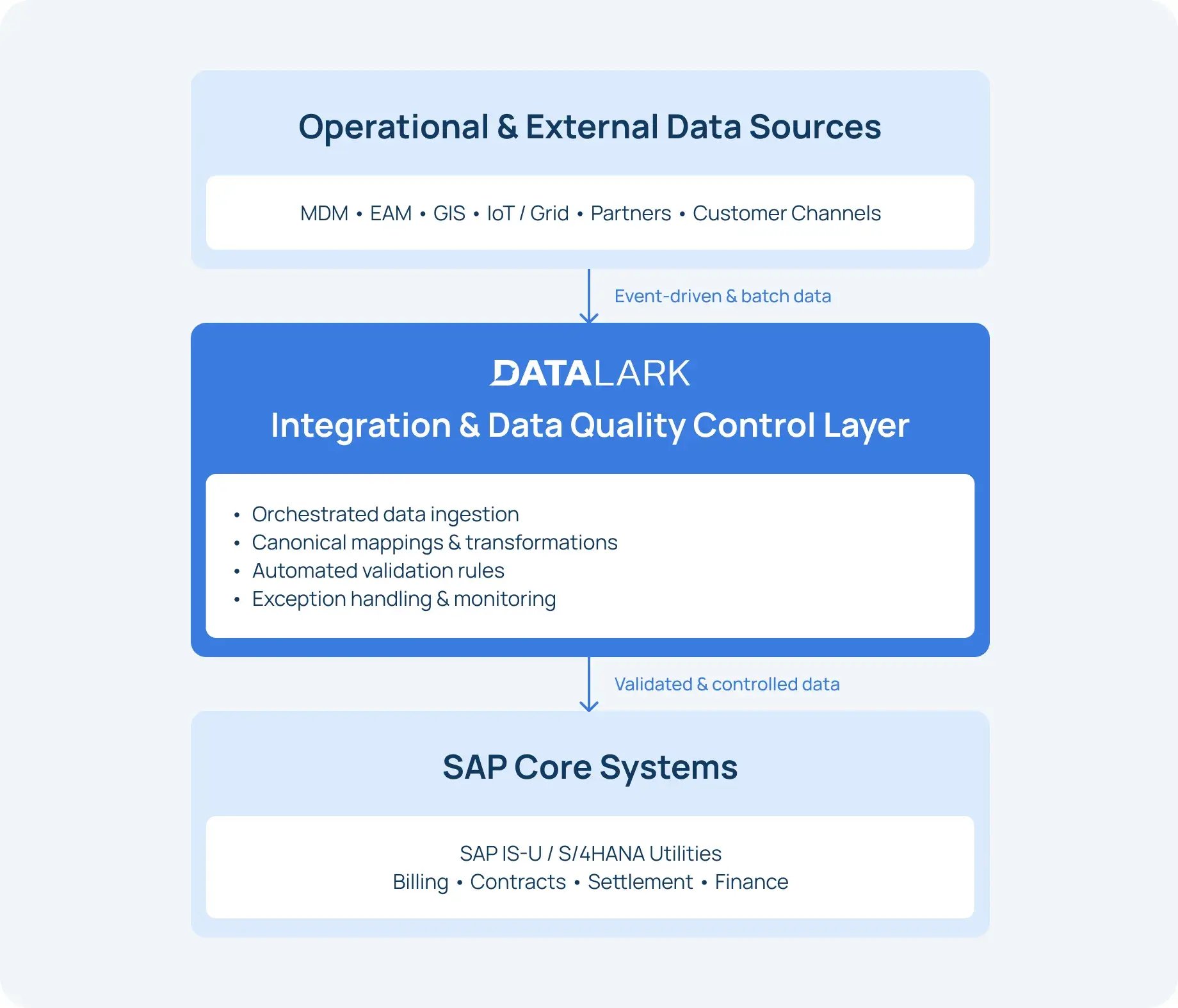
In utility and energy environments, DataLark supports data operations by providing the architectural capabilities required to manage complexity at scale. By centralizing data integration and data quality automation, SAP and non-SAP systems operate together reliably under conditions of continuous change, regulatory pressure, and increasing data volume.
Rather than introducing another system of record, DataLark functions as an enabling layer that improves consistency, control, and resilience across the existing landscape.
Real-World Use Cases in Utilities & Energy
The value of automated data integration and data quality automation becomes most visible when applied to core utility processes. These processes are highly standardized across the industry, yet complex enough that even small data inconsistencies can have wide operational impact. The following use cases illustrate how integration and quality controls operate in practice across typical utility landscapes.
Meter-to-cash: Ensuring reliable data flow from meter events to billing
The meter-to-cash process is one of the most data-intensive and operationally sensitive workflows in utilities. It spans multiple systems and combines high-frequency operational data with contractual and financial logic.
In a typical landscape:
- Meter readings and events originate in Meter Data Management systems.
- Contractual and billing logic resides in SAP IS-U or SAP S/4HANA Utilities.
- Exceptions and adjustments may involve CRM and customer service platforms.
Key challenges in this flow are not related to calculation logic, but to data consistency and sequencing:
- Meter exchanges must be reflected correctly in SAP before readings are billed.
- Meter-to-installation relationships must remain consistent across systems.
- Readings must be complete, timely, and associated with the correct billing periods.
With DataLark acting as an integration and control layer:
- Meter events and readings are integrated into SAP through standardized data flows.
- Utility-specific validation rules ensure that readings are only passed on when prerequisite master data is consistent.
- Inconsistent or incomplete data is isolated before it reaches billing runs.
This approach reduces billing exceptions, limits post-invoice corrections, and decreases dependency on manual pre-billing checks — without embedding additional logic into SAP billing processes themselves.
Asset lifecycle management: Aligning operational and financial views
Asset lifecycle processes in utilities span long time horizons and multiple system perspectives. Operational systems track physical condition and maintenance activity, while ERP systems reflect financial status, capitalization, and depreciation.
Typical system involvement includes:
- EAM platforms managing asset condition and maintenance
- SAP handling financial accounting and asset valuation
- GIS defining network topology and location context
A recurring challenge is keeping asset states aligned across these views:
- An asset may be operationally retired, but still financially active.
- Maintenance-driven status changes may not propagate to accounting systems.
- Asset identifiers may differ between operational and financial systems.
Using DataLark:
- Asset master and status data is integrated across systems through a centralized flow.
- Validation rules ensure that lifecycle state transitions are consistent and allowed.
- Changes are propagated in a controlled sequence to avoid temporary misalignment.
This reduces reconciliation effort between operations and finance, improves the reliability of asset reporting, and supports long-term investment planning based on consistent asset data.
Partner and contractor data: Controlling external data at the boundary
Utilities rely heavily on external partners and contractors for meter installation, maintenance, inspections, and construction. These partners often operate their own systems and submit data back to the utility landscape.
Common issues include:
- Inconsistent data formats and identifiers
- Missing or incomplete mandatory fields
- Delayed or out-of-sequence updates
Without control at the boundary, this data enters core systems and requires downstream correction.
With DataLark in place:
- Partner data is integrated through standardized ingestion pipelines.
- Validation rules enforce utility-specific requirements before data is accepted.
- Non-compliant data is flagged or rejected before it affects SAP or operational systems.
This approach allows utilities to scale partner involvement without proportionally increasing manual data checks or operational risk.
Cross-use-case benefits
Across all three scenarios, several common benefits emerge:
- Data quality is enforced before critical processes execute.
- Integration logic is reusable across processes and systems.
- SAP remains stable and focused on core business logic.
- Operational teams rely less on manual reconciliation and exception handling.
These use cases demonstrate that automated integration and data quality are not abstract architectural concepts, but direct enablers of reliable utility operations.
Preparing Utility Companies for the Future
Future change in utilities will not arrive as a single modernization event, but as a continuous sequence of platform evolution, regulatory adjustment, ecosystem expansion, and operational innovation. Preparing for this environment requires architectures that prioritize adaptability and controlled evolution rather than static optimization around today’s system landscape.
Key considerations for future-ready utility architectures include:
- Architectures must absorb continuous change: SAP roadmaps, regulatory updates, and operational innovations increasingly arrive incrementally. Architectures designed around fixed interface assumptions or tightly coupled integrations struggle to accommodate these changes without rework. Future-ready designs allow data flows, mappings, and validation logic to evolve independently of individual system releases.
- Long-term coexistence of legacy and modern platforms must be assumed: Utilities rarely retire systems quickly due to operational risk and regulatory constraints. Preparing for the future means designing for prolonged coexistence between SAP ECC, SAP S/4HANA Utilities, MDM, EAM, GIS, and newer platforms. Integration and control mechanisms must tolerate differing data models, lifecycles, and update patterns without forcing premature consolidation.
- External ecosystems will become a structural dependency: Contractors, service providers, and distributed energy partners will play a growing role in utility operations. These actors operate outside the utility’s direct system governance. Architectures must therefore treat external data as variable by default and enforce consistency at controlled boundaries rather than relying on downstream remediation.
- Governance must align with system and process boundaries: Centralized ownership of all data is increasingly unrealistic in complex utility landscapes. Future-ready governance defines ownership at the object and attribute level, embedding conflict-resolution logic where responsibilities overlap. Governance models must be enforceable through architecture, not just policy documentation.
- Change must not reintroduce manual controls as a fallback: One of the most common failure modes during ongoing modernization is the gradual return of manual reconciliation and exception handling. Architectures prepared for future change ensure that validation rules, exception handling, and observability remain automated and traceable even as systems and processes evolve.
Preparing utilities for future change is fundamentally an architectural challenge. By designing for coexistence, external dependency, distributed governance, and continuous evolution, utilities can adapt to regulatory, technological, and operational change without reintroducing fragility or manual overhead. Future-ready architectures do not eliminate complexity — they ensure it remains controlled.
Conclusion
Utility and energy companies operate some of the most complex and long-lived system landscapes. As operational models evolve, regulatory expectations increase, and software ecosystems expand, the reliability of day-to-day operations depends less on individual platforms and more on how data moves, is validated, and is controlled across the landscape.
This article has shown that data fragmentation in utilities is not a temporary anomaly, but a structural condition driven by overlapping system responsibilities, event-driven processes, and prolonged coexistence of legacy and modern platforms. Traditional data management approaches (e.g., tightly coupled integrations, embedded validation logic, and manual remediation) were not designed to operate under these conditions; they increasingly constrain both operational reliability and architectural change.
Addressing this challenge requires treating data integration and data quality as operational capabilities, rather than supporting activities. Automated data integration provides the coordination layer that allows heterogeneous systems to exchange data reliably. Data quality automation provides the control layer that enforces utility-specific rules and protects critical processes — such as billing, asset management, and compliance — from error propagation.
Within this context, platforms like SAP and DataLark play complementary roles. SAP remains the system of record for core contractual, billing, and financial processes, while DataLark strengthens the surrounding architecture by centralizing integration and data quality controls without displacing existing systems or introducing new ownership conflicts.
Most importantly, a controlled data foundation enables utilities to evolve without regression. It allows new systems, partners, and regulatory requirements to be introduced without reintroducing manual reconciliation. In an industry where reliability is non-negotiable, this capability becomes a prerequisite for sustainable modernization.
Learn how DataLark can support your data operations and help transform data reliability from an ongoing challenge into a managed capability.