


Explore SAP E-commerce integration, including architecture, key data flows, common pitfalls, and best practices for reliable data synchronization.
SAP E-Commerce Integration: Architecture, Data Flows, and Common Pitfalls
Modern digital commerce relies on seamless data exchange between enterprise systems and online storefronts. For many organizations, SAP serves as the backbone of their operations, managing core business processes, such as finance, inventory, procurement, product data, and order fulfillment. At the same time, E-commerce platforms power customer-facing digital experiences, enabling online browsing, purchasing, and customer account management.
To operate efficiently, these systems must work together seamlessly. SAP E-commerce integration connects ERP systems (e.g., SAP S/4HANA or SAP ECC) with E-commerce platforms, ensuring that data flows reliably between them. Product catalogs, pricing, inventory levels, customer records, and order data must move continuously between SAP and the E-commerce storefront to support real-time digital commerce operations.
Without effective integration, businesses quickly encounter operational problems. Customers may see incorrect inventory availability, pricing discrepancies, or outdated product information. Orders placed online may fail to reach the ERP system promptly, leading to delays in fulfillment and customer dissatisfaction. As E-commerce operations scale, these issues can become increasingly difficult to manage.
Reliable E-commerce SAP integration enables organizations to synchronize critical data across systems and maintain consistent business operations. It allows companies to automate order processing, keep product data aligned across channels, and ensure accurate inventory availability for online shoppers.
In this article, we explore the architecture of SAP E-commerce integration, examine the key data flows between ERP and E-commerce systems, and discuss common pitfalls that organizations encounter when implementing these integrations. We also outline best practices that help businesses build reliable and scalable integration architectures.
What Is SAP E-Commerce Integration?
SAP E-commerce integration refers to the technical and operational process of connecting SAP ERP systems with E-commerce platforms, ensuring that data moves consistently and reliably between them. The purpose of this integration is to make certain that information used by online storefronts and backend enterprise systems remains synchronized, while supporting core business processes, such as product management, inventory updates, and order fulfillment.
In most organizations, SAP ERP serves as the central hub for operational data and business logic. Product records, pricing structures, inventory levels, and transactional data are typically maintained within SAP. On the other hand, E-commerce platforms focus on enabling digital sales and customer interactions. Because these systems perform different roles within the technology landscape, they must exchange data continuously to support day-to-day operations.
When E-commerce SAP integration is properly implemented, information flows automatically between the storefront and the ERP environment, ensuring that:
- Product data maintained in SAP appears in the online catalog.
- Inventory levels displayed to customers reflect real stock availability.
- Orders placed online are transferred to SAP for fulfillment and financial processing.
Systems involved
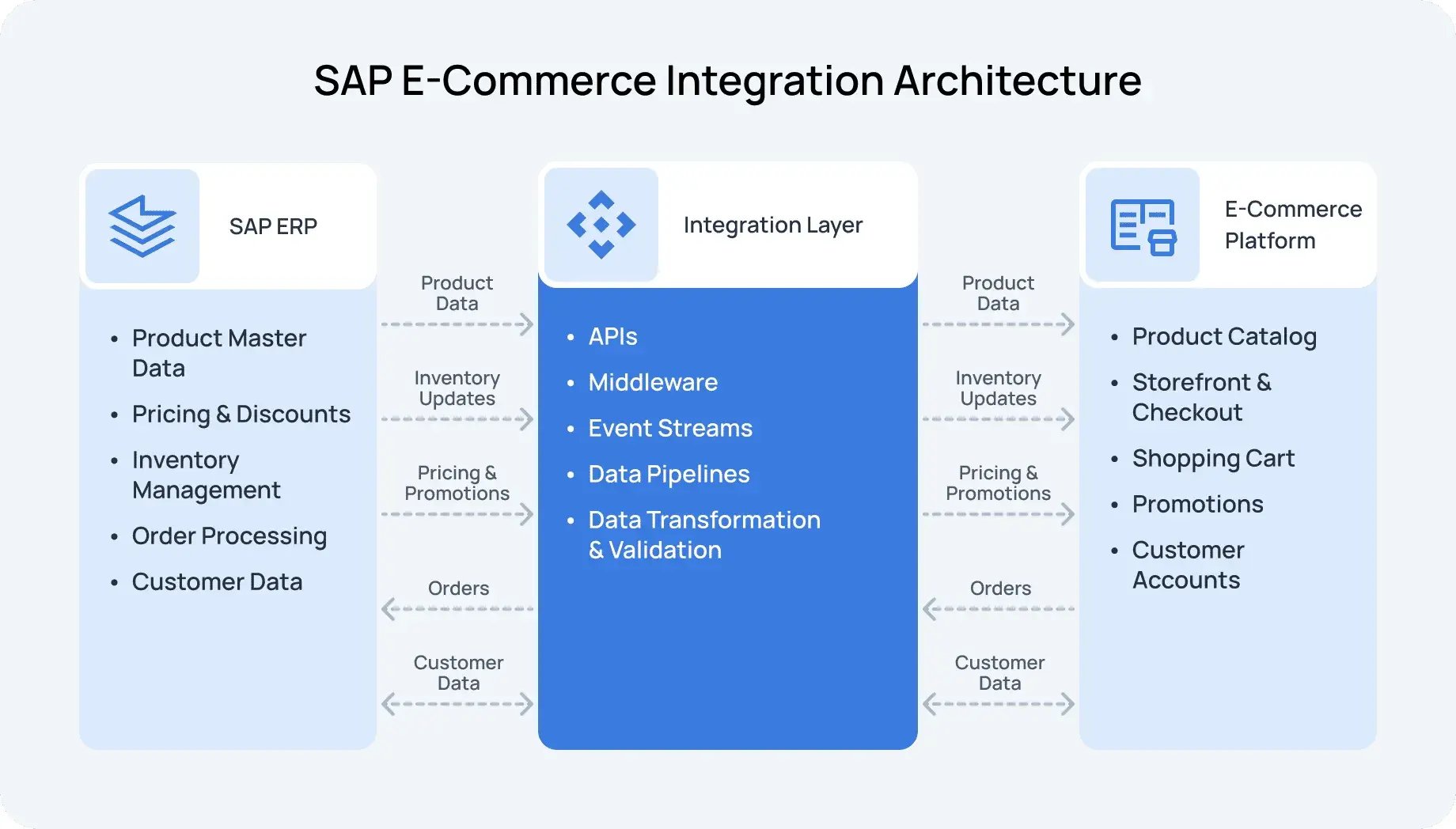
A typical SAP E-commerce integration environment includes several layers of systems that work together to support online commerce operations.
ERP layer
The ERP layer manages the core operational processes of the organization. In SAP environments, this layer typically includes:
- SAP S/4HANA, the modern ERP platform used by many enterprises to manage business processes
- SAP ECC, which remains widely used in existing SAP landscapes
These systems store and manage essential business data, including product master records, pricing logic, inventory availability, customer accounts, and order management processes. Because of this role, SAP is often the authoritative source for the information that must be displayed and processed in E-commerce channels.
E-commerce layer
The E-commerce layer represents the digital storefront where customers interact with the business. Platforms in this layer enable customers to explore products, compare options, and complete purchases online.
Organizations use a variety of E-commerce platforms, including:
- SAP Commerce Cloud, often chosen by organizations already invested in the SAP ecosystem
- Shopify, commonly used for scalable digital storefronts
- Magento / Adobe Commerce, which offers flexible customization for online stores
- BigCommerce and Salesforce Commerce Cloud, which support enterprise digital commerce environments
These platforms are optimized for customer experience, search, merchandising, and checkout functionality, but they typically rely on ERP systems for the operational data that supports those activities.
Integration layer
The integration layer connects SAP with the E-commerce platform and manages how information moves between them. This layer is responsible for orchestrating data exchange, transforming data formats, and ensuring that updates occur reliably.
Integration infrastructure often includes:
- APIs that enable direct system-to-system communication
- Middleware platforms that coordinate complex integration workflows
- Message queues or event streaming technologies that support asynchronous updates
- Data integration pipelines that transform, validate, and distribute data between systems
By separating integration logic from individual applications, this layer helps organizations maintain flexible and scalable system architectures.
Why it is necessary
Reliable SAP E-commerce integration is essential because digital commerce operations depend on synchronized data across multiple systems. Product availability, pricing accuracy, and order processing all rely on information that originates in SAP but must be accessible within the E-commerce platform.
Integration enables organizations to maintain consistency across systems while automating critical business processes, for example:
- Product catalog synchronization: Product data stored in SAP can be distributed to the E-commerce storefront so customers see accurate product descriptions, attributes, and categories.
- Inventory availability updates: Stock levels maintained in SAP can be reflected online, helping ensure that customers only purchase items that are actually available.
- Pricing alignment across systems: Pricing conditions defined in SAP (e.g., discounts or customer-specific pricing) can be applied to products displayed in the storefront.
- Order transfer to ERP workflows: Orders placed through the E-commerce platform can be transmitted to SAP, where they enter standard fulfillment, logistics, and accounting processes.
- Customer data consistency: Customer records created or updated in the storefront can be synchronized with SAP so that order processing and account management remain consistent.
By enabling these processes, E-commerce SAP integration ensures that customer-facing platforms and backend enterprise systems operate as a unified environment rather than as disconnected applications.
Typical SAP E-Commerce Integration Architecture
Designing an effective SAP E-commerce integration architecture goes beyond connecting systems — it is about defining how data moves, how processes are triggered, and how reliability is maintained across the entire flow.
As E-commerce operations grow, integration becomes less about individual connections and more about building a structured, scalable mechanism for handling continuous data exchange. A well-designed architecture ensures that data flows are predictable, resilient, and easy to manage over time.
Core architecture components
Instead of focusing on the systems themselves, it is more useful to look at the functional responsibilities within the architecture.
At a practical level, SAP E-commerce integration relies on several key capabilities working together:
- Data orchestration: Integration workflows must control how data moves between systems. This includes determining when data is transferred, in what sequence, and under what conditions. For example, product data may need to be validated and enriched before it is sent to the storefront, while orders must follow a strict processing sequence once created.
- Data transformation and mapping: SAP and E-commerce platforms use different data structures. Integration logic must translate data between these formats, ensuring that fields, attributes, and identifiers align correctly. This is particularly important for complex objects, such as product variants, pricing conditions, or customer hierarchies.
- Communication management: Different data flows may require different communication patterns. Some interactions must happen in real time (e.g., checking availability during checkout), while others can be processed asynchronously (e.g., bulk product updates). The architecture must support both without creating bottlenecks.
- Error handling and recovery: Failures are inevitable in distributed systems. The architecture must detect failed transactions, trigger retries where appropriate, and prevent data loss. Without structured error handling, small issues can quickly escalate into operational disruptions.
- Monitoring and visibility: Integration processes need to be observable. Teams should be able to track whether data flows are functioning correctly, identify delays, and detect inconsistencies. Visibility is essential for maintaining trust in the system and responding to issues quickly.
By organizing integration around these responsibilities rather than around individual systems, organizations can build architectures that are easier to scale and maintain.
Integration approaches
Within this functional structure, different integration approaches define how data is exchanged and processed:
- Direct API integration: Direct API-based integration enables systems to communicate with each other through synchronous requests. This approach is straightforward and can work well for simple or low-volume scenarios. However, as the number of data flows increases, direct connections can become difficult to manage. Each new integration adds complexity, and tight coupling between systems makes it harder to introduce changes without affecting other processes.
- Middleware-based integration: Middleware introduces a centralized layer that manages integration logic. Instead of embedding transformation and orchestration directly into each system, these responsibilities are handled in one place. This approach allows teams to standardize integration patterns and reuse logic across multiple data flows. It also simplifies maintenance, as updates can be made within the middleware without requiring changes to the connected systems.
- Event-driven integration: Event-driven integration focuses on reacting to changes rather than continuously requesting data. When a relevant event occurs (e.g., an inventory update or order creation) it triggers downstream processes. This model supports more flexible and scalable architectures because systems do not need to wait for immediate responses. Instead, they process events independently, which reduces dependencies and improves resilience under high load.
Hybrid architectures
In most real-world scenarios, organizations combine multiple integration approaches to meet different requirements.
For example:
- Real-time interactions may rely on APIs.
- Complex workflows may be orchestrated through middleware.
- High-volume updates may be handled through event-driven pipelines.
This hybrid approach allows each type of data flow to be handled in the most appropriate way, balancing speed, reliability, and scalability.
As a result, modern SAP E-commerce integration architectures are rarely uniform. Instead, they are composed of complementary patterns that together support continuous, reliable data exchange across more and more complex digital commerce environments.
Core Data Flows in SAP E-Commerce Integration
At the center of any SAP E-commerce integration are the data flows that connect backend operations with the digital storefront. These flows define how information is exchanged, updated, and processed across systems. On a broad scale, they determine whether the integration supports a smooth customer experience or creates operational friction.
Each data flow has its own characteristics in terms of direction, frequency, and complexity. Some flows require near real-time updates, while others can be processed in batches. Understanding these differences is essential for designing reliable integration processes.
Product catalog synchronization
Product data is one of the foundational elements of any E-commerce operation. In most SAP-driven environments, product information is created and maintained centrally and then distributed to the E-commerce platform.
This data typically includes:
- Product identifiers and SKUs
- Names, descriptions, and attributes
- Category assignments and hierarchies
- Variant structures, such as size, color, or configuration
- References to media assets, such as images
The challenge in product synchronization primarily lies in ensuring that it is structured correctly for the storefront. SAP product models are often more complex or structured differently than those used by E-commerce platforms.
As a result, integration workflows must handle:
- Mapping of product attributes between systems
- Transformation of hierarchical data into storefront-friendly formats
- Validation of required fields before publishing
If this process is not handled carefully, inconsistencies can appear in the storefront (e.g., missing attributes, incorrect product variants, or improperly categorized items).
Inventory synchronization
Inventory data must reflect real-world stock availability as closely as possible. This makes inventory synchronization one of the most time-sensitive aspects of E-commerce SAP integration.
Inventory updates typically include:
- Available stock levels
- Reserved or allocated quantities
- Warehouse-specific availability
- Backorder status
Unlike product data, which can often be updated periodically, inventory data often requires frequent or near real-time updates. Delays in synchronization can lead to situations where customers purchase items that are no longer in stock.
To manage this effectively, integration processes must balance:
- Update frequency (to maintain accuracy)
- System load (to avoid performance issues)
- Consistency across multiple sales channels
In more advanced architectures, event-driven updates are used so that inventory changes trigger immediate synchronization rather than rely solely on scheduled updates.
Pricing and promotions
Pricing is another critical data flow that originates in SAP and must be reflected accurately in the E-commerce platform. In many organizations, pricing logic is not static; it is governed by rules, conditions, and customer-specific agreements.
Pricing data may include:
- Base prices for products
- Customer-specific or contract pricing
- Promotional discounts and campaigns
- Tiered pricing based on quantity
- Regional or currency-based variations
Because of this complexity, pricing synchronization is not always a simple data transfer. Integration workflows must often interpret and transform pricing conditions into a format that the E-commerce platform can apply during product display and checkout.
Inconsistent pricing between systems can lead to discrepancies between displayed and final prices, checkout errors, or loss of customer trust. Ensuring alignment requires careful handling of pricing logic and frequent updates where necessary.
Order data flow
While many data flows move information from SAP to the E-commerce platform, order data typically flows in the opposite direction.
When a customer places an order, the E-commerce platform captures the transaction and then transfers it to SAP for further processing. This flow is critical because it connects the customer-facing purchase with backend fulfillment and financial operations.
Order data usually includes:
- Product line items and quantities
- Customer details and account references
- Billing and shipping information
- Payment status or authorization
- Delivery preferences
Once received in SAP, the order enters standard business processes, such as inventory allocation, picking and packing, shipping and delivery, and invoicing.
Because this flow directly impacts revenue and customer satisfaction, it must be both accurate and reliable. Failed or delayed order transfers can result in fulfillment delays, manual corrections, or lost transactions.
Customer data synchronization
Customer data often needs to move in both directions between systems, depending on how the organization manages customer relationships.
Typical flows include:
- New customer registrations created in the E-commerce platform
- Updates to customer profiles or contact information
- Customer account data maintained in SAP, particularly in B2B scenarios
In B2C environments, the E-commerce platform may act as the primary source of customer data. In B2B scenarios, SAP often holds more complex customer structures, including account hierarchies, pricing agreements, and credit limits.
This creates challenges in maintaining a consistent view of the customer across systems. Integration processes must address:
- Matching and reconciling customer identities
- Preventing duplicate records
- Synchronizing updates without overwriting critical data
When customer data is not properly aligned, it can affect everything from order processing to personalized pricing and customer service interactions.
Together, these data flows form the operational backbone of SAP E-commerce integration. Each flow must be designed with its specific requirements in mind, while still fitting into a cohesive integration architecture that ensures consistency, reliability, and scalability across the entire system landscape.
Common Pitfalls in SAP E-Commerce Integration
Even with a well-designed architecture, organizations frequently encounter challenges when implementing and scaling SAP E-commerce integration. These issues often arise not from the technology itself, but from how data is structured, managed, and monitored across systems.
Understanding the most common pitfalls helps teams anticipate risks and design more resilient integration processes.
Inconsistent product data
Product data inconsistencies are one of the most common and visible issues in E-commerce environments. Because product information often originates in SAP but must be adapted for the storefront, discrepancies can easily occur during transformation and synchronization.
Typical causes include:
- Missing required attributes in the source system
- Incorrect mapping between SAP fields and E-commerce fields
- Differences in how product variants are structured
- Incomplete or outdated product records
These issues can result in:
- Broken or incomplete product pages
- Incorrect product variations being displayed
- Poor search and filtering experiences
Maintaining consistent product data requires accurate mapping, as well as validation processes that ensure data completeness before it reaches the storefront.
Inventory mismatches
Inventory synchronization must be both accurate and timely. When stock levels are not updated frequently enough — or when updates fail entirely — discrepancies between SAP and the E-commerce platform can occur.
Common causes include:
- Delayed synchronization processes
- Failed or skipped inventory updates
- Conflicts between multiple inventory sources
- Lack of real-time update mechanisms
The impact of inventory mismatches can be significant:
- Overselling products that are no longer available
- Increasing backorders and fulfillment delays
- Damaging customer trust and satisfaction
To avoid these issues, integration processes must ensure that inventory updates are frequent, reliable, and aligned across all sales channels.
Order synchronization failures
Order data must move reliably from the E-commerce platform to SAP. Failures in this process can disrupt fulfillment and require manual intervention to correct.
Typical failure points include:
- API communication errors during order transfer
- Data validation issues that prevent order creation in SAP
- Incomplete or improperly formatted order data
- Integration workflow interruptions
When order synchronization fails, the consequences can include:
- Delayed order processing
- Manual re-entry of orders
- Increased operational workload
- Potential revenue loss
Because order data directly impacts business operations, this flow must be carefully monitored and supported by robust error-handling mechanisms.
Data mapping complexity
One of the underlying challenges in E-commerce SAP integration is the difference in how systems structure and interpret data. SAP often uses highly structured and detailed data models, while E-commerce platforms may require simpler or differently organized formats.
This leads to complexity in mapping:
- Product attributes and classifications
- Pricing structures and conditions
- Customer records and hierarchies
- Order data formats and statuses
Mapping issues can result in:
- Data being incorrectly transformed during transfer
- Loss of important information
- Misalignment between systems
Effective integration requires a clear and well-maintained mapping strategy that evolves alongside both systems.
Lack of monitoring and error handling
Many integration implementations focus heavily on building data flows, but overlook the importance of monitoring and error management. Without visibility into integration processes, issues may go undetected until they affect business operations.
Common gaps include:
- Lack of real-time monitoring of data flows
- No automated alerts for failed transactions
- Missing retry mechanisms for failed processes
- Limited visibility into data inconsistencies
These gaps can lead to:
- Silent failures that accumulate over time
- Data inconsistencies between systems
- Delayed detection of critical issues
To maintain reliable integration, organizations need structured monitoring, clear alerting mechanisms, and automated recovery processes to ensure that data continues to flow even when issues occur.
Addressing these pitfalls requires technical solutions and a strong focus on data governance, validation, and operational visibility. By identifying these risks early, organizations can build more resilient SAP E-commerce integration processes that support consistent and reliable digital commerce operations.
Best Practices for Reliable SAP E-Commerce Integration
Building a reliable SAP E-commerce integration requires more than choosing the right architecture or tools. It depends on how integration processes are designed, governed, and maintained over time. The following best practices focus on ensuring long-term stability, scalability, and data consistency.
Define clear data ownership
A common source of integration issues is ambiguity around which system is responsible for specific data. Without clear ownership, conflicts arise when multiple systems attempt to update the same information.
To avoid this, organizations should explicitly define:
- Which system is the source of truth for each data domain
- Where updates are allowed to originate
- How conflicts between systems are resolved
For example, product structures, pricing logic, and inventory levels are often controlled centrally, while the E-commerce platform may manage session-based or presentation-specific data (e.g., shopping cart contents, recently viewed products, personalized recommendations, promotional banners). Establishing these boundaries ensures that data flows remain predictable and prevents unintended overwrites or inconsistencies.
Implement automated data validation
Reliable integration depends on the quality of the data being exchanged. Even well-designed data flows can break down if incorrect or incomplete data enters the process.
Automated validation should be applied at key points within integration workflows to check for:
- Missing mandatory fields
- Incorrect data formats or structures
- Invalid or inconsistent identifiers
- Logical inconsistencies within datasets
By validating data before it is transferred or processed, organizations can prevent errors from propagating across systems. This reduces the need for manual corrections and helps maintain consistent data across the entire landscape.
Design for scalability
E-commerce environments are inherently dynamic. Traffic volumes, order rates, and data updates can fluctuate significantly depending on promotions, seasonality, or business growth.
Integration processes should be designed to handle:
- Increasing transaction volumes without degradation in performance
- Large-scale data updates, such as product catalog changes
- Spikes in activity during peak periods
Scalability also involves designing data flows that can operate efficiently under load. This includes using asynchronous processing where appropriate, avoiding unnecessary dependencies, and ensuring that bottlenecks do not form in critical paths.
Monitor integration data flows
Visibility into integration processes is essential for maintaining reliability. Without monitoring, issues may remain undetected until they affect business operations.
Effective monitoring should provide insight into:
- The status of data flows and pipelines
- Processing times and potential delays
- Failed or incomplete transactions
- Patterns that may indicate emerging issues
This visibility allows teams to respond quickly to problems and maintain confidence in the integrity of the integration. Monitoring should be continuous and integrated into daily operations, rather than treated as an afterthought.
Automate data integration and quality processes
Manual intervention in integration workflows increases the risk of errors and makes it difficult to scale operations. Automation helps ensure that data flows remain consistent and that issues are identified and addressed proactively.
Automation can support:
- Continuous data synchronization between systems
- Detection of anomalies or inconsistencies
- Enforcement of data quality rules
- Handling of routine integration tasks without manual input
Solutions like DataLark enable organizations to automate data integration workflows and maintain data quality across complex system landscapes. By combining automation with validation and monitoring, teams can reduce operational overhead, while ensuring that data remains accurate and reliable.
Future Trends in SAP E-Commerce Integration
As digital commerce ecosystems evolve, SAP E-commerce integration is shifting from relatively static, point-to-point connections toward more dynamic, scalable, and resilient integration models. Several trends are shaping how organizations design and operate these integrations going forward.
One of the most significant shifts is the move toward event-driven architectures. Instead of relying on scheduled data transfers or synchronous requests, systems increasingly react to events, such as inventory changes or order creation. This approach reduces latency, improves scalability, and allows systems to operate more independently, which produces an important advantage in high-volume E-commerce environments.
At the same time, API-first strategies are becoming standard. Organizations are exposing business capabilities through well-defined APIs, making it easier to connect SAP with multiple frontends, marketplaces, and third-party services. This is particularly relevant as companies expand beyond a single storefront into omnichannel and composable commerce setups.
Composable commerce architectures present another important trend of businesses assembling their digital commerce stack from multiple specialized services rather than relying on a single monolithic platform. In such environments, SAP must integrate with the primary E-commerce platform, as well as additional services, such as search, personalization, payment, and fulfillment systems. This increases the number of integration points and makes coordination across systems more complex.
From an operational perspective, there is a growing emphasis on real-time data synchronization and observability. Organizations are no longer satisfied with delayed updates or limited visibility into integration processes. Instead, they expect near real-time data flows combined with clear monitoring of data pipelines, processing times, and potential failures.
An often overlooked but increasingly critical aspect is the role of data quality and governance within integration workflows. As integration architectures become more distributed, the risk of inconsistencies grows. Leading organizations are addressing this by embedding validation, monitoring, and correction mechanisms directly into their data pipelines, rather than treating data quality as a separate concern.
Taken together, these trends point toward a future where SAP E-commerce integration is less about connecting systems and more about orchestrating continuous, reliable data flows across a distributed ecosystem. Organizations that adopt flexible architectures, prioritize automation, and invest in data quality management will be better positioned to support scalable and resilient digital commerce operations.
Conclusion
Effective SAP E-commerce integration is a critical foundation for delivering reliable, scalable digital commerce experiences. From managing complex data flows to ensuring consistency across systems, the success of your integration directly impacts both operational efficiency and customer satisfaction.
As architectures become more distributed and data volumes grow, maintaining accurate, synchronized data across SAP and E-commerce platforms becomes increasingly challenging. This is where automation, monitoring, and data quality management play a central role.
DataLark helps organizations streamline SAP E-commerce integration by automating data pipelines, ensuring data consistency, and providing visibility into integration processes. By reducing manual effort and proactively identifying issues, teams can maintain reliable data flows and focus on scaling their digital commerce operations.
If you're looking to improve the reliability of your SAP E-commerce integration and eliminate data inconsistencies, explore how DataLark can support your integration and data quality processes.