


Explore why strong retail data quality and SAP integration are essential for reducing operational friction and supporting omnichannel growth.
Making Retail Data Work Smarter: A Fresh Look at Connecting E-Commerce and SAP
Retail and E-commerce businesses operate in a world where speed, accuracy, and consistency define success. Behind each product listing, each order confirmation, and each warehouse pick lies a chain of systems that must work together flawlessly. But in reality, these systems — from SAP to E-commerce platforms to logistics partners — often operate in silos, each speaking its own language and updating at its own pace.
The result is familiar to most retailers: inconsistent product data, delays in inventory updates, manual corrections to supplier information, and order data that needs constant cleanup. As omnichannel operations scale, these small inconsistencies turn into major operational risks.
Solving these challenges starts with smarter data connections. Retailers gain the reliability and agility they need to grow when integrations are automated, when data quality is continuously maintained, and when SAP and E-commerce channels stay aligned. DataLark helps create that foundation by enabling cleaner, more connected data flows across the entire retail ecosystem.
Data Bottlenecks Retailers Face Today
Today’s retailers juggle a growing ecosystem of tools: ERPs like SAP, E-commerce platforms like Shopify or Magento, marketplace APIs, payment processors, logistics partners, and more. Each system speaks its own language, structures information differently, and updates on its own schedule.
Here’s how those bottlenecks show up in day-to-day operations:
- Inconsistent SKUs: A single product might appear under different identifiers across systems: one SKU in SAP, another in Shopify, and a slightly different format on Amazon. When these identifiers don’t align, it creates confusion in inventory management, causes failures in order processing, and requires manual mapping to reconcile data. These mismatches also make it difficult to maintain accurate SAP retail master data and often lead to duplicated or conflicting entries.
- Delayed inventory updates: Inventory accuracy relies on fast, consistent updates across all channels. However, many systems still sync in batches or depend on manual triggers. When stock changes aren’t reflected immediately, retailers risk overselling during spikes in demand or underutilizing available inventory. Delays ripple into customer dissatisfaction, fulfillment issues, and lost revenue — especially during peak sales periods.
- Pricing discrepancies: Promotions, regional pricing, and marketplace-specific fees mean that pricing structures change often. Without automated data flows, updates applied in one system may not propagate reliably to others. This leads to mismatched prices across E-commerce channels, inaccurate promotional displays, or even margin loss when incorrect pricing reaches checkout systems.
- Lost or misrouted orders: When order data arrives and it is incomplete, in inconsistent formats, or with incorrect field mapping, systems downstream — especially SAP — struggle to process it correctly. Addresses may be improperly formatted, fulfillment types might be missing, or payment details may not match expected values. Orders can stall, route to the wrong warehouse, or require manual intervention, which slows fulfillment and increases operational costs.
- Endless manual data cleanup: Because these issues accumulate, retail teams often rely on spreadsheets, error logs, or ad-hoc scripts just to keep operations moving. They constantly correct product attributes, fix supplier data, standardize SKUs, and/or reconcile mismatched inventory. This manual cleanup becomes a daily task that consumes valuable team capacity and introduces opportunities for human error.
Modern operations require accurate, automated, and real-time data flows. Retailers no longer have the luxury of allowing slow integrations or inconsistent data to disrupt the customer experience.
Why Data Quality and Integration Matter More in Retail & E-Commerce
In modern retail, data is not just operational support; it is the connective tissue that powers every customer-facing and backend process. As retailers expand across channels, regions, and fulfillment networks, the volume and velocity of data grow exponentially. This increased complexity raises the stakes. When data is incomplete, inconsistent, or poorly integrated, it directly affects profitability, customer experience, and scalability.
The main reasons why retail data integration and retail data quality management have become core strategic capabilities are described below.
Data quality issues amplify across channels
A single incorrect product dimension, price, or attribute can propagate instantly to marketplaces, E-commerce platforms, warehouses, and partner systems. Because these channels cross-reference one another, errors multiply quickly.
A mismatch between SAP retail master data and marketplace product listings, for example, can cause rejections, delays, or misclassifications. This isn’t merely an operational nuisance: it's a barrier to growth as marketplaces increasingly enforce strict data compliance.
Automation and accuracy are essential for real-time decision-making
Retailers rely on near real-time insights for replenishment, demand forecasting, and promotions. But even sophisticated analytics fall apart without high-quality, integrated data feeding the models. When the underlying information is inconsistent (e.g., outdated stock levels, missing vendor data, duplicated SKUs), automated decisions become unreliable. Clean, well-integrated data ensures that planning, inventory optimization, and pricing models perform as intended.
Operational efficiency hinges on dependable system-to-system communication
E-commerce SAP integration is no longer a technical upgrade; it’s an operational necessity. Systems must exchange data continuously and consistently for workflows like order allocation, pick/pack/ship processing, or pricing updates.
Without seamless integration, retailers face bottlenecks such as delayed orders, warehouse downtime, or misaligned stock. High-quality integration ensures each system receives the right data at the right time, enabling smoother and faster operations.
Compliance and marketplace governance depend on consistent data
Marketplaces like Amazon, Zalando, and Walmart enforce stricter product data standards every year. Missing values, inconsistent categories, or formatting errors can result in listing suppression or account penalties. Robust retail data quality management helps maintain compliance by standardizing product data before it reaches external platforms, thus reducing rejection rates and maintaining seller performance metrics.
Customer trust rests on accurate, synchronized information
Consumers expect execution to match what they see online:
- The product should be in stock.
- The price should reflect promotions.
- The description should match the actual item.
- The delivery date should be accurate.
Even small discrepancies erode trust rapidly in competitive markets. When retail data integration keeps product, pricing, and inventory data synchronized between SAP and E-commerce channels, the customer experience becomes more dependable and consistent.
Scaling omnichannel operations requires a clean data foundation
As retailers adopt ship-from-store, same-day delivery, marketplace expansions, or new sales channels, the data footprint grows. If master data is already fragmented or inconsistent, each expansion effort becomes exponentially harder. Clean SAP retail master data combined with automated integration workflows builds a resilient foundation for future initiatives and minimizes onboarding time for new channels or partners.
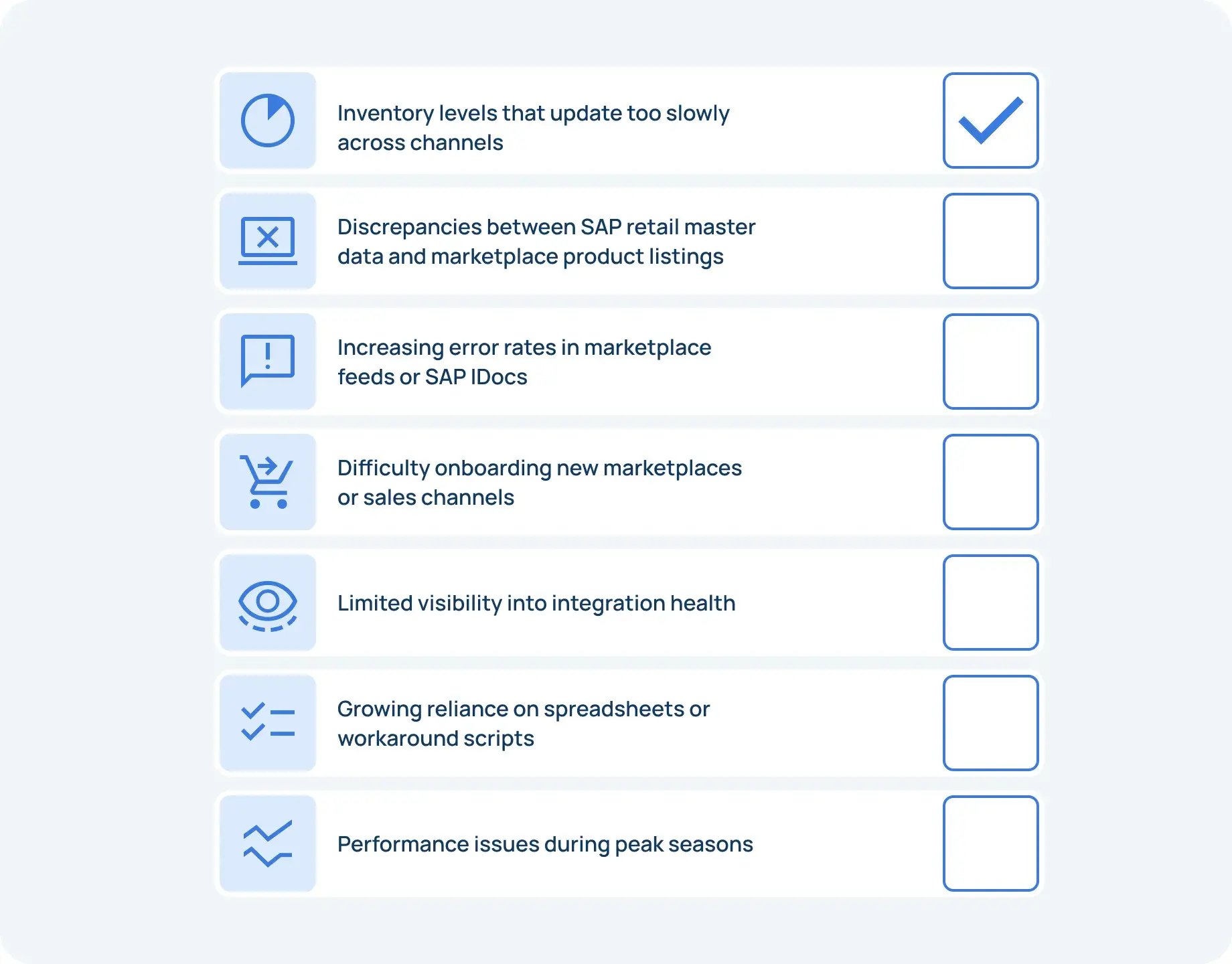
Sidebar: Top Indicators Your SAP–E-Commerce Integration Needs Modernization
Modern retail operations rely on fast, accurate data flows, but many existing integration setups were built years ago and are now stretched beyond their limits. Here are key signs your SAP’s E-commerce integration may be holding your business back:
- Frequent manual interventions to fix order or product data: If teams routinely adjust SKUs, reformat addresses, or correct price or tax values before SAP can process them, the integration layer is no longer robust enough for current operations.
- Inventory levels that update too slowly across channels: Delays of even 15–30 minutes can cause overselling, especially on high-velocity marketplaces. Slow or batch-based updates almost always indicate outdated integration architecture.
- Discrepancies between SAP retail master data and marketplace product listings: When product attributes, classifications, or item hierarchies drift out of sync, it’s often because data transformations aren’t automated or governed effectively.
- Increasing error rates in marketplace feeds or SAP IDocs: A rising number of failed messages, stuck IDocs, or marketplace listing rejections suggests that the integration logic or mapping rules need a refresh.
- Difficulty onboarding new marketplaces or sales channels: If adding a new channel requires weeks of custom development, your integration approach is too rigid. Modern retail architectures rely on reusable templates, connectors, and dynamic mapping.
- Limited visibility into integration health: Retailers often rely on logs, email alerts, or manual checks to identify failures. A lack of transparency indicates the need for centralized monitoring and more intelligent data workflows.
- Growing reliance on spreadsheets or workaround scripts: When business users start bridging gaps manually, it’s a sign that integration foundations aren’t keeping up with operational complexity.
- Performance issues during peak seasons: Holiday sales, seasonal spikes, or marketing campaigns amplify underlying weaknesses. If your integration pipeline becomes unstable under load, modernization is overdue.
Experiencing any of the above issues? Request a DataLark demo to learn how it can automate and modernize your data flows.
Modernizing Retail Data Flows: What DataLark Brings to the Table
DataLark modernizes complex retail landscapes by automating integrations, improving data quality, and ensuring consistency across SAP and every E-commerce channel. Here’s a deeper look at what DataLark brings to retail teams.
Automated, end-to-end retail data integration
DataLark serves as the connective layer between SAP, E-commerce platforms, marketplaces, WMS systems, PIMs, and supplier data feeds. Instead of building one-off integrations or maintaining complex middleware, retailers can define reusable workflows that move, validate, and transform data automatically.
This approach dramatically reduces the operational overhead associated with maintaining point-to-point integrations, especially in environments that rely on both structured SAP data and more flexible E-commerce formats.
Continuous data quality validation and error prevention
In retail, errors rarely stay isolated. A malformed product attribute, incorrect category assignment, or missing brand value can cause listing rejections, customer confusion, or SAP processing failures. With a built-in retail data quality management rule engine, DataLark checks incoming data for completeness, consistency, and formatting before it enters critical systems.
For example:
- Validating SKU formats and product hierarchies against SAP retail master data
- Standardizing units of measure
- Flagging missing attributes before marketplaces reject listings
- Checking inventory and price values for anomalies
- Validating supplier fields before onboarding
Instead of discovering issues downstream — where they’re much more expensive — DataLark catches them at the source.
Configurable, rule-based data transformation
Retail data rarely arrives in the right format. Supplier files use different naming conventions, marketplace APIs deliver unpredictable structures, and new channels often require new classifications or mapping patterns.
DataLark enables retailers to define transformation rules visually and without scripting. Teams can map fields, restructure hierarchies, enrich product information, and unify data models across systems. This reduces the effort required to maintain accurate SAP retail master data and helps retailers adopt new channels without re-engineering integrations.
Smart error handling and automated remediation
Traditional integrations fail silently or surface errors only after they disrupt operations. DataLark introduces automated error-handling logic that routes issues to appropriate stakeholders, retries operations intelligently, or corrects data based on predefined rules.
This means: fewer stuck IDocs; fewer manual SAP fixes; and a smoother flow of product, inventory, and order data between systems.
Pre-built connectors and accelerators for retail systems
Retailers no longer need to build each connection from scratch. DataLark offers pre-built connectors that are easy to configure for:
- SAP ECC and SAP S/4HANA
- Shopify, Magento, BigCommerce
- Amazon, eBay, Walmart, Zalando, and other marketplaces
- WMS and 3PL providers
- Supplier data feeds and PIM systems
These connectors ensure fast deployment of E-commerce SAP integration and reduce the time-to-value for any new channel or process.
Alignment with SAP-focused architectures
SAP landscapes come with strict data models, validation rules, and governance expectations. DataLark aligns with these constraints by understanding SAP structures, including materials, variants, characteristics, pricing conditions, and retail-specific hierarchies.
By integrating directly with SAP’s expectations, DataLark ensures that incoming data is always SAP-ready, thus reducing integration failures and improving master data consistency.
Scalability for growing omnichannel operations
As retailers scale — adding marketplaces, new regions, new shipping partners, or new product lines — integration complexity rises exponentially. DataLark’s flexible data pipeline automation engine and reusable templates make expansion far simpler. Teams can replicate proven workflows, apply consistent transformations, and maintain centralized governance without starting from scratch.
Key Retail Workflows Depend on Clean, Connected Data
Retail data challenges aren’t theoretical; they show up in specific, recurring workflows that affect product availability, customer experience, and operational efficiency. Below are the most common areas where improved data integration and data quality deliver immediate value.
Automated product data enrichment & synchronization
Product data is the backbone of every retail system, but it’s also the most fragmented. Suppliers often deliver product information in inconsistent formats, with missing fields, incorrect classifications, or unsupported attribute structures. Marketplaces, in turn, impose strict formatting and completeness requirements.
Why this matters:
- Poorly formatted data leads to listing rejections or suppressed visibility on marketplaces like Amazon.
- SAP requires structured SAP retail master data that often differs from marketplace schemas.
- Marketing, merchandising, and fulfillment teams rely on accurate attributes to deliver a consistent customer experience.
What automation solves:
- Standardizes and enriches product information before it enters SAP or E-commerce systems.
- Harmonizes naming conventions, categories, variants, and units of measure.
- Fills in missing attributes using rules or reference data sources.
- Ensures version control and eliminates duplicate SKUs.
Clean, synchronized product data ensures faster onboarding of new products, fewer listing errors, and higher catalog consistency across all channels.
Real-time inventory synchronization across channels
Inventory accuracy defines customer satisfaction. The higher the sales velocity, the more damaging a delay or discrepancy becomes.
Typical issues:
- Batch-based updates cause overselling during peak traffic.
- Channel-specific reservations or holds aren’t reflected in SAP.
- Marketplace stock levels fall out of sync, leading to penalties or customer complaints.
What automated retail data integration enables:
- Near real-time updates across SAP, online stores, marketplaces, and WMS.
- Channel-aware stock allocation (e.g., priority to E-commerce vs. physical stores).
- Automated detection of anomalies like negative stock or sudden volume spikes.
- Safety stock rules and dynamic thresholds.
With accurate and timely inventory, retailers minimize cancellations, avoid marketplace penalties, and optimize fulfillment.
Order data integration from marketplaces and webshops
Orders enter a retailer’s landscape in many formats, and SAP is particularly sensitive to missing or malformed data. Without automated checks, issues propagate into fulfillment, invoicing, and customer service.
Where errors usually appear:
- Address fields not properly formatted for SAP validation.
- Missing customer identifiers or payment details.
- Marketplace-specific order fields not mapped correctly to SAP.
- Delivery method inconsistencies (e.g., “Express” vs. SAP-coded shipping types).
What automation delivers:
- Normalization and validation of incoming order data before it reaches SAP.
- Clean mapping across hundreds of marketplace and E-commerce variations.
- Prevention of stuck IDocs or incomplete SAP sales orders.
- Automated exception handling and routing.
This reduces manual corrections dramatically and accelerates order throughput from click to warehouse.
Automated vendor & supplier data processing
Supplier-provided data is one of the largest sources of inconsistency in retail operations. Without governance, it results in messy master data, onboarding delays, and inefficiencies across procurement and merchandising.
Common pain points:
- Suppliers use different attribute standards and file formats.
- Pricing lists arrive with missing currency, taxes, or validity dates.
- Product hierarchies differ from SAP retail master data structures.
- Duplicate vendors or incomplete supplier profiles create downstream confusion.
How automation improves the process:
- Standardizes vendor master data before it enters SAP.
- Validates product and pricing data against retailer-specific rules.
- Deduplicates suppliers and ensures data completeness.
- Simplifies ongoing updates and reduces dependency on manual reviews.
By improving data quality at the source, retailers maintain cleaner master data and reduce exceptions in procurement and inventory management workflows.
Logistics & delivery data integration
From warehouse management to last-mile delivery, logistics systems produce high volumes of status updates that must flow back into SAP and customer-facing channels accurately and quickly.
Typical challenges:
- Inconsistent tracking number formats.
- Delays in delivery status updates across carriers.
- Mismatched warehouse stock numbers due to timing differences.
- Errors in shipment confirmations flowing into SAP.
What automation enables:
- Harmonized status updates from WMS, 3PLs, and carriers.
- Automated validation of shipment data before updating SAP.
- Proactive detection of failed deliveries or incomplete handoffs.
- Up-to-date information for customer notifications and support teams.
This creates a more transparent, reliable delivery experience and reduces operational friction.
How Better Data Integration Improves Retail Operations
Modern retail and E-commerce environments rely on hundreds of interconnected processes that only function well when data is accurate, timely, and consistent across systems. When SAP, E-commerce platforms, marketplaces, suppliers, and logistics partners exchange information without friction, operational teams can shift their focus from firefighting to optimizing. Strong data integration and robust data quality practices don’t just reduce errors; they create a resilient foundation for scaling products, channels, and regions with confidence.
Key operational improvements include:
- Significant reduction of manual corrections and operational workarounds: Teams frequently waste hours each week resolving predictable issues: fixing SKU mismatches, correcting supplier file inconsistencies, reformatting addresses, or manually clearing stuck IDocs. With structured, automated data flows, most of these issues never reach end users. The reduction in manual intervention frees planning, merchandising, and operations teams to focus on strategic tasks like assortment expansion, supplier negotiations, or improving channel performance.
- Consistent, accurate inventory, pricing, and product data across all channels: Retailers must ensure that what customers see online matches real availability and correct pricing. Detailed integration rules help reconcile stock movements between WMS, SAP, and marketplaces, to keep availability aligned across rapidly changing environments. Similarly, price updates propagate reliably to all channels, preventing margin loss, suppressed listings, and inconsistent promotions. Clean product data also supports better search relevance and fewer listing issues.
- Faster onboarding for new products, suppliers, and channels: The speed of product onboarding is often not limited by operational capacity, but by data quality challenges: missing attributes, varying file formats, incorrect classifications, or supplier inconsistencies. Automated validation and transformation dramatically shorten the time between receiving supplier data and having SAP retail master data ready for use. The same principle applies to new marketplaces and regions. Reusable mapping and transformation logic allows teams to replicate proven workflows rather than rebuilding integrations from scratch.
- Lower return rates and fewer customer complaints: Many returns stem from inaccurate product details, inconsistent sizing information, or incorrect delivery expectations — not product defects. When product and logistics data stay synchronized across SAP and customer-facing channels, customers receive what they expect. Accurate delivery statuses also reduce customer service inquiries and improve transparency. Over time, this consistency leads to measurable improvements in CSAT, NPS, and repeat purchase behavior.
- More stable and predictable SAP-centric processes: SAP enforces strict rules on how data must be structured and validated. Poorly formatted inputs often result in stuck IDocs, failed transactions, or incomplete master data entries that disrupt core workflows. Entering high-quality, pre-validated data into SAP reduces exceptions, increases process reliability, and ensures that critical functions (e.g., replenishment, pricing maintenance, and order fulfillment) run smoothly. This stability becomes especially valuable during peak seasons when process volume spikes.
- Reduced long-term IT maintenance costs: Many retailers rely on legacy point-to-point scripts or middleware integrations that accumulate complexity and technical debt over time. These systems are expensive to maintain and fragile when new channels or requirements emerge. By centralizing transformation logic and adopting configurable integration workflows, retailers reduce dependency on custom code and specialized internal knowledge. This leads to lower support costs and more predictable system behavior over the long term.
- Greater scalability for omnichannel growth: Expanding into new marketplaces, regions, or fulfillment models often poses significant data challenges, for example: new tax structures, new attribute requirements, new logistics providers, or different product classification schemes. With standardized workflows, transformation rules, and validation processes already in place, expansion becomes a repeatable exercise rather than a bespoke IT project. The business gains agility to rapidly test new markets, introduce new brands, or adapt to evolving customer expectations.
Real-World Results: What Retailers Typically Achieve After Improving Their Data Workflows
When retailers strengthen data quality practices and modernize SAP-to-E-commerce integrations, improvements appear quickly, often within weeks. These outcomes are not theoretical; they mirror patterns observed across mid-market and enterprise retailers that operate in fast-moving omnichannel environments. The figures below illustrate typical ranges of improvement that retailers achieve once clean, reliable data flows are in place.
Common outcomes include:
- Sharp reduction in order processing failures and fulfillment delays: Retailers often report a 40-70% decrease in SAP order exceptions once order data is validated before entering key transaction paths. For example, a mid-sized apparel retailer processing 15,000 daily orders reduced stuck IDocs from roughly 300 per day to under 40. The change saved the fulfillment team several hours per shift and improved same-day shipment rates by nearly 20%.
- Massive drop in manual catalog cleanup and attribute correction: Product data preparation is typically one of the largest hidden time sinks in retail operations. Some retailers see a 70-90% reduction in manual catalog adjustments after implementing structured attribute mapping and standardized product setups. One consumer electronics retailer cut new SKU onboarding time from 3-4 hours per item (due to supplier inconsistencies) to under 30 minutes, enabling them to launch categories weeks earlier.
- Significantly accelerated time-to-market for products and channels: With reusable mappings and consistent data models, retailers can onboard new suppliers or launch channels dramatically faster. A European footwear brand reduced marketplace onboarding cycles from 18-21 days down to 3-5 days, allowing them to participate in high-traffic seasonal events they previously missed due to slow preparation cycles.
- Better inventory accuracy and far fewer overselling events: Retailers frequently see oversell incidents drop by 60-90% once inventory updates synchronize more reliably across SAP, marketplaces, and warehouses. A typical improvement: a home goods retailer reduced nightly oversell cases from about 50 per day on Amazon to fewer than 5 during peak season, largely due to faster stock propagation and immediate correction of invalid quantities.
- Higher listing quality and better performance on marketplaces: Marketplaces reward consistent, structured product data. Retailers regularly see 20-40% reduction in listing rejections, lower suppression rates, and improved conversion due to more complete product content. For example, a beauty brand saw their “incomplete attribute” rejection rate on Zalando drop from 22% to under 5% after standardizing category rules and size/ingredient attributes.
- Stronger operational resilience during high-volume periods: During high-traffic events, such as Black Friday, retailers with modernized data flows report 30-50% fewer integration-related incidents, dramatic reductions in manual monitoring, fewer delays in warehouse processing, and more stable SAP inbound/outbound queues. One marketplace-driven retailer noted that their Black Friday integration monitoring team shrank from 12 temporary staff to 3 coordinators, which is a direct result of cleaner data entered into SAP.
- Improved customer satisfaction and lower return rates: A significant portion of returns in fashion, beauty, and home goods come from inaccurate or incomplete product information. When attributes, images, and descriptions become more consistent across channels, retailers often see 5-15% drops in avoidable returns, especially for size-dependent or color-sensitive products. Customer service teams also report fewer “Where is my order?” inquiries when logistics data flows smoothly across carriers, SAP, and customer-facing systems.
Why Strong Data Foundations Matter for SAP-Centric Retailers
For retailers running SAP, clean and well-structured data isn’t just beneficial: it’s essential. SAP’s tightly governed data and transaction models power everything from replenishment to pricing and to warehouse execution. But this rigor also means SAP reacts quickly — and sometimes harshly — to inconsistent or incomplete data coming from E-commerce platforms, marketplaces, suppliers, or external logistics systems.
Below are the core reasons why SAP-centric retailers experience data quality issues more acutely and why they gain outsized value from fixing them.
SAP enforces strict master data requirements and immediately rejects bad inputs
SAP retail master data depends on precise hierarchies, variant structures, units of measure, and classification rules. Even small inconsistencies (e.g., a missing base unit, mismatched size codes, or incorrect product group assignments) cause SAP to create partial or duplicate materials or simply reject the inbound data.
This often leads to downstream issues like incomplete pricing conditions, misaligned assortments, or broken variant families. Suppliers and marketplaces rarely deliver data that perfectly match SAP’s expectations, so without upstream harmonization, teams spend significant time correcting master data just to keep core processes functioning.
Transactional workflows in SAP break easily when data is malformed
Unlike flexible front-end systems, SAP requires structured, validated inputs for transactions such as sales orders, purchase orders, and inbound deliveries. When data arrives with missing tax indicators, mismatched delivery types, or inconsistent address formats, SAP flags it immediately, usually as stuck IDocs, incomplete documents, or posting errors.
These interruptions stack quickly, especially during high-order-volume periods. A single incorrect field mapping from a marketplace integration can affect thousands of orders in a single afternoon, slowing fulfillment and burdening both operations and IT teams.
Alignment between SAP and E-commerce systems is critical for omnichannel consistency
E-commerce platforms and marketplaces allow flexible, sometimes loosely structured data. SAP does not. Product attributes, variant logic, shipping method names, and even pricing models often differ dramatically between systems. When these differences aren’t normalized before data enters SAP, inconsistencies appear everywhere, from product listings to warehouse routing.
For example, an unsupported marketplace shipping service might block delivery creation in SAP, or uncontrolled variants (e.g., size/color combinations) may not map cleanly into SAP’s material/variant model. Aligning these data structures upstream ensures that product visibility, availability, and order processing remain consistent across all channels.
Clean SAP data directly improves replenishment, forecasting, and supply chain execution
SAP’s planning engines rely heavily on accurate master data that encompasses lead times, product hierarchies, dimensions, purchasing info records, and more. When any of these fields are missing or inconsistent, forecasting and replenishment become unreliable.
Simple issues (e.g., incorrect case pack quantities or outdated vendor lead times) can lead to chronic stockouts, inflated safety stocks, and poor allocation decisions. Retailers that improve the quality of their SAP retail master data typically see smoother replenishment cycles, fewer manual overrides, and significantly better supply chain visibility.
A scalable, structured integration layer protects SAP from technical debt
Many SAP retailers have accumulated years of custom ABAP code, user exits, and point-to-point integrations created under intense timelines. These solutions often work initially, but they grow brittle over time. They require specialists to maintain, they break easily when external systems change, and they make channel expansion slow and risky.
When data transformation and validation move into a structured integration layer upstream, SAP becomes much easier to maintain. New marketplaces, suppliers, and fulfillment models can be added in full compliance with SAP Clean Core, without rewriting core SAP logic. This reduces operational risk and preserves SAP as a stable backbone, even as the retail landscape evolves.
Getting Started: A Practical Approach to Modernizing Retail Data Workflows
Improving data quality and integration across SAP, E-commerce platforms, marketplaces, suppliers, and logistics systems doesn’t require a large, disruptive transformation. In practice, the retailers who see the fastest and most sustainable results begin by addressing the data workflows that create the most friction, then scale their improvements outward. The goal is to build a structured, reliable foundation that supports growth without overhauling entire architectures at once.
Below are several principles and starting points that consistently help retailers make meaningful progress.
Start with a single, high-impact workflow
Every retailer has one process where data quality issues surface most visibly. This often occurs with product onboarding, order processing, or inventory synchronization. Beginning with this workflow allows teams to:
- Isolate the biggest sources of manual work or recurring errors.
- Test and refine validation and transformation rules in a controlled scope.
- Demonstrate operational improvements quickly without widespread system changes.
Retailers often find that improvements in one workflow naturally extend into others, building momentum for broader modernization.
Stabilize the data inputs before adjusting SAP
SAP issues are often symptoms of upstream inconsistencies, not failures of SAP itself. Addressing data quality at the source — in supplier files, marketplace feeds, or E-commerce exports — prevents downstream disruptions and reduces the need for SAP-specific troubleshooting.
Practical steps include:
- Normalizing variant structures and attributes before they reach SAP.
- Validating address formats and order fields upstream.
- Enforcing naming conventions and master data rules at ingestion time.
This upstream approach protects SAP from unnecessary transactional failures and reduces technical debt over time.
Define clear transformation and validation rules
Retailers benefit from codifying the logic that was previously handled manually or buried in custom scripts. Documented, modular rules offer several advantages:
- Transparency into how data is cleaned, mapped, and structured.
- Consistency across channels, suppliers, and product categories.
- Easier onboarding of new team members or external partners.
- The ability to expand or adjust rules without rewriting integrations.
The more explicit the ruleset, the easier it becomes to maintain and scale.
Use reusable patterns for new channels and regions
Instead of building bespoke integrations for each marketplace, region, or system, retailers gain speed by establishing reusable templates for:
- Attribute mapping
- Pricing and tax structures
- Inventory availability logic
- Shipping method translation
- Status update formats
This approach dramatically reduces onboarding times and keeps the data model coherent as the business expands.
Monitor data health continuously, not just during incidents
Many retailers only investigate data issues when something breaks: a listing rejection, a stuck IDoc, or a fulfillment disruption. A more effective approach is continuous monitoring of:
- Attribute completeness and correctness
- SKU alignment across systems
- Inventory propagation latency
- Order error patterns
- Discrepancies in SAP retail master data
Monitoring reveals systemic issues early, helping teams prevent operational consequences rather than react to them.
Scale to additional workflows once the foundation is stable
After stabilizing an initial workflow and establishing reusable rules, retailers typically expand into adjacent processes such as:
- Supplier data onboarding
- Logistics updates and delivery confirmations
- Automated enrichment for new product categories
- Regional pricing configurations
- WMS or 3PL integrations
This incremental scaling ensures that improvements accumulate logically, without overwhelming teams or introducing new fragility.
Conclusion
Retail and E-commerce operations succeed or fail on the strength of their data. Product attributes, inventory levels, pricing structures, order details, and delivery updates all need to move accurately and consistently between SAP and the systems that shape customer experience. When these data flows break down, the symptoms are familiar: overselling, listing errors, delayed shipments, suppressed marketplace visibility, and mounting operational workloads.
This guide demonstrates that these issues aren’t isolated problems. They are structural outcomes of fragmented data foundations. Retailers who overcome them do so by adopting governed, reusable workflows that stabilize data at the source, not through reactive troubleshooting. This is exactly where DataLark supports retail teams: by providing a structured environment to validate, transform, and synchronize data across SAP, E-commerce platforms, marketplaces, and logistics systems with far greater consistency and reliability.
With cleaner upstream inputs and predictable integrations, retailers quickly see fewer exceptions, smoother fulfillment, lower returns, faster marketplace onboarding, and more reliable planning rhythms. The impact is especially noticeable in SAP-centric organizations, where process integrity depends on precise master data and well-structured transactions.
Importantly, modernizing retail data workflows doesn’t require a large transformation initiative. It starts with stabilizing one high-impact process (e.g., product onboarding or order validation) and building reusable rules that eliminate the root causes of inconsistency. From there, scaling to additional workflows becomes a natural progression rather than a disruptive project.
In a retail landscape defined by rapidly shifting customer expectations, evolving marketplace standards, and increasingly complex supply chains, clean, connected data is one of the few durable advantages retailers can control. Strengthening your data foundation reduces operational risks and provides the flexibility and resilience needed to adapt and grow.
If you’re ready to bring greater clarity, consistency, and automation to your retail data workflows, DataLark can help. Start with one workflow, realize the value quickly, and expand at your own pace. Reach out to us for a conversation or a guided demonstration of what a cleaner, more connected data foundation could look like for your business.