


Learn how SAP data archiving works, explore SAP data archiving solutions, and understand the SAP data archiving process in S/4HANA.
SAP Data Archiving: A Practical Guide to Reducing Data Volume Without Risk
SAP systems are accumulating data faster than most organizations can manage it. Years of transactional history, redundant records, obsolete documents, and rarely used master data all accumulate in production systems. What once felt like a storage issue has now become a performance, cost, and compliance risk — especially for organizations running SAP S/4HANA or planning a migration.
SAP data archiving is often discussed as a technical housekeeping task. In reality, it is a strategic discipline that directly affects system performance, migration complexity, audit readiness, and long-term operational stability. Done well, SAP data archiving reduces data volume without disrupting business processes or compromising compliance. Done poorly, it can break reporting, invalidate audits, and create serious downstream issues.
This guide takes a practical, risk-aware approach to SAP data archiving. It explains what archiving really means, why it matters more than ever in S/4HANA environments, how the SAP data archiving process works end to end, and how to choose SAP data archiving solutions that scale safely.
Why SAP Data Volume Is a Business Risk
SAP systems were never designed with today’s data growth rates in mind. Over time, organizations accumulate:
- Completed transactional records that are no longer operationally relevant
- Historical documents that are kept “just in case”
- Legacy data structures carried forward through multiple upgrades
- Redundant records created by integrations, interfaces, and manual corrections
As data volumes grow, the impact becomes visible across the SAP landscape. What initially looks like a gradual accumulation of historical records eventually turns into a systemic issue that affects performance, cost structures, transformation programs, and compliance posture. In both ECC and SAP S/4HANA environments, unmanaged data growth quietly increases risk until it starts to constrain day-to-day operations and strategic initiatives.
The following issues are among the most detrimental:
- Degrading system performance and stability: Large and ever-growing tables increase read and write times across transactional and reporting processes. Background jobs take longer to complete, batch windows overlap, and system responsiveness deteriorates during peak business hours. Over time, even well-tuned SAP systems struggle to maintain predictable performance when operational data is mixed with years of inactive historical records.
- Rising infrastructure and licensing costs: In SAP S/4HANA, data volume has a direct financial impact. Since active data resides in memory, keeping unnecessary historical data online increases HANA memory requirements and, consequently, infrastructure and licensing costs. Organizations often discover that a significant portion of their S/4HANA footprint is consumed by data that delivers little to no ongoing business value.
- Increased complexity and risk in transformation programs: Excessive data volume is one of the most common hidden cost drivers in S/4HANA migrations and system carve-outs. More data means longer migration runtimes, more test cycles, higher reconciliation effort, and a greater likelihood of data inconsistencies. Programs that initially ignore SAP data archiving often pay for it later through extended timelines and increased risk at cutover.
- Operational inefficiency in data management and support: Large datasets complicate everyday data operations, such as reconciliation, validation, monitoring, and troubleshooting. Support teams spend more time isolating issues in oversized tables, while data teams struggle to distinguish active business data from obsolete records. This slows incident resolution and reduces overall operational agility.
- Growing compliance and audit exposure: Retaining data indefinitely is not a safe compliance strategy. Regulations such as GDPR, SOX, and industry-specific retention requirements mandate controlled data lifecycles. Without structured SAP data archiving, organizations risk keeping personal or financial data longer than legally allowed, while also making it harder to demonstrate audit traceability and controlled data handling.
In practice, unmanaged SAP data volume is more than just a technical inconvenience; it is a compounding business risk. Addressing it proactively through SAP data archiving helps organizations regain control over performance, cost, compliance, and transformation outcomes before these issues escalate.
What SAP Data Archiving Is (and What It Isn’t)
SAP data archiving is the structured process of removing completed, no-longer-needed business data from the active SAP database, while preserving it in a secure, retrievable format for compliance, audit, and reference purposes.
From a technical perspective, SAP data archiving relies on predefined archive objects that define which tables and records can be archived together, while maintaining logical and referential integrity. From a business perspective, archiving is governed by process completion status, retention rules, and audit requirements. Both technical and business dimensions are essential: archiving that is technically correct but business-inappropriate can still introduce significant risk.
What SAP data archiving is
SAP data archiving is:
- A controlled lifecycle process aligned with business process completion and legal retention requirements, rather than arbitrary time-based rules.
- A database volume reduction mechanism designed to remove inactive data from the operational system, without breaking business processes or historical traceability.
- An auditable and reversible approach where archived data remains accessible through SAP display transactions and can be retrieved when required for audits or investigations.
- A foundation for long-term system stability, supporting predictable performance, manageable data growth, and sustainable operations.
When implemented correctly, SAP data archiving reduces operational data volume while preserving the ability to explain, reconstruct, and validate historical business activity.
What SAP data archiving is not
SAP data archiving is not:
- Mass deletion of data, where records are permanently removed without regard for legal or audit obligations.
- A purely technical cleanup task executed without business ownership, validation, or governance.
- A one-time activity performed once and forgotten, only to be revisited when systems reach critical limits again.
- A substitute for data quality management, as archiving does not fix inconsistencies or errors; it requires clean, consistent data to be executed safely.
A common source of confusion is the assumption that archiving and deletion are interchangeable. In reality, deletion eliminates data and its audit trail, while archiving preserves business context and traceability. This distinction becomes especially important in regulated environments and in SAP S/4HANA landscapes, where both performance and compliance are closely scrutinized.
Why SAP Data Archiving Matters More in S/4HANA
SAP S/4HANA changes how data is stored, processed, and consumed, but it does not eliminate the need for disciplined data lifecycle management. On the contrary, the architectural and commercial characteristics of S/4HANA make unmanaged data growth more visible and more costly than in traditional SAP ECC systems. As organizations modernize their SAP landscapes, SAP data archiving becomes a prerequisite for maintaining performance, cost efficiency, and operational control.
The most important reasons why SAP data archiving is especially critical in SAP S/4HANA are as follows:
- In-memory architecture amplifies the cost of excess data: In SAP S/4HANA, active data is stored in memory rather than on disk. While this enables faster processing, it also means that every additional gigabyte of operational data directly increases memory consumption and infrastructure costs. Historical transactional data that delivers no ongoing business value still occupies premium resources if it remains active, turning poor data lifecycle management into a recurring financial burden.
- Simplified data models do not prevent data volume growth: S/4HANA reduces data redundancy by eliminating aggregates and indexes, but it does not reduce the number of business transactions generated by daily operations. Sales, logistics, finance, and manufacturing processes continue to create large volumes of transactional data. Without SAP data archiving, even newly implemented S/4HANA systems can experience rapid data growth within a few years of go-live.
- Migration programs expose data volume-related risks: During ECC-to-S/4HANA migrations, data volume is a major driver of project complexity and risk. Larger datasets increase migration runtimes, prolong test cycles, and significantly expand reconciliation and validation efforts. Organizations that postpone SAP data archiving until late in the migration process often face compressed timelines, higher failure rates, and increased pressure during cutover.
- Operational stability depends on ongoing data volume control: Post-migration, S/4HANA systems require continuous data volume management to maintain stable operations. Excessive data volumes affect background processing, reporting performance, and system maintenance activities, such as upgrades and patches. SAP data archiving supports predictable system behavior by keeping the operational dataset aligned with current business needs.
- Compliance and retention requirements become more visible: S/4HANA transformations often coincide with increased regulatory scrutiny and data governance initiatives. Without structured archiving, organizations risk retaining sensitive or regulated data beyond required retention periods. SAP data archiving provides the framework needed to align technical data handling with legal and compliance obligations.
In S/4HANA environments, SAP data archiving is no longer a peripheral maintenance task. It is a core operational capability that supports system performance, cost control, compliance, and long-term sustainability of the SAP landscape.
The SAP Data Archiving Process: End-to-End
The SAP data archiving process is not a single technical activity, but a sequence of tightly connected steps that span business validation, technical execution, and post-archiving assurance. Each step builds on the previous one, and weaknesses at any stage can compromise the safety and effectiveness of the entire archiving effort. Treating this process holistically is essential to reducing data volume without introducing operational or compliance risk.
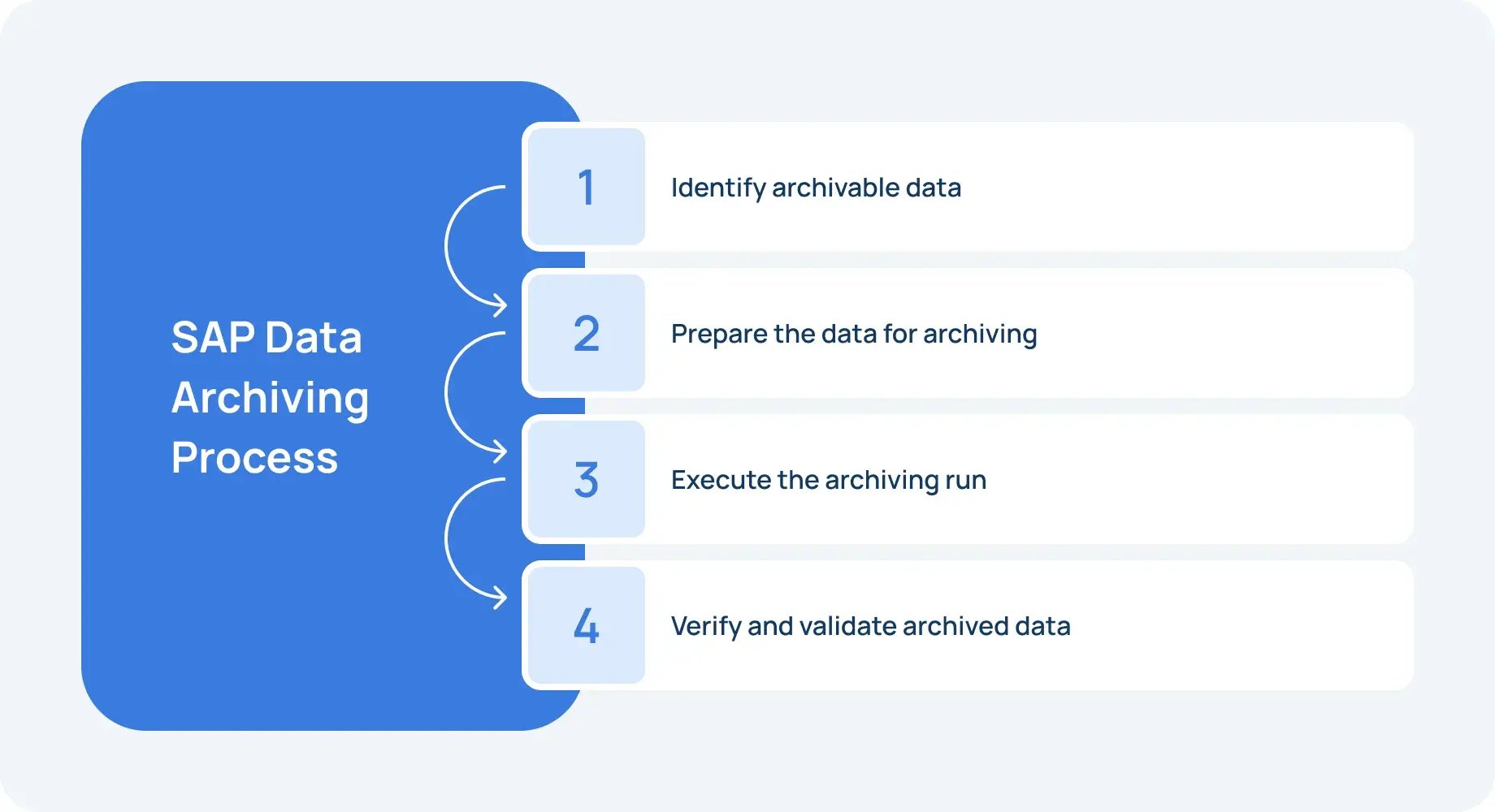
Step 1: Identify archivable data
The starting point of SAP data archiving is determining which data is eligible for removal from the active database. Eligibility is defined by both business and legal criteria. From a business perspective, only data belonging to fully completed processes can be archived. From a legal and regulatory perspective, retention periods must be respected and documented.
This step typically involves:
- Distinguishing transactional data from master data and configuration data
- Verifying that business documents are fully closed, with no open follow-on processes
- Reviewing statutory and internal retention requirements
- Confirming that archived data will not be required for operational reporting or integrations
Failure to correctly identify archivable data often results in archive job errors, incomplete archiving runs, or post-archiving business disruptions.
Step 2: Prepare the data for archiving
Once archivable data has been identified, it must be prepared for archiving. This preparation phase is where most risks surface, as it exposes inconsistencies, incomplete records, and hidden dependencies within the data.
Key preparation activities include:
- Checking data consistency across related tables and documents
- Resolving incomplete or technically inconsistent records
- Identifying and addressing cross-module dependencies
- Ensuring that data quality issues do not block archiving objects
Archiving does not correct data quality problems. Inconsistent or corrupted data can cause archive objects to fail or result in records that cannot be reliably retrieved later. Thorough preparation ensures that archiving removes only what is intended and preserves business and audit integrity.
Step 3: Execute the archiving run
The execution phase is where SAP data archiving is technically carried out. In standard SAP, this typically consists of two distinct steps: the write phase and the delete phase.
During the write phase, eligible data is selected based on predefined criteria and written to archive files. At this stage, the data remains in the database, allowing organizations to review and validate the selection before anything is deleted.
During the delete phase, the archived data is removed from the active database. Referential integrity is preserved, and table sizes are reduced accordingly. Execution must be carefully planned and scheduled, as large archiving runs can impact system performance if they compete with business-critical processes.
Step 4: Verify and validate archived data
Verification and validation are critical to ensuring that SAP data archiving has achieved its objectives without unintended consequences. This step confirms that the correct data has been archived, that no required data has been removed, and that business and compliance requirements continue to be met.
Validation activities typically include:
- Comparing record counts and data volumes before and after archiving
- Reconciling archived data against source documents and totals
- Verifying that archived data remains accessible for audit and review
- Confirming that reports, interfaces, and downstream processes continue to function correctly
Without structured validation, archiving introduces silent risk. Errors may not surface until audits, reconciliations, or operational issues reveal that critical data is missing or inconsistent.
Taken together, these steps form a repeatable and controllable SAP data archiving process. When executed with proper governance and validation, the process reduces operational data volume, while maintaining confidence in data integrity, business continuity, and compliance.
SAP Data Archiving Solutions: Understanding Your Options
SAP data archiving can be implemented using different solution approaches, each with implications for scalability, risk management, and operational effort. While SAP provides native archiving capabilities, many organizations augment or extend them to address validation, automation, and governance requirements that emerge in complex landscapes. Choosing the right approach requires a clear understanding of what each option delivers and where its limitations lie.
SAP standard data archiving
SAP standard data archiving is built into the SAP platform and relies on predefined archive objects that control how business data is selected, written to archive files, and removed from the active database.
From a functional standpoint, standard archiving:
- Preserves logical and referential integrity across related tables
- Integrates with SAP transactions to display archived data
- Is supported and maintained as part of the SAP core system
However, standard archiving places a significant burden on process discipline and manual validation. While SAP provides the technical mechanisms for archiving, it offers limited support for automated reconciliation, cross-object consistency checks, and end-to-end transparency. As data volumes grow and archiving becomes more frequent, these limitations can increase operational risk and effort.
SAP Information Lifecycle Management (ILM)
SAP Information Lifecycle Management extends standard archiving by introducing policy-driven retention, legal hold, and blocking capabilities. ILM is primarily designed to help organizations align data handling with regulatory and compliance requirements.
Key strengths of SAP ILM include:
- Centralized management of retention rules
- Support for legal holds and data blocking
- Strong alignment with privacy and compliance initiatives
At the same time, SAP ILM adds architectural and operational complexity. It requires clearly defined governance models, well-maintained master data, and disciplined processes. ILM does not eliminate the need for data quality checks or validation; rather, it makes them more critical. Organizations without sufficient data governance maturity often struggle to realize the full value of ILM.
Third-party SAP data archiving solutions
Some organizations adopt third-party SAP data archiving solutions to complement SAP’s native capabilities. These solutions typically focus on operational scalability, automation, and enhanced control across the archiving lifecycle.
Common capabilities provided by third-party solutions include:
- Automated validation and reconciliation before and after archiving
- Improved visibility across multiple archive objects and systems
- Support for continuous, large-scale archiving operations
- Reduced reliance on manual checks and custom scripts
The effectiveness of third-party solutions depends heavily on how well they integrate with SAP’s standard archiving mechanisms and governance processes. They should be evaluated not as replacements for SAP archiving, but as enablers that reduce risk and operational overhead in complex environments.
How to evaluate SAP data archiving solutions
Regardless of the approach chosen, organizations should assess SAP data archiving solutions against a consistent set of criteria:
- Coverage: Does the solution support the required archive objects and business scenarios?
- Validation and control: How does it ensure data integrity before and after archiving?
- Audit readiness: Can archived data be traced, explained, and retrieved when required?
- Operational effort: How much manual work is required to execute and maintain archiving runs?
- Scalability: Can the approach support continuous archiving as data volumes grow?
Selecting SAP data archiving solutions without considering these factors often leads to short-term success and long-term operational challenges.
Understanding the strengths and limitations of each archiving option allows organizations to design a solution that fits their data volume, compliance requirements, and operational maturity — rather than forcing SAP data archiving into a one-size-fits-all approach.
Common Risks in SAP Data Archiving (and How to Avoid Them)
Although SAP data archiving is a mature capability within the SAP ecosystem, it remains one of the most operationally sensitive data management activities. The technical steps are well defined, but the surrounding governance, validation, and cross-functional coordination often determine whether archiving reduces risk or creates new exposure. Understanding the most common failure patterns allows organizations to design safeguards before issues surface.
The most common potential pitfalls include:
- Archiving without comprehensive validation: One of the most frequent risks is executing the SAP data archiving process without structured pre- and post-archiving validation. Archive jobs may complete successfully from a technical perspective, yet still result in incomplete datasets, broken document chains, or reconciliation discrepancies. Without systematic volume comparisons, record-level checks, and business sign-off, organizations may not detect issues until audits or reporting inconsistencies reveal them. Preventing this risk requires embedded validation checkpoints throughout the archiving lifecycle, not just at the end.
- Overlooking cross-system and reporting dependencies: SAP systems rarely operate in isolation. Archived data may still be referenced by data warehousing systems, external reporting tools, tax engines, or downstream integrations. If these dependencies are not identified and tested before deletion, archiving can lead to broken reports, interface failures, or silent data gaps in analytics environments. Mitigation requires impact analysis across the broader SAP landscape, including technical interfaces and business reporting use cases.
- Treating archiving as a one-time cleanup project: Many organizations initiate SAP data archiving in response to acute system performance issues or as a pre-migration task for SAP S/4HANA. Once the immediate objective is achieved, archiving is deprioritized. Data volumes then begin accumulating again, eventually recreating the same challenges. Sustainable risk reduction requires embedding SAP data archiving into ongoing operations with defined schedules, ownership, and monitoring.
- Insufficient business and compliance involvement: Archiving decisions that are made solely by IT teams may overlook legal retention requirements, regulatory constraints, or operational data needs. Conversely, overly conservative business positions may oppose necessary data volume reduction. Without cross-functional governance, archiving may either expose the organization to compliance risk or fail to achieve meaningful system optimization. Clear accountability between IT, legal, compliance, and business stakeholders is essential.
- Archiving inconsistent or low-quality data: Archiving does not correct underlying data quality problems. Inconsistent records, open transactions, or improperly maintained master data can cause archive object failures or create retrieval issues later. If data integrity is not verified before archiving, organizations risk moving unresolved inconsistencies into long-term storage, where they become more difficult to diagnose. A disciplined data preparation phase significantly reduces this exposure.
- Delaying archiving until late stages of transformation programs: In migration or system conversion projects, archiving is sometimes postponed until timelines are already constrained. This compresses preparation, validation, and testing windows, increasing the probability of errors. When SAP data archiving is treated as an early-stage activity within transformation programs, it reduces data volume, simplifies testing, and lowers overall project risk.
SAP data archiving introduces risk only when it is executed without governance, validation, and long-term operational discipline. When these safeguards are embedded into the process, archiving becomes a controlled mechanism for reducing data volume while strengthening system stability and compliance posture.
Best Practices for Reducing SAP Data Volume Without Business Disruption
Reducing SAP data volume is not simply a technical optimization exercise; it is a controlled change to the operational data foundation of the enterprise. When SAP data archiving is executed without sufficient planning and discipline, it can disrupt reporting, compliance processes, and downstream integrations. However, when guided by clear principles and embedded governance, it becomes a sustainable mechanism for maintaining performance, controlling cost, and protecting business continuity.
The following best practices consistently distinguish stable, low-risk SAP data archiving programs from reactive or disruptive ones:
- Align archiving strategy with business and compliance stakeholders: Effective SAP data archiving begins with cross-functional alignment. Business owners must confirm that processes are fully complete before data is archived, while compliance and legal teams must validate retention requirements. Without this alignment, archiving decisions may conflict with operational needs or regulatory obligations. Establishing clear ownership and approval workflows ensures that archiving reflects enterprise priorities rather than isolated technical objectives.
- Base archiving decisions on data volume and usage analysis: Archiving should be driven by measurable insights rather than assumptions. Conducting detailed volume analysis at the table and the archive object level helps identify where data growth is most significant and where reductions will have meaningful impact. Usage analysis further distinguishes between data that is technically old — but still operationally relevant — and data that can safely be removed from the active system. This analytical approach minimizes unintended consequences.
- Implement incremental and scheduled archiving cycles: Large, one-time archiving initiatives introduce concentrated risk. Incremental archiving cycles — executed on a defined schedule — reduce system strain and simplify validation. Regular, smaller runs make discrepancies easier to detect and resolve while embedding SAP data archiving into normal operational routines. This approach also prevents the accumulation of excessive backlogs that require disruptive clean-up efforts.
- Embed validation and reconciliation into the archiving lifecycle: Data volume reduction must never compromise data integrity. Automated validation steps before and after each archiving run — including record counts, financial reconciliations, and document completeness checks — significantly reduce operational risk. Validation should not be treated as a final checkpoint, but as an integral component of every stage in the SAP data archiving process.
- Assess downstream impacts across the SAP landscape: Archiving decisions must account for the broader ecosystem, including BW environments, analytics platforms, tax engines, and external interfaces. Dependencies should be documented and tested before deletion phases are executed. This landscape-level perspective prevents silent reporting failures and ensures business users continue to access required historical information.
- Integrate archiving into transformation and upgrade roadmaps: SAP data archiving delivers the greatest benefit when aligned with major initiatives, such as S/4HANA migrations, system consolidations, or infrastructure optimization projects. Starting early in the transformation lifecycle reduces migration data loads, shortens testing cycles, and lowers reconciliation complexity. Treating archiving as a strategic enabler — rather than a late-stage corrective measure — significantly improves program outcomes.
- Establish continuous monitoring and governance: Long-term stability depends on sustained oversight. Defined KPIs (e.g., data growth rates, archive object execution frequency, and validation success metrics) help organizations track the health of their archiving strategy. Clear governance structures ensure that responsibilities remain assigned and that SAP data archiving evolves alongside business and regulatory changes.
Reducing SAP data volume without disrupting operations requires discipline, transparency, and coordination. When these best practices are embedded into ongoing data management operations, SAP data archiving becomes a predictable and scalable capability that supports performance, compliance, and transformation objectives over the long term rather than one that reacts to crises after they emerge.
When Should You Begin SAP Data Archiving?
One of the most common misconceptions about SAP data archiving is that it should only begin when performance issues become visible or when a major transformation project forces action. In reality, the timing of SAP data archiving has a direct impact on system stability, project risk, and long-term cost control. Organizations that treat archiving as a reactive measure often face compressed timelines and elevated risk, while those that start early benefit from controlled, incremental data lifecycle management.
The decision to begin SAP data archiving should be driven by strategic and operational considerations rather than system distress signals alone, for example:
- As soon as data growth becomes measurable and predictable: Data volume growth follows business expansion, integration complexity, and transaction throughput. Once growth trends are established, waiting for performance degradation is unnecessary and counterproductive. Early implementation of SAP data archiving allows organizations to manage volume proactively rather than respond under pressure. Monitoring key tables and archive objects helps determine when growth rates justify structured archiving cycles.
- Before initiating an SAP S/4HANA migration: One of the most effective moments to begin SAP data archiving is during the preparation phase of an S/4HANA migration. Reducing historical data prior to system conversion decreases migration runtimes, simplifies testing, and lowers reconciliation effort. Organizations that postpone archiving until late in the migration program often encounter avoidable complexity and increased cutover risk. Starting early enables phased archiving aligned with project milestones.
- During system stabilization or landscape consolidation: Following major upgrades, acquisitions, or system harmonization initiatives, data inconsistencies and redundancies often surface. These periods provide a structured opportunity to review retention policies and embed SAP data archiving into the stabilized environment. Integrating archiving into post-transformation stabilization helps prevent renewed data accumulation.
- As part of ongoing operational governance in S/4HANA: For organizations already running SAP S/4HANA, archiving should not be treated as a legacy ECC concern. Instead, it should be incorporated into steady-state operations with defined schedules, governance models, and monitoring metrics. Regular archiving cycles prevent uncontrolled data growth and maintain predictable infrastructure costs in memory-based environments.
- When regulatory or retention requirements change: Shifts in legal frameworks, privacy regulations, or industry compliance standards may require adjustments to data retention practices. These changes provide a natural trigger to reassess SAP data archiving policies and ensure that historical data is managed in accordance with updated obligations.
Delaying SAP data archiving until performance or cost issues become acute significantly narrows available options and increases operational risk. Starting early and embedding archiving into continuous data lifecycle management transforms it from a reactive cleanup task into a strategic capability that supports sustainable SAP operations.
Conclusion
SAP data archiving is no longer a background maintenance activity. In modern SAP landscapes — especially in SAP S/4HANA environments — it directly influences system performance, infrastructure cost, compliance posture, and transformation risk. Organizations that treat archiving as a reactive cleanup measure inevitably face recurring data growth, operational strain, and avoidable complexity in major initiatives, such as migrations and consolidations.
Reducing SAP data volume without risk requires more than executing archive objects. It demands structured governance, disciplined preparation, cross-system dependency analysis, and rigorous validation before and after each archiving cycle. When these controls are embedded into ongoing operations, SAP data archiving becomes a predictable and scalable lifecycle process, rather than an emergency response to system limitations.
At its core, successful SAP data archiving is about control. The technical mechanisms provided by SAP are mature and reliable, but their effectiveness depends heavily on the quality, consistency, and validation of the data being archived. In high-volume and multi-system environments, manual checks and fragmented processes are rarely sufficient to guarantee long-term stability.
SAP data archiving is only as reliable as the validation and control mechanisms surrounding it. In complex landscapes, ensuring that archived data is complete, consistent, and reconcilable across modules and reporting systems requires more than periodic review. Platforms, like DataLark, can strengthen this control layer by automating validation workflows, enforcing reconciliation before deletion phases, and providing transparency into data quality conditions that may impact archive runs.
Ultimately, SAP data archiving should not be viewed as a one-time optimization project. It is a foundational discipline within enterprise data lifecycle management. When supported by governance, automation, and continuous monitoring, it enables organizations to reduce data volume sustainably without compromising operational continuity, compliance, or trust in their SAP systems.