


A practical guide to SAP cloud migration with expert strategies for data readiness, integration, and S/4HANA success. Reduce risk and improve timelines.
SAP Cloud Migration: A Practical Guide to a Faster, Cleaner, More Reliable Move to the Cloud
For most organizations running SAP today, cloud transformation has moved from a strategic ambition to a practical necessity. The business environment demands systems that are more agile, scalable, and cost-efficient. SAP is accelerating this evolution through S/4HANA, modern cloud delivery models, and broader transformation programs supported by RISE with SAP journey. As a result, companies across industries are modernizing their SAP landscapes to remain competitive, improve operational performance, and prepare for the next decade of innovation.
However, while the business case for SAP cloud migration is compelling, the execution is often harder than expected. Organizations face complex systems, customizations accumulated over years, dozens or even hundreds of integrations, and data landscapes that have expanded organically — sometimes chaotically — over time. Although cloud migration methodologies and tools have matured, one element continues to make or break project timelines: data.
Data is both the fuel and friction of SAP cloud migrations. It contains the essential business information, but also years of inconsistencies, duplicates, and workarounds. When organizations move to cloud-based SAP systems, these issues surface rapidly.
In this comprehensive guide, we break down the strategic, technical, and practical realities of SAP cloud migration with a particular focus on data readiness, arguably the most underestimated success factor. Whether you're preparing for an S/4HANA migration, adopting RISE with SAP, or replatforming SAP workloads onto hyperscalers, this guide will help you navigate complexity with greater clarity and confidence.
What Is SAP Cloud Migration?
At its core, SAP cloud migration refers to moving SAP systems — data, configurations, custom code, and integrations — from on-premise infrastructure to cloud-based environments. But in practice, it encompasses a broad range of transformation journeys.
ECC to S/4HANA Cloud migration
For many organizations, the most significant transformation is the move from ECC to S/4HANA Cloud. This is not a simple technical upgrade. It fundamentally changes the underlying data and process architecture.
Key differences include:
- A unified, simplified data model (e.g., Universal Journal)
- The shift to the Business Partner model for master data
- Removal of redundant or deprecated tables
- More standardized, cloud-aligned business processes
- New integration patterns centered on APIs rather than legacy interfaces
Because S/4HANA enforces stricter data and process consistency, migrating from ECC often requires deep cleansing, harmonization, and transformation of master and transactional data. This is one of the main reasons data readiness plays such a central role in these projects.
Migration within a RISE with SAP journey
Organizations choosing RISE with SAP typically embark on a holistic modernization journey: process redesign, application transformation, and cloud infrastructure consolidation guided by SAP’s strategic framework.
RISE does not replace the technical work of preparing and transforming data, but it provides a structured pathway, governance model, and tools that facilitate:
- Transitioning to S/4HANA
- Rationalizing custom code and extensions
- Modernizing integrations using SAP BTP services
- Aligning the organization around clean core principles
Within this context, cloud migration becomes part of a broader business transformation agenda, rather than a standalone IT initiative.
Replatforming SAP to hyperscalers
Some organizations choose to migrate existing SAP systems to public cloud platforms such as AWS, Azure, or Google Cloud. This path is often selected to reduce infrastructure costs, improve scalability, and take advantage of cloud-native resilience and automation.
While this is sometimes framed as a “lift-and-shift,” it still introduces meaningful complexity:
- Database upgrades and OS migrations
- Redesign of backup, disaster recovery, and monitoring
- Integration updates to match cloud connectivity models
- Performance re-optimization for cloud environments
Data transformation may be lighter than in an S/4HANA migration, but validation, harmonization, and integration alignment remain critical.
Hybrid cloud architectures
Many enterprises land on a hybrid model: they keep certain workloads on-premise while moving core systems or innovation layers to the cloud. This is common in scenarios where:
- Manufacturing execution systems (MES) must stay local
- Latency-sensitive workloads require on-site processing
- Regulatory requirements mandate data residency
- The organization prefers a phased approach to modernization
Hybrid environments demand strong data synchronization, consistent master data across systems, and a modern integration strategy. Without these, technical migration may succeed, but business processes become fragmented.
Three primary approaches to SAP cloud migration
Regardless of the broader cloud strategy, SAP data migrations typically follow one of three well-established approaches. Each one carries distinct implications for data readiness, process redesign, and the overall transformation timeline.
- Brownfield (system conversion): A brownfield migration converts an existing ECC system directly into S/4HANA while retaining historical data, core configurations, and many custom extensions. It minimizes disruption to the business and preserves process continuity, making it attractive for organizations with stable, mature operations. However, because existing data structures are carried forward, this approach requires highly reliable, well-prepared data to avoid propagating legacy inconsistencies into the new environment.
- Greenfield (new implementation): A greenfield migration establishes an entirely new S/4HANA system based on SAP standard processes, with legacy data selectively migrated into the redesigned environment. It offers a clean break from outdated customizations and allows organizations to adopt best practices and modern process templates. This approach demands extensive data extraction, cleansing, transformation, and validation, since no data can be transferred “as-is” from the legacy system.
- Selective data transition (SDT): Selective data transition combines the advantages of both brownfield and greenfield approaches. It enables organizations to consolidate multiple SAP systems, redesign processes where needed, and still retain selected portions of historical data. Because SDT involves targeted restructuring and controlled migration of specific datasets, it relies heavily on advanced tooling, systematic data transformation, and rigorous harmonization across systems.
Key Challenges Companies Face During SAP Cloud Migrations
SAP cloud migrations routinely face obstacles long before go-live. Industry surveys consistently show that a significant share of ERP modernization initiatives run into delays or exceed budgets; data issues are cited as one of the top reasons why. Understanding these challenges early helps teams anticipate risk and build a more resilient migration plan. Some common stumbling blocks organizations face include:
- Fragmented and complex data landscapes: Most organizations operate SAP systems alongside legacy ERPs, third-party applications, custom databases, and industry-specific platforms. Over time, these landscapes accumulate divergent data models, inconsistent naming conventions, and siloed business logic. When preparing for cloud migration, this fragmentation becomes a major barrier. Data must be unified, reconciled, and aligned before it can support a modern, cloud-based architecture.
- Inconsistent or low-quality data: SAP cloud environments — particularly S/4HANA — enforce stricter data structures, mandatory fields, and process dependencies than ECC. Issues that were previously tolerable, such as missing master data attributes, duplicate business partners, or outdated financial structures, quickly become obstacles. This mismatch between “system reality” and “business reality” is one of the primary causes of migration delays and rework.
- Manual and error-prone data preparation processes: Many organizations still rely on spreadsheets, manual mapping files, and disconnected cleanup exercises to prepare data for migration. These methods are slow, difficult to scale, and prone to human error. As migration cycles repeat (SIT, UAT, mock cutovers), the manual workload compounds, often overwhelming teams and jeopardizing project timelines.
- Integration breakdowns during testing: Cloud migrations frequently require shifts from legacy IDoc interfaces to APIs, event-driven architecture, or new BTP-based connectivity. Even well-designed integrations break down when source systems use non-harmonized master data or inconsistent reference structures. A single misaligned key field or outdated domain value can cascade into failures across multiple downstream systems during testing.
- Limited visibility into data readiness: A recurring issue in migration programs is the inability to clearly see where data truly stands. Project teams struggle to answer questions such as which objects are ready for load, which business units are behind, which validation rules are failing most often, or how error patterns are evolving across cycles. Without this visibility, teams operate reactively, discovering issues only when they surface in late-stage testing.
- Pressure around timelines, cutovers, and business disruption: SAP cloud migrations often occur under fixed deadlines mandated by corporate strategies, regulatory constraints, or global coordination across regions. Cutover windows are narrow, and business downtime must be minimized. When data tasks slip, the entire cutover plan becomes vulnerable, forcing teams into high-stress remediation or emergency cleanup during critical phases of the migration.
Why Data Readiness Is the Biggest Success Factor
Data readiness is consistently the strongest predictor of whether an SAP cloud migration stays on track or encounters delays. While organizations often focus first on system architecture, process redesign, or infrastructure planning, it is the underlying state of the data that ultimately determines how smoothly the transition unfolds. As companies move toward S/4HANA and cloud-based delivery models, long-standing data issues become highly visible, forcing teams to confront inconsistencies that may have been buried in legacy systems for years.
S/4HANA and cloud architectures require clean, standardized data
One of the biggest shifts in moving to S/4HANA is the adoption of a simplified, more integrated data model. The introduction of the Business Partner concept — the consolidation of financial structures into the Universal Journal and the elimination of redundant tables — means that data must be complete, accurate, and consistently governed.
Cloud systems are far less tolerant of exceptions, workarounds, and outdated records. Issues that may have gone unnoticed or unaddressed in ECC environments now become blockers during conversion. This structural tightening makes data quality not just beneficial, but essential.
Data drives every stage of migration
From planning to testing to cutover, data underpins the entire migration lifecycle. Early assessments depend on accurate profiling to determine scope and identify transformation requirements. Process design relies on consistent master data that reflects how the business truly operates. Integrations can only be tested effectively when key fields, business partners, materials, and financial structures are aligned across systems. And cutover cannot succeed without validated load files and reconciled data sets. Every phase of the project relies on data being correct, complete, and compatible with the target architecture.
Data issues become increasingly expensive later in the project
The later data problems surface, the harder they are to fix. In early phases, cleansing or harmonizing data may be relatively straightforward. But once functional design is complete, integrations are built, and testing cycles are underway, a single unresolved data issue can disrupt multiple streams simultaneously.
During cutover rehearsals — or worse, during the final cutover — the cost of a data-related delay becomes enormous, often involving emergency remediation, extended downtime, or rescheduled go-live dates. This is why mature migration programs invest heavily in data readiness long before technical conversion begins.
Data readiness enables cloud-driven business value
Clean, well-governed data is not only a requirement for migration: it is the foundation for what comes after. Cloud-based SAP landscapes unlock automation, embedded analytics, AI-driven insights, and digital processes that depend on reliable information. Whether improving supply chain transparency, enhancing financial reporting, or enabling predictive planning, all of these capabilities rely on a consistent, high-quality data layer. Organizations that prioritize data readiness early reduce migration risk and position themselves to fully realize the benefits of S/4HANA and cloud transformation.
A Proven SAP Cloud Migration Framework
Successful SAP cloud migrations follow a clear, repeatable pattern. Although every organization has unique constraints, the same sequence of activities appears across S/4HANA conversions, selective data transitions, and hyperscaler replatforming. A structured framework helps teams anticipate challenges, control complexity, and maintain alignment across business and IT. The sections below outline the major stages of an effective SAP cloud migration and highlight the critical actions that drive success in each phase.
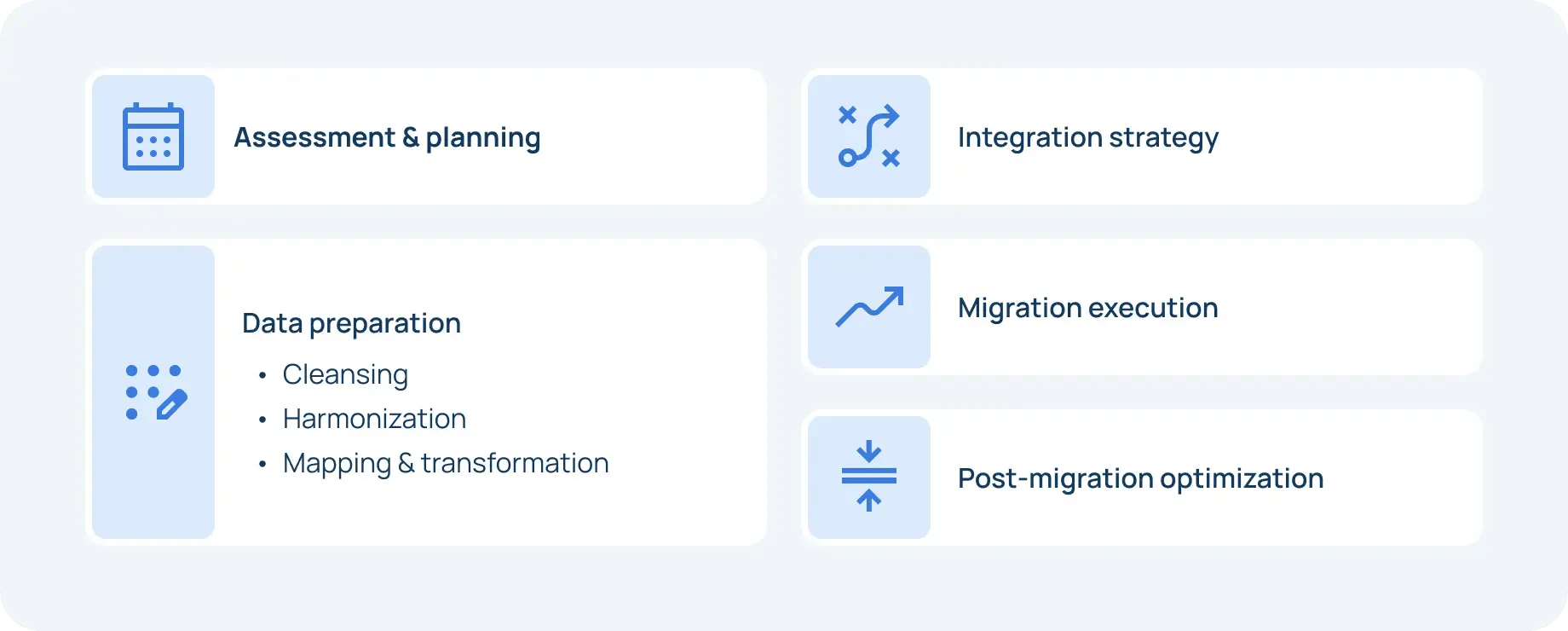
Assessment & planning
The assessment and planning phase builds the foundation for the entire migration. It establishes what must change, what can be retained, and how the organization will transition to the new environment. This is also where teams uncover data issues, integration dependencies, and system constraints that need to be addressed before technical work begins.
Key steps include:
- Profiling master and transactional data to identify quality issues and structural gaps.
- Reviewing existing custom code, extensions, and configurations to understand what requires remediation or redesign.
- Mapping the current system landscape, including interfaces, third-party applications, and dependent processes.
- Determining the appropriate migration approach (brownfield, greenfield, or selective data transition).
- Defining scope, timelines, waves, and the roles of business stakeholders.
A thorough and realistic assessment prevents late surprises and supports a more predictable project trajectory.
Data preparation
Data preparation is typically the longest, most effort-intensive stage of SAP cloud migration. It ensures that legacy data can be successfully loaded, validated, and used within the new cloud environment. This phase is where automation adds enormous value, reducing manual work and accelerating readiness. It covers:
-
Cleansing: Cleansing focuses on correcting data issues that would cause errors or inconsistencies in the target system. Clean data is essential for reliable test cycles and a smooth cutover.
Key steps include:
- Identifying and fixing missing, incomplete, or outdated values.
- Removing duplicate master data across customers, vendors, materials, and financial objects.
- Standardizing entries such as units of measure, currencies, addresses, and industry-specific fields.
- Resolving conflicts between legacy values that no longer fit modern data models.
-
Harmonization: Harmonization ensures that data across business units, regions, or multiple SAP instances is consistent and aligned with standard processes.
Key steps include:
- Aligning material groups, plant codes, business partner structures, and financial hierarchies.
- Harmonizing reference data domains, especially in organizations with decentralized operations.
- Ensuring that global templates or standard processes can be supported by the unified data model.
-
Mapping & transformation: Mapping and transformation translate legacy data structures into the architecture of the target system, which is particularly important for S/4HANA’s simplified data model.
Key steps include:
- Defining mapping rules for master and transactional objects (e.g., Business Partner conversion, Universal Journal alignment).
- Applying transformation logic required for system compatibility.
- Verifying mappings with process owners to ensure business accuracy.
- Generating load-ready files or API-ready structures for migration cycles.
Together, cleansing, harmonization, and transformation ensure that data flows cleanly and predictably into the cloud environment.
Integration strategy
SAP cloud migrations require a modernized integration landscape. Cloud environments depend on APIs, events, and more modular connectivity patterns, making integration strategy a critical design activity.
Key steps include:
- Assessing existing interfaces and determining which must be redesigned for cloud compatibility.
- Selecting integration technologies (APIs, OData services, event-driven architectures, BTP Integration Suite).
- Aligning master data and reference values across systems to prevent integration failures.
- Designing future-proof integration patterns that support both cloud and hybrid scenarios.
Strong integration planning reduces downstream failures during testing and ensures that business processes flow seamlessly after go-live.
Migration execution
Migration execution transforms planning into real results. This is where teams load data, test processes, validate integrations, and rehearse cutover. Given the iterative nature of SAP projects, repeatable workflows and automated validation become essential in this phase.
Key steps include:
- Preparing load files or API-based data packages for each migration cycle.
- Executing SIT, UAT, mock cutovers, and dress rehearsals with high-quality data.
- Performing reconciliation to identify load errors, mismatches, or gaps.
- Resolving defects rapidly to prevent accumulation of unresolved issues.
- Ensuring cross-functional coordination during each test cycle.
The pace and quality of this phase often determine whether the project remains on schedule.
Post-migration optimization
After go-live, organizations shift focus from transition to optimization. This phase ensures long-term stability and prepares the organization to take full advantage of the cloud environment.
Key steps include:
- Monitoring and improving data quality as new records are created.
- Fine-tuning integrations for cloud performance and reliability.
- Adjusting governance processes to support SAP Clean Core principles.
- Enhancing system performance, automating recurring tasks, and enabling new cloud capabilities.
- Transitioning from hypercare into a steady-state support model.
Post-migration optimization is where operational excellence is established and the value of cloud modernization becomes measurable.
How DataLark Accelerates SAP Cloud Migration
DataLark plays a transformative role in SAP cloud migrations by automating the most manual and time-consuming parts of data preparation. SAP cloud projects succeed when data is clean, consistent, harmonized, and migration-ready across every cycle, and this is exactly where DataLark creates the greatest impact. Instead of relying on spreadsheets, ad-hoc scripts, or one-off cleanup exercises, DataLark provides an end-to-end environment for extracting data from SAP and non-SAP systems, transforming it for S/4HANA or cloud architectures, validating it continuously, and preparing it for migration loads.
The result is faster project timelines, fewer defects during testing, and dramatically more predictable cutovers.
Automated data extraction across SAP and non-SAP systems
Reliable migration starts with consistent access to accurate, up-to-date data. DataLark automates the extraction and synchronization of data from diverse sources — SAP ECC, S/4HANA, BW, cloud platforms, and legacy systems — and eliminates the need for manual pulls or custom scripts. This ensures that teams enter every migration cycle with current, complete datasets and spend time fixing issues, not chasing data.
Key capabilities include:
- Continuous or scheduled data extraction from SAP and non-SAP sources.
- Support for large-volume datasets without manual intervention.
- Automated refresh of migration data for SIT, UAT, and cutover rehearsals.
- Unified access to multiple systems through standardized pipelines.
By automating this foundational step, DataLark removes one of the biggest bottlenecks in SAP data migration: inconsistent and outdated data extracts.
AI-driven transformation logic and mapping suggestions
Mapping data between legacy structures and target SAP cloud models is traditionally a slow, spreadsheet-heavy effort that involves dozens of workshops and endless revisions. DataLark dramatically accelerates this process using AI to analyze patterns, infer mapping rules, and highlight inconsistencies across systems.
Key capabilities include:
- Automated suggestions for field mappings, value mappings, and transformation rules.
- Detection of structural inconsistencies between source and target systems.
- Guided alignment for business partner, financial, logistics, and master data transformations.
- Cross-system harmonization supported by an intuitive rule engine.
This reduces weeks of manual effort to hours and gives teams a consistent, governed approach to defining transformation logic.
Automated data quality validation
One of the most common causes of migration delay is data quality issues. DataLark continuously validates data against S/4HANA structures, business rules, and custom project-specific requirements, allowing teams to detect and resolve issues early, not during critical test cycles.
Key capabilities include:
- Automated checks for mandatory fields, referential integrity, and format compliance.
- Validation against S/4HANA-specific constraints, such as Business Partner or Universal Journal rules.
- Cross-object checks to ensure consistency across related datasets.
- Trend analysis showing error reduction from cycle to cycle.
Continuous validation ensures that each migration cycle starts with cleaner, more reliable data than the last.
Reusable, repeatable pipelines for migration cycles
SAP cloud migrations require multiple iterations: SIT, UAT, mock cutovers, and final rehearsals. DataLark enables teams to define pipelines once and use them repeatedly across cycles, ensuring consistency, reducing rework, and improving speed with every iteration.
Key capabilities include:
- Pipelines that encapsulate extraction, transformation, validation, and load preparation.
- Reuse of the same logic across different cycles without manual rebuilding.
- Automated generation of load-ready files or API-ready payloads.
- Clear tracking of changes between cycles.
This approach shortens cycle times and dramatically reduces human error.
Cross-system harmonization support
For organizations with multiple SAP instances, regional variations, or fragmented master data landscapes, harmonization is one of the most challenging aspects of migration. DataLark supports harmonization by comparing data across systems, identifying inconsistencies, and applying transformation rules at scale.
Key capabilities include:
- System-to-system comparison for harmonizing plant codes, material structures, or customer hierarchies.
- Automated conflict detection across global master data domains.
- Transformation pipelines that apply harmonization rules consistently across all relevant datasets.
This ensures that data entering the cloud environment is coherent and aligned with standardized global processes.
Unified visibility into data readiness across teams
SAP cloud migrations involve multiple functional teams, global business units, and technical streams. DataLark offers a consolidated view of data readiness that keeps every stakeholder aligned, replacing scattered spreadsheets and isolated cleanup tasks with a real-time, collaborative workspace.
Key capabilities include:
- Detailed reports showing readiness percentages by object, region, or business area.
- Insights into recurring errors and rule violations.
- Transparency into which data domains require additional business involvement.
- Cycle-by-cycle reporting to demonstrate progress and support governance.
Unified visibility helps project leaders make faster, more informed decisions.
Post-migration data quality monitoring
Clean data at go-live is only the beginning. DataLark supports organizations beyond the migration itself, helping to maintain continuous data quality monitoring and enforce governance in the cloud environment.
Key capabilities include:
- Ongoing validation of newly created master data.
- Monitoring of quality trends to prevent regressions.
- Enforcement of transformation and business rules in steady-state operations.
- Support for future rollout waves or continuous improvement initiatives.
This ensures that the organization benefits from long-term stability, not just a clean cutover.
Best Practices for a Smooth SAP Cloud Migration
The following best practices reflect lessons learned from real-world transformations and highlight where focused effort delivers the greatest impact:
- Start data readiness early: Early profiling and cleansing prevent cascading delays later in the project. The sooner teams understand data gaps and inconsistencies, the more predictable each migration cycle becomes, especially when preparing for S/4HANA’s stricter data model.
- Automate repeatable data tasks: Manual cleansing, mapping, extraction, and validation do not scale across multiple SIT, UAT, and cutover cycles. Automation reduces error rates, accelerates load preparation, and frees teams to focus on high-value remediation instead of repetitive work.
- Align business and IT on data definitions: In complex organizations, different regions or functions often interpret data objects differently. Ensuring early agreement on what constitutes a customer, material, plant, or financial object helps to avoid conflicts during harmonization and prevents late-stage rework.
- Adopt iterative migration cycles: Small, frequent test cycles reveal transformation issues early and make it easier to refine mappings or corrections. Trying to achieve “one perfect load” rarely works; iterative cycles lower risk and improve quality incrementally.
- Standardize business rules and reference data: Harmonized material groups, plant codes, units of measure, and financial structures are essential for Clean Core adoption and stable cloud integrations. Standardization simplifies transformation logic and improves downstream reporting consistency.
- Include downstream systems in planning: SAP cloud migrations often change integration patterns and master data semantics. Downstream applications (analytics, MES, procurement, CRM, finance tools) must be prepared for new structures or value mappings to avoid disruptions during testing.
- Reinforce governance before and after go-live: A stable cloud environment depends on strong data stewardship. Governance ensures that new master data follows the same quality rules established during migration, preventing regression and reducing long-term maintenance costs.
- Design integrations with cloud-native practices: API-driven and event-based patterns offer greater flexibility and resilience than legacy IDoc-heavy integrations. Modern integration design reduces failure points, improves scalability, and supports future expansions via SAP BTP or hyperscalers.
- Plan cutover realistically and test it thoroughly: Even strong datasets can fail under pressure if cutover orchestration is rushed. Early mock cutovers help validate timings, dependencies, sequencing, and team roles, minimizing business disruption and ensuring a reliable final go-live.
How to Evaluate Your Organization’s Data Readiness for SAP Cloud Migration
Assessing data readiness early is one of the strongest predictors of SAP cloud migration success. Many delays arise from data issues that surface unexpectedly during test cycles or cutover preparation, not necessarily from technical conversion challenges. A structured self-assessment helps teams understand whether their data can support a move to S/4HANA or cloud-based SAP, or whether foundational cleanup and harmonization work is still needed.
-
Assess overall data quality: High-quality data is essential for smooth migration cycles, error-free loads, and reliable testing. Organizations should understand how complete, accurate, and current their master and transactional data truly is.
Ask yourself: Do we consistently encounter missing fields, outdated records, or duplicates? How confident are we that our core master data objects reflect current business reality?
-
Evaluate the level of harmonization across systems: Enterprises running multiple SAP or legacy systems often have diverging structures and reference values. Harmonization ensures that plants, materials, customers, suppliers, and finance structures align across the landscape.
Ask yourself: Do our systems use different codes or conventions for the same business entities? Are we prepared to migrate to a uniform, cloud-ready data model?
-
Validate integration readiness: SAP cloud migrations introduce new integration patterns based on APIs, events, or SAP BTP services. Downstream systems must be able to consume transformed master data and updated values without breaking.
Ask yourself: Will downstream applications understand the new S/4HANA values, structures, and identifiers? Are our integrations designed to accommodate new APIs or message formats?
-
Review transformation logic and mapping clarity: Clear mapping rules are essential when moving from legacy ECC tables to S/4HANA’s simplified data model. Transformation logic must be documented, validated, and consistent across data domains.
Ask yourself: Do we have complete and validated mapping rules for all key objects? Are our mappings still evolving, or do they represent a stable understanding of the target system?
-
Confirm alignment on business rules and ownership: Data readiness is not purely technical; it depends on cross-functional agreement about how data should be structured and governed going forward. Misalignment leads to conflicting decisions during migration.
Ask yourself: Do business stakeholders agree on definitions for key objects? Is there clarity on who owns which parts of the data and who approves transformation decisions?
-
Examine the degree of automation in data preparation: Manual spreadsheets and scripts cannot sustain the pace of iterative SIT, UAT, and cutover rehearsals. Automation is essential for repeatability, consistency, and cycle-time reduction.
Ask yourself: Can we reliably repeat extraction, validation, and load preparation steps without manual rework? How much of our data preparation process is automated today?
If any of these areas are weak or undefined, your migration timeline may be at risk.
Conclusion
SAP cloud migration is more than a technical upgrade — it’s a fundamental modernization of how an organization manages data, processes, and operational intelligence. The success of the transformation journey ultimately hinges on the quality, consistency, and readiness of the underlying data. Projects that treat data preparation as an early, strategic priority tend to move faster, experience fewer surprises during testing, and approach cutover with far greater confidence.
As migration cycles become more iterative and cloud architectures more interconnected, organizations increasingly rely on automation to manage the scale and complexity of data transformation. Platforms like DataLark help teams replace manual cleanup tasks and ad-hoc spreadsheets with predictable, repeatable, and transparent data readiness processes. This accelerates the migration itself and sets the stage for long-term value: cleaner master data, stronger governance, and a cloud environment capable of supporting innovation.
Ultimately, the organizations that succeed with SAP cloud migration are those that approach data readiness as a core enabler rather than a late-stage checkpoint. With a solid data foundation in place, the cloud becomes more than a deployment model — it becomes a platform for continuous improvement and a catalyst for business transformation.